NIFTY 50 vs SENSEX: Composition, Methodology, and Performance Differences
When you hear "Indian stock market," two names come up almost every time: NIFTY 50 and SENSEX. They’re the two biggest barometers of India’s economy, but they’re not the same. Many investors mix them up, assuming they track the same stocks or move in lockstep. They don’t. Understanding how they differ-what’s in them, how they’re calculated, and how they’ve performed over time-can make a real difference in how you invest.
What Is SENSEX?
SENSEX, short for the Sensitive Index is the benchmark stock market index of the Bombay Stock Exchange (BSE), tracking the performance of 30 large, financially sound, and actively traded companies across key sectors, has been around since 1986. It’s India’s oldest and most watched index. The BSE, based in Mumbai, is Asia’s first stock exchange. SENSEX isn’t just a number-it’s a snapshot of how India’s biggest companies are doing.
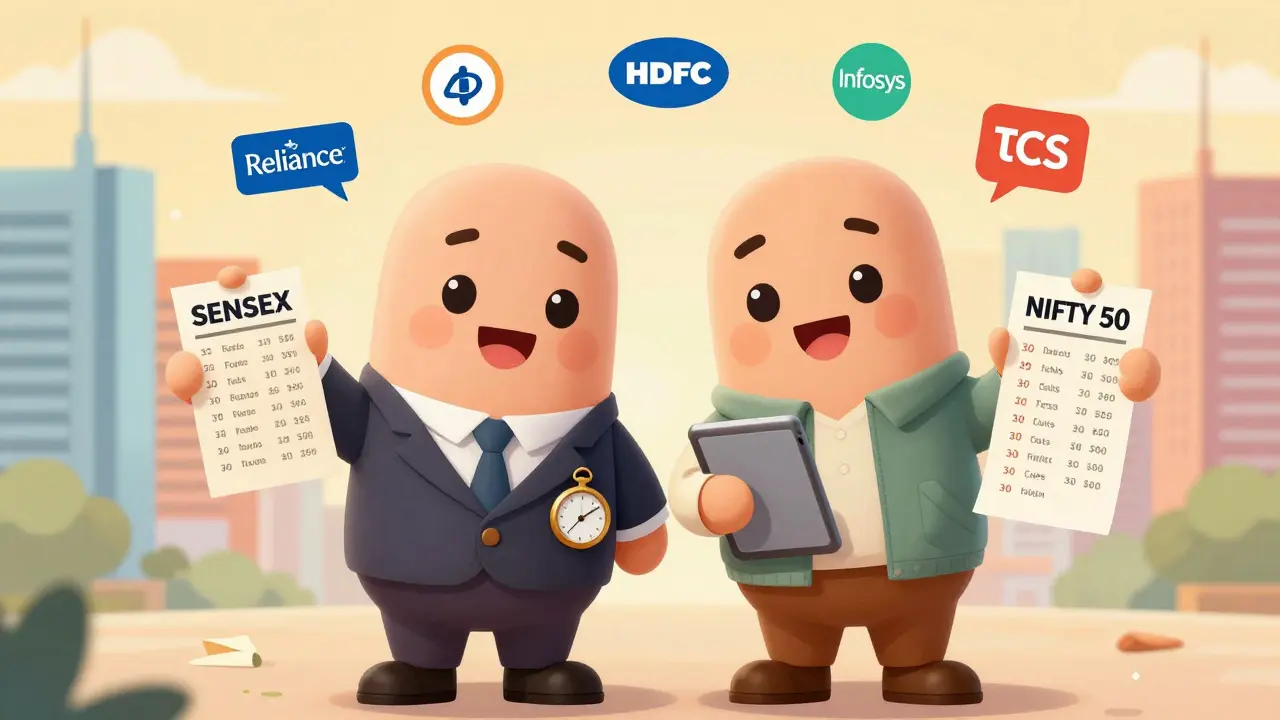
The 30 companies in SENSEX aren’t chosen randomly. They’re picked based on market capitalization, liquidity, trading volume, and sector representation. The index includes heavyweights like Reliance Industries, HDFC Bank, ICICI Bank, Infosys, and Tata Consultancy Services. These aren’t small players-they’re the backbone of India’s corporate sector. If SENSEX drops, it usually means these top 30 stocks are under pressure. If it rises, it’s often because they’re performing well.
What Is NIFTY 50?
Launched in 1996, the NIFTY 50 is the benchmark index of the National Stock Exchange (NSE), representing the performance of 50 of the largest and most liquid Indian companies across 13 sectors, is the other major player. Unlike SENSEX, NIFTY 50 is broader. It includes 50 stocks instead of 30, and it’s weighted by free-float market capitalization, which means it focuses on shares actually available for public trading-not all shares issued.
NIFTY 50 covers more sectors and more companies than SENSEX. While both include the same top names like HDFC Bank and Reliance, NIFTY 50 adds companies like Kotak Mahindra Bank, Axis Bank, and Bharti Airtel that aren’t always in SENSEX. It also has a stronger presence in sectors like IT, pharmaceuticals, and consumer goods. Because it’s more diversified, some analysts say NIFTY 50 gives a more balanced view of the broader Indian market.
Composition: 30 vs 50 Stocks
One of the biggest differences between NIFTY 50 and SENSEX is the number of stocks they track. SENSEX has 30. NIFTY 50 has 50. That might sound like a small difference, but it changes how the index behaves.
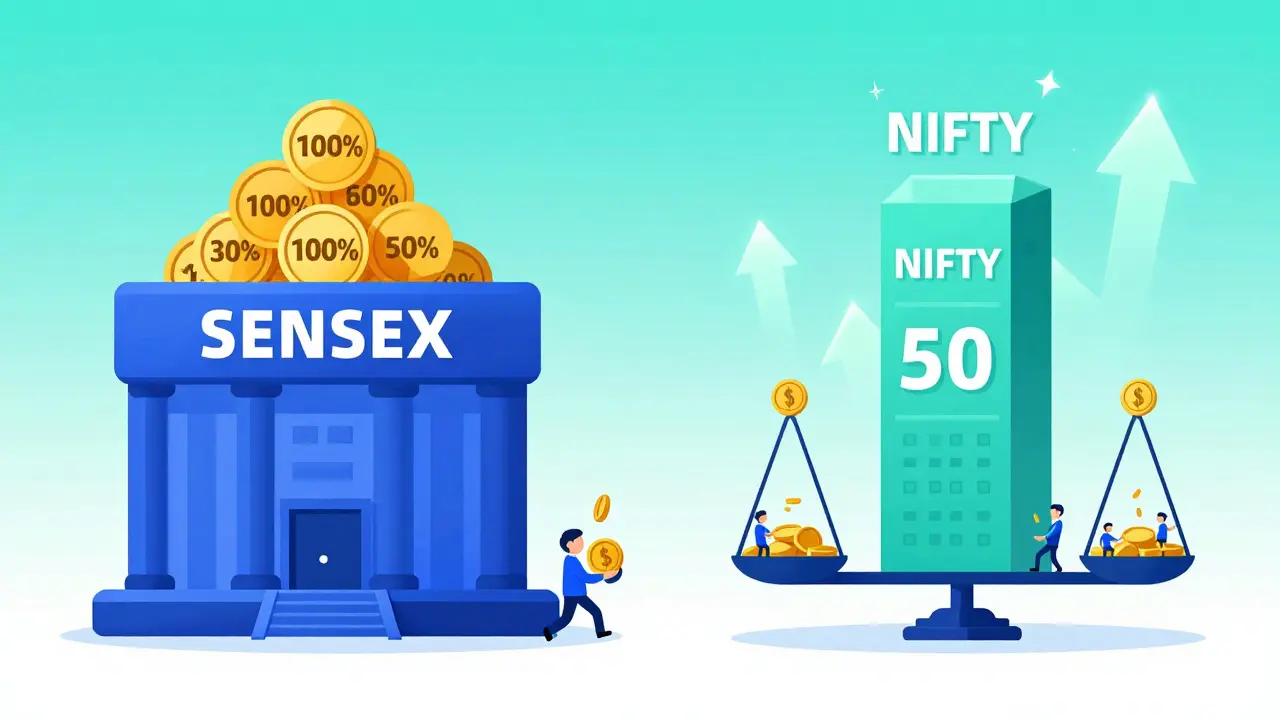
With fewer stocks, SENSEX is more sensitive to movements in its biggest components. For example, if Reliance Industries jumps 5% in a day, it can push SENSEX up by 1-2% because it makes up nearly 10% of the index. NIFTY 50, with twice as many stocks, spreads that impact. A 5% move in Reliance still matters, but it doesn’t swing the whole index as dramatically.
Also, the sector weights differ. SENSEX leans more toward banking and financial services, which together make up over 40% of the index. NIFTY 50 is more balanced-banking and financials are still the largest chunk, but IT and consumer goods have a stronger presence. In 2025, NIFTY 50’s IT sector alone accounted for nearly 15% of its total weight, while SENSEX’s IT weight hovered around 8%.
Methodology: How They’re Calculated
Both indices use market capitalization to weight their components, but they calculate it differently.
SENSEX uses the full market capitalization method. That means it considers all shares issued by a company-whether they’re held by promoters, governments, or the public. This can inflate the weight of companies with large promoter holdings, even if few shares are actually traded.
NIFTY 50 uses the free-float market capitalization method. This counts only shares available to public investors. Promoter holdings, government stakes, and locked-in shares are excluded. This gives a more accurate picture of what’s actually being traded. For example, a company like State Bank of India might have a huge market cap, but if 70% of its shares are held by the government, NIFTY 50 only weights the remaining 30%. SENSEX would weight the full 100%.
This difference matters. Free-float weighting reduces the influence of non-trading shares and makes the index more responsive to real market sentiment. It also makes NIFTY 50 more aligned with global standards-most international indices like the S&P 500 use free-float.
Performance: Which One Outperforms?
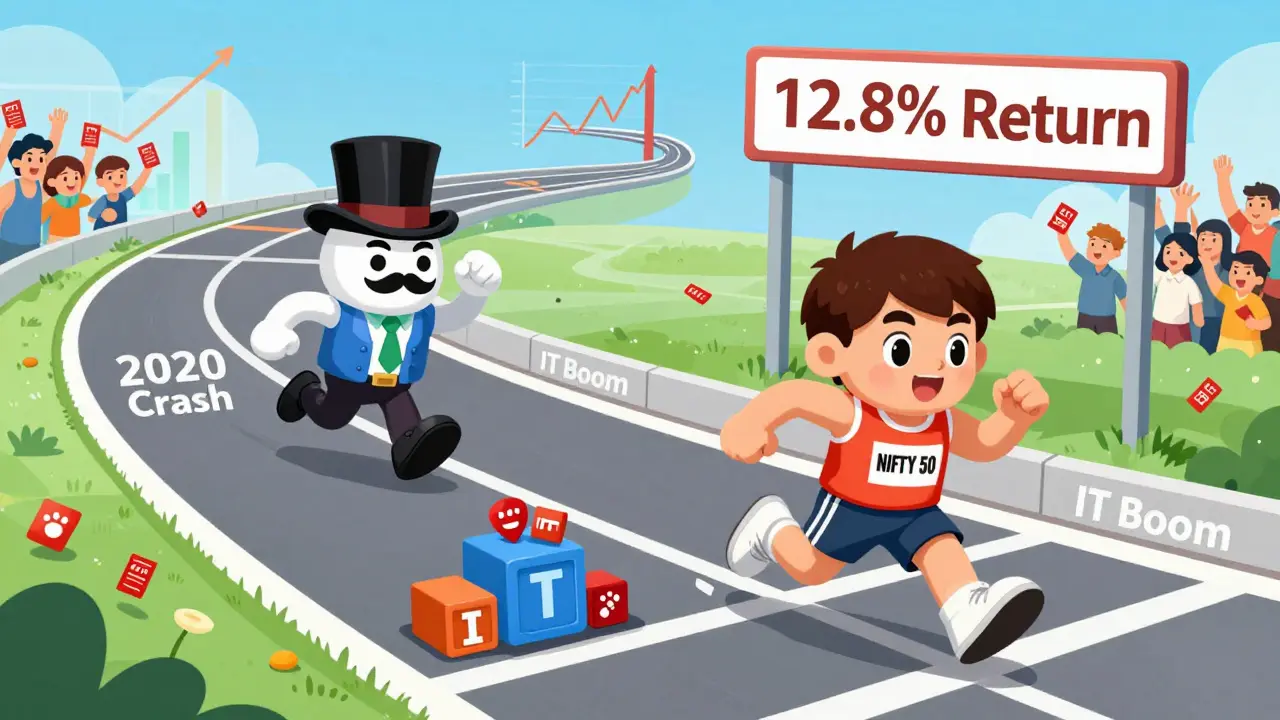
Over the last 10 years, NIFTY 50 has slightly outperformed SENSEX. From March 2016 to March 2026, NIFTY 50 delivered an annualized return of about 12.8%, while SENSEX returned 11.9%. That might not sound like much, but compounding makes it significant. A ₹1 lakh investment in NIFTY 50 in 2016 would be worth ₹3.3 lakh today. The same amount in SENSEX would be worth ₹3.1 lakh.
Why the gap? Partly because NIFTY 50 includes more high-growth companies in IT and consumer discretionary. Companies like Infosys, TCS, and Asian Paints have had strong runs, and they’re in NIFTY 50. SENSEX includes them too, but their weight is smaller. Also, NIFTY 50’s free-float methodology gave it a slight edge during market rallies when retail investor participation surged.
But don’t assume NIFTY 50 is always better. In 2020, during the pandemic crash, SENSEX fell less sharply than NIFTY 50. Why? Because its banking-heavy composition provided stability. Banks like HDFC and ICICI held up better than some volatile IT stocks. So each index has its own rhythm.
Which One Should You Follow?
If you’re an investor in India, you don’t need to choose one over the other. Most mutual funds and ETFs track NIFTY 50 because it’s more liquid and widely used by institutional investors. Over 90% of index funds in India are linked to NIFTY 50. That’s because the NSE is the most active exchange in India, handling over 70% of daily equity trading volume.
But if you’re watching market sentiment, SENSEX still has emotional weight. Older investors, journalists, and TV anchors still default to SENSEX. It’s the original. If you’re reading a headline that says "SENSEX crosses 75,000," it’s still the headline that grabs attention.
For most people, tracking NIFTY 50 makes practical sense. It’s more representative of the real market, has better liquidity, and is used by more investment products. But if you want to understand the full picture, watch both. When they move together, the market is in sync. When they diverge, something’s shifting-maybe a sector is overheating, or a big bank is under pressure.
Real-World Example: How They Diverged in 2024
In April 2024, NIFTY 50 rose 4.2% in a single week while SENSEX gained just 2.1%. Why? Because Infosys and TCS announced strong earnings, and their free-float weights in NIFTY 50 pushed the index higher. SENSEX included those stocks too, but their smaller weight and the full-market cap method meant their impact was muted. Meanwhile, Reliance’s stock dipped slightly, dragging SENSEX down more than NIFTY 50.
This isn’t unusual. In 6 out of the last 12 quarters, NIFTY 50 and SENSEX moved in different directions by more than 0.5%. That’s a clear signal: they’re not twins. They’re cousins-related, but with different personalities.
Key Takeaways
- NIFTY 50 tracks 50 stocks; SENSEX tracks 30.
- NIFTY 50 uses free-float market cap; SENSEX uses full market cap.
- NIFTY 50 has broader sector exposure, especially in IT and consumer goods.
- NIFTY 50 has slightly outperformed SENSEX over the last decade.
- Most mutual funds and ETFs in India track NIFTY 50.
- SENSEX still holds cultural weight, even if it’s less precise.
Frequently Asked Questions
Are NIFTY 50 and SENSEX the same thing?
No. They’re both Indian stock market indices, but they’re run by different exchanges (NSE and BSE), track different numbers of stocks (50 vs. 30), and use different calculation methods. NIFTY 50 is more modern and widely used by funds; SENSEX is older and more symbolic.
Which index is better for investing?
For most investors, NIFTY 50 is the better choice. Most index funds and ETFs in India are based on NIFTY 50 because it’s more liquid, has broader sector coverage, and uses free-float weighting-which reflects real market activity. If you’re buying an index fund, it’s almost certainly tracking NIFTY 50.
Why does SENSEX still matter if NIFTY 50 is more accurate?
SENSEX is the original. It’s been around since 1986, and for decades, it was the only benchmark. Many people still use it as a quick pulse check on the market. News outlets, TV channels, and older investors often refer to SENSEX because it’s familiar. It’s not outdated-it’s just less precise.
Can I invest directly in NIFTY 50 or SENSEX?
No, you can’t buy the index itself. But you can invest in index funds or ETFs that track them. For NIFTY 50, popular options include Nippon India ETF Nifty 50 and ICICI Prudential Nifty 50 Index Fund. For SENSEX, you can buy BSE SENSEX ETFs like the HDFC SENSEX ETF. Both are easy to buy through any stockbroker.
Do both indices include the same top companies?
Yes, they overlap heavily. The top 10 stocks in both indices are nearly identical-Reliance, HDFC Bank, ICICI Bank, Infosys, TCS, and so on. But NIFTY 50 includes more companies from growth sectors like IT and consumer goods, while SENSEX is more focused on banking and heavy industry.
Next Steps
If you’re new to investing in India, start by checking the latest values of both indices on the NSE and BSE websites. See how they move on days when oil prices shift, interest rates change, or big earnings come out. Over time, you’ll notice patterns. You might even find that NIFTY 50’s movements predict broader market trends better than SENSEX.
And if you’re building a portfolio, consider putting money into a NIFTY 50 index fund. It’s low-cost, diversified, and tracks the most liquid part of the market. But keep an eye on SENSEX too-sometimes, the old benchmark still tells you something the new one doesn’t.