Capital Gains Tax on Property Sale in India: Long-Term vs Short-Term Rules
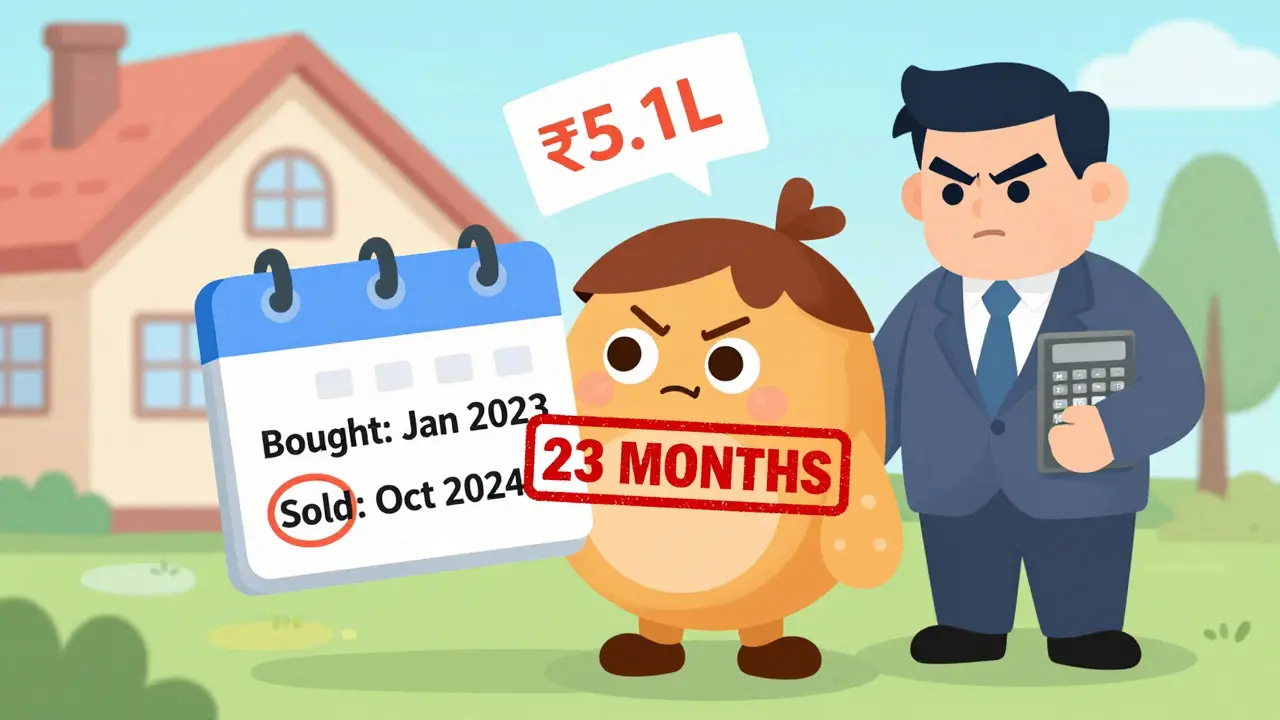
When you sell a property in India, the profit you make isn’t just income-it’s taxable. But here’s the catch: how much tax you pay depends entirely on whether you held the property for more than two years or less. That’s the difference between long-term capital gains and short-term capital gains. And getting this wrong can cost you thousands of rupees. Most people think selling a home or plot is simple: you list it, sell it, and pocket the cash. But the tax department doesn’t see it that way. They see a gain. And they want their cut. The rules changed in 2024, and many investors are still operating on outdated info. Let’s cut through the noise. First, the big picture: capital gains tax applies to any property you sell-residential, commercial, land, even a garage. It doesn’t matter if you built it, inherited it, or bought it as an investment. The moment you sell for more than you paid, the government wants a share. The key factor? Holding period. If you owned the property for more than 24 months before selling, it’s long-term. Less than 24 months? Short-term. That 24-month rule was lowered from 36 months in 2017, and it stuck. No changes since then as of 2026. Short-term capital gains are treated like regular income. That means they’re added to your total income for the year and taxed at your slab rate. If you’re in the 30% tax bracket, your profit from a property sold in 18 months gets hit at 30%. No deductions. No exemptions. Just pure tax. Let’s say you bought a flat in Pune for ₹45 lakh in January 2023. You sold it in October 2024 for ₹62 lakh. That’s a gain of ₹17 lakh. Since you held it for less than 24 months, this ₹17 lakh gets added to your salary or business income. If your total income including this gain is ₹14 lakh, you’re in the 30% bracket. Your tax on the gain? ₹5.1 lakh. That’s nearly 30% of your profit gone. Now, long-term capital gains are different. They’re taxed at a flat 20%-but with a twist. You don’t just take the sale price and subtract the purchase price. You adjust for inflation. That’s called indexation. Indexation uses the Cost Inflation Index (CII) published by the Income Tax Department. The CII number for the year you bought the property gets compared to the CII for the year you sold it. The difference lets you inflate your original cost. This reduces your taxable gain. Let’s go back to the Pune flat. You bought it in January 2023 (CII 348) and sold it in October 2025 (CII 381). Your indexed cost of acquisition is: (₹45,00,000 × 381) ÷ 348 = ₹49,31,034 Your actual gain? ₹62,00,000 − ₹49,31,034 = ₹12,68,966 Now you pay 20% tax on ₹12.69 lakh = ₹2,53,793. That’s less than half of what you’d pay if it were short-term. The difference? Over ₹2.5 lakh saved. Indexation is the secret weapon for long-term investors. It’s why holding property beyond two years isn’t just smart-it’s financially essential. There’s one more layer: exemptions. If you’re selling a residential property and you’re reinvesting the entire capital gain, you can avoid tax entirely under Section 54. You have to buy another house within 2 years before or 1 year after the sale. Or you can deposit the amount in a Capital Gains Account Scheme (CGAS) and buy within 3 years. The new property must be in India. No foreign real estate qualifies. But here’s what most miss: you can’t use this exemption if you already own two residential properties. If you’re sitting on two homes and sell a third, you lose the exemption. The rule is strict-no loopholes. What about commercial property? No Section 54. But there’s Section 54F: if you sell any long-term capital asset (including land or a shop) and buy a residential property, you can get partial exemption. The exemption is proportional. If your gain is ₹1 crore and the new house costs ₹60 lakh, you get 60% of the gain exempted. Another option: Section 54EC. You can invest your long-term capital gains in notified bonds-like those issued by NHAI or REC. The catch? You have to invest within 6 months of the sale, and the bonds have a 5-year lock-in. The maximum you can invest per financial year is ₹50 lakh. So if you made ₹80 lakh profit, you can shelter ₹50 lakh this way. The rest? Still taxable. Don’t forget: you need to file Form 26QB when you sell. That’s the form for reporting the buyer’s TDS (tax deducted at source). The buyer must deduct 1% of the sale value if the property is worth more than ₹50 lakh. If they don’t, you’re still liable. The tax department will come after you. Also, if you’re selling to an NRI, the buyer must deduct 20% TDS on long-term gains and 30% on short-term. That’s non-negotiable. The NRI seller can claim a refund later if they file an ITR. What if you inherited the property? The holding period starts from when the original owner bought it. So if your father bought land in 1998 and you sold it in 2025, you’ve held it for 27 years. That’s long-term. The cost you use? The original purchase price, adjusted for inflation from 1998. You don’t get a step-up in cost basis like in the U.S. And if you’re splitting the sale proceeds with a co-owner? Each person is taxed on their share. If you own 50%, you pay tax on 50% of the gain. No joint filing. No averaging. Separate returns. The bottom line? If you’re planning to sell, ask yourself: Did you hold it longer than 24 months? If yes, you have options-indexation, reinvestment, bonds. If no, brace for a heavy tax hit. Many investors hold property for 18 months thinking they’ll flip fast. But the math doesn’t lie. The tax difference between 23 and 25 months can be hundreds of thousands of rupees. Waiting two years isn’t patience-it’s strategy. Don’t wait until the day before closing to check your tax liability. Calculate your indexed cost early. Talk to a CA. Know your CII numbers. The rules are clear. The savings are real. And if you’re still unsure? Run two scenarios: one as if you sold tomorrow, one as if you waited six more months. The difference will shock you. This isn’t about avoiding tax. It’s about paying the right amount at the right time. And in India’s real estate market, timing is everything.
What happens if I sell a property before 24 months?
If you sell a property before completing 24 months of ownership, the profit is treated as short-term capital gain. It gets added to your total income and taxed at your applicable income tax slab rate. There’s no indexation benefit. You also can’t claim exemptions under Sections 54, 54F, or 54EC for short-term gains. The tax rate could be as high as 30% depending on your income bracket.
Can I avoid capital gains tax by gifting the property?
Gifting a property to a relative doesn’t trigger capital gains tax at the time of transfer. But when the recipient sells it later, they’ll be taxed based on the original owner’s purchase cost and holding period. If the original owner bought it in 2015 and you gift it in 2025, the recipient’s holding period starts in 2015. They’ll benefit from indexation if they sell after 2027. But if they sell before 24 months from 2015, they’ll face short-term tax rates. Gifting delays the tax-it doesn’t eliminate it.

Do I have to pay tax if I sell my only home?
Yes, if you made a profit. But you can avoid tax under Section 54 if you reinvest the entire gain in another residential property in India within the allowed time. If you’re selling your only home and buying a new one, you qualify. But if you already own two homes, you lose the exemption. Also, the new property must be in India. Buying abroad doesn’t count.

Can NRIs get a refund on TDS deducted on property sale?
Yes. When an NRI sells property in India, the buyer deducts TDS at 20% (long-term) or 30% (short-term). The NRI must file an income tax return in India to claim a refund if the actual tax liability is less than what was deducted. Many NRIs don’t file, so they lose money. Filing ITR is mandatory to recover excess TDS.
Is there a limit on how much I can invest in Section 54EC bonds?
Yes. You can invest a maximum of ₹50 lakh in Section 54EC bonds in a single financial year. The bonds are issued by NHAI and REC, and have a 5-year lock-in. If your capital gain is ₹80 lakh, you can only shelter ₹50 lakh this way. The remaining ₹30 lakh is taxable at 20%. You can’t carry forward unused bond capacity to the next year.