How to Exit a Mutual Fund in India: Choosing Redemption vs Switch vs SWP
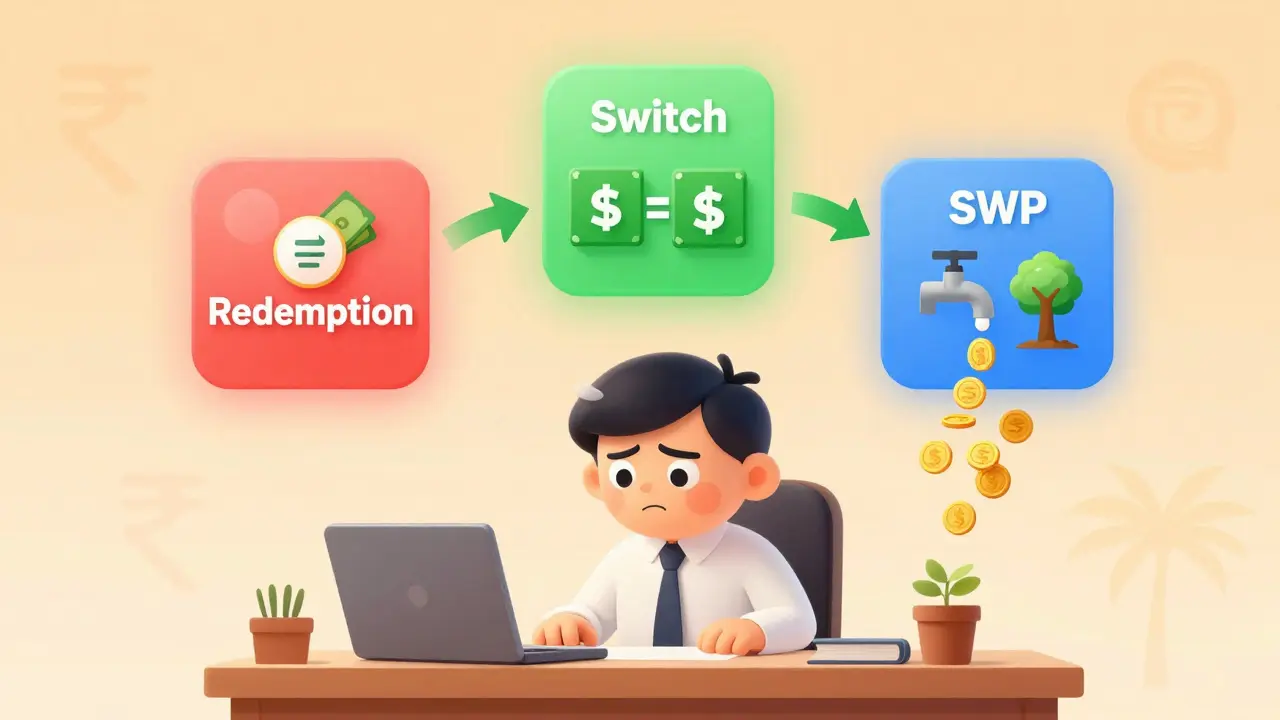
Exiting a mutual fund in India isn’t as simple as clicking a button and getting cash. You have three real options-redemption, switch, and SWP-and each one changes your money, taxes, and long-term goals differently. Picking the wrong one could cost you thousands in taxes or leave you without the income you need. Let’s cut through the jargon and show you exactly how each works, when to use it, and what most investors miss.
Redemption: Just Sell It
Redemption is the most straightforward way out. You ask the fund house to sell your units and send the money to your bank account. It’s what most people think of when they say, "I want to cash out."
Here’s how it works: You log into your mutual fund account, select the scheme, enter the number of units or amount you want to redeem, and hit submit. The fund house processes it, calculates your Net Asset Value (NAV) on the next business day, and transfers the money within 1-3 working days for equity funds, and often same-day for debt funds.
But here’s what nobody tells you: redemption triggers capital gains tax. If you held the fund for less than a year, you pay 15% short-term capital gains tax on equity funds. For debt funds, it’s taxed at your income tax slab rate if held under 3 years. Even if you’re selling to pay an emergency bill, you still owe tax on the profit.
Example: You invested ₹2 lakh in an equity fund 8 months ago. Today, it’s worth ₹2.6 lakh. You redeem it. That ₹60,000 profit gets taxed at 15% = ₹9,000. You walk away with ₹2.51 lakh, not ₹2.6 lakh.
Redemption makes sense if:
- You need cash urgently
- You’re done with investing in that fund category
- You’re rebalancing your portfolio and need to move money elsewhere
Watch out: Don’t redeem just because the market dipped. If you sell low and buy back later, you lock in losses. Wait for a recovery, or use SWP instead.
Switch: Move Without Selling
A switch lets you move your money from one mutual fund scheme to another within the same fund house-without triggering a redemption. It’s like transferring your savings account to a different bank, but inside the same institution.
Here’s the trick: When you switch, the system sells your units in the original fund and buys units in the new fund on the same day, using the NAVs of that day. No cash touches your bank account. That’s why it’s often called an "intra-fund transfer."
Switching is powerful because it can help you avoid taxes. If you’re moving from an equity fund to another equity fund, the holding period continues. So if you held for 11 months and switch, you’re still on track for long-term capital gains (LTCG) after 12 months.
Example: You have ₹5 lakh in a large-cap equity fund. You think mid-cap funds will do better. You switch to a mid-cap fund. The system sells your large-cap units, buys mid-cap units-all on the same day. Your 11-month holding clock doesn’t reset. You still get LTCG benefits when you eventually exit.
But there are limits:
- You can only switch between funds from the same AMC (Asset Management Company)
- Some AMCs charge a switch fee (usually ₹100-₹500)
- Not all funds allow switches-check the scheme documents
- You can’t switch from equity to debt without tax consequences if held under 3 years
Switching is smart if:
- You’re adjusting your risk level (e.g., from aggressive to balanced)
- You’re moving from a underperforming fund to a better one
- You want to avoid tax on short-term gains
Pro tip: Use the "switch" option during market corrections. Sell your losing fund, buy a stronger one, and let the new one recover. You avoid the tax hit of cashing out and still position yourself for growth.
SWP: Get Paid Without Selling Everything
SWP stands for Systematic Withdrawal Plan. It’s not an exit-it’s a steady income stream. You set up regular withdrawals from your mutual fund, and the fund house sells just enough units each month to give you a fixed amount.
Imagine you have ₹40 lakh in a balanced fund. You set up an SWP for ₹25,000 per month. Each month, the fund sells units worth ₹25,000 based on that day’s NAV. Your remaining balance keeps growing (or shrinking) based on market performance.
Here’s the magic: You don’t have to liquidate your entire investment. You’re still invested. The fund keeps earning returns while you get monthly cash.
Tax-wise, each SWP withdrawal is treated as a partial redemption. So if you withdraw ₹25,000 and ₹5,000 of that is profit, you pay tax on ₹5,000. The tax is calculated based on how long you held those specific units.
SWP works best for:
- Retirees needing monthly income
- People who don’t want to touch their principal
- Investors who want to avoid lump-sum tax bills
Example: Raj, 62, has ₹30 lakh in a debt fund. He sets up an SWP of ₹20,000/month. Over 12 years, he withdraws ₹28.8 lakh. His original investment remains untouched. The fund grew to ₹38 lakh. He got ₹28.8 lakh income and still has ₹38 lakh left.
SWP is not a magic bullet. If the market crashes and your fund’s NAV drops, the fund has to sell more units to give you the same amount. That eats into your corpus faster. So pick stable funds-debt or balanced-for SWP, not aggressive equity.

Which One Should You Pick?
Let’s cut to the chase. Here’s a simple decision tree:
| Goal | Best Option | Why |
|---|---|---|
| You need cash now | Redemption | Fastest way to get money |
| You want to move to a better fund | Switch | Keep holding period, avoid tax |
| You need monthly income without selling everything | SWP | Preserves capital, spreads tax |
| You’re retiring | SWP | Steady cash flow, tax efficiency |
| You’re rebalancing portfolio | Switch | Move without tax disruption |
| You’re exiting a fund permanently | Redemption | No future exposure |
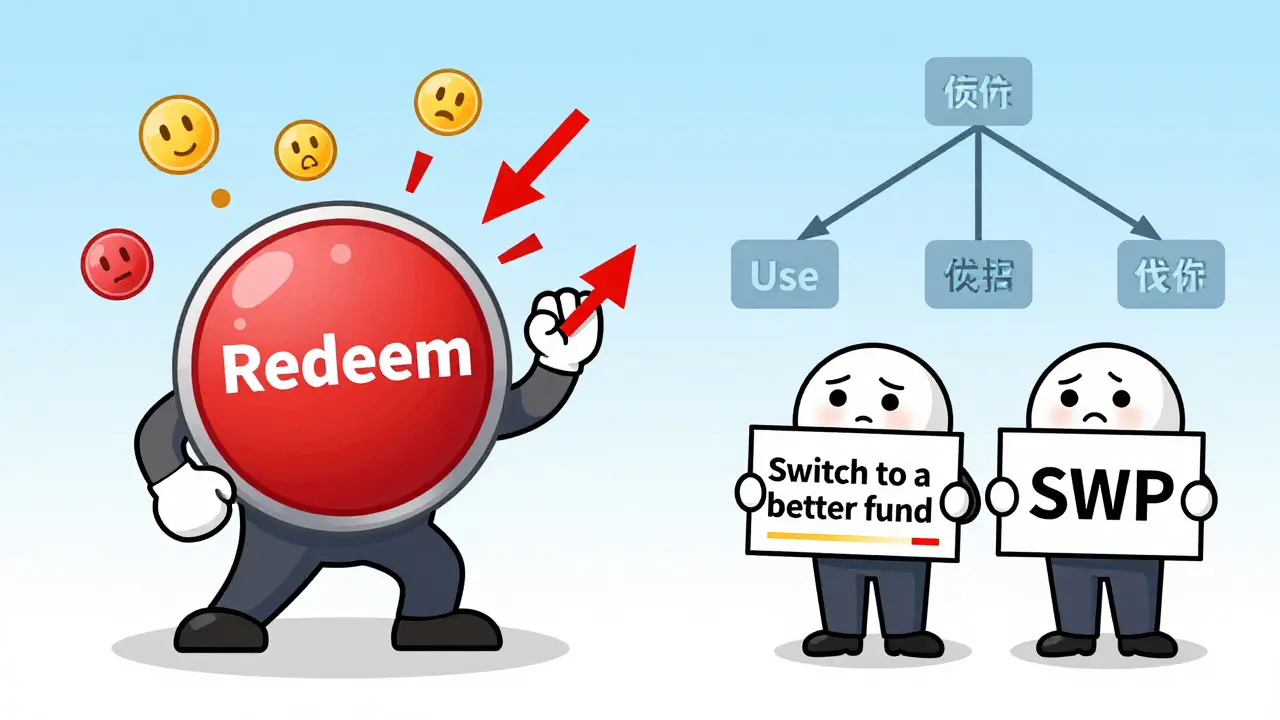
Most people make one mistake: They redeem everything at once. That’s fine if you’re done investing. But if you’re still in the game, SWP or switch keeps your money working.
Common Mistakes to Avoid
- Redeeming during a market dip-wait for recovery or use SWP
- Switching between funds of different asset classes without checking tax rules
- Setting SWP too high-your corpus can vanish if withdrawals exceed returns
- Not updating your bank details-redemption fails if your account is inactive
- Forgetting exit loads-many funds charge 0.5%-2% if you exit within 1 year
Exit loads are hidden fees. Check your fund’s statement. If you bought a fund 11 months ago and want to exit now, you might lose 1% of your value. That’s ₹10,000 on ₹10 lakh. Always check the exit load schedule before clicking "redeem."
What Happens After You Exit?
After redemption or SWP, you’ll get a tax statement (Form 16A) from your fund house. Keep it. You’ll need it to file your ITR. If you switched, your holding period carries over. You’ll see it in your folio statement under "date of purchase."
SWP doesn’t end when your corpus runs out. It stops automatically when your balance hits zero. You can always restart it later with more money.
Final Tip: Don’t Just Exit-Replan
Exiting a mutual fund isn’t the end. It’s a transition. Ask yourself: What’s next? Are you moving to another fund? Buying real estate? Retiring? Your next step should be planned before you hit "redeem."
Use SWP if you’re still investing. Use switch if you’re upgrading. Use redemption only if you’re done.
Can I exit a mutual fund anytime?
Yes, you can exit anytime, but check for exit loads. Most equity funds charge 1% if you exit within 1 year. Debt funds may charge up to 0.25% if held under 3 years. Always review the scheme’s offer document before redeeming.
Is SWP better than redemption for retirees?
Yes. SWP gives you regular income without touching your entire investment. It also spreads out your tax liability over time. Redemption gives you a lump sum, which may push you into a higher tax bracket. SWP keeps your money invested, so it can keep growing while you withdraw.
Can I switch from equity to debt mutual fund?
Yes, but it triggers tax. If you held the equity fund for less than 1 year, short-term gains are taxed at 15%. If held over 1 year, long-term gains over ₹1 lakh are taxed at 10%. Debt funds are taxed at your slab rate if held under 3 years. Always calculate the tax impact before switching.
How long does a mutual fund switch take?
A switch is usually processed on the same day you request it. The units are sold in the old fund and bought in the new fund using that day’s NAV. You’ll see the transaction reflected in your folio within 24-48 hours. Some AMCs may take up to 3 days for processing.
Do I need to pay tax on SWP?
Yes. Each SWP withdrawal is treated as a partial redemption. Only the profit portion is taxable. For equity funds, if units were held over 1 year, gains above ₹1 lakh are taxed at 10%. For debt funds, gains are taxed at your income tax slab rate if held under 3 years. The fund house provides a tax statement for each withdrawal.
Exit smart. Don’t just move money-move it with purpose.