Property Stamp Duty and Registration in India: How to Calculate Your Full Purchase Costs
Buying property in India isn’t just about the price tag. Hidden fees like stamp duty and registration charges can add 5% to 12% extra to your final cost-and in some states, even more. If you’re planning to buy a home, plot, or commercial space, skipping these calculations could leave you short on cash at closing. This guide breaks down exactly what you pay, where it varies, and how to avoid nasty surprises.
What Is Stamp Duty and Why Does It Exist?
Stamp duty is a state-level tax you pay when legal documents for property transfer are signed. Think of it as a government fee for officially recognizing your ownership. It’s not optional. Without paying stamp duty and registering the property, your sale deed isn’t legally valid. The government uses this money to fund public services, maintain land records, and track real estate transactions.
Registration is the process of recording your property deed with the Sub-Registrar’s office. You need both: stamp duty to make the document legally enforceable, and registration to make it official in government records. Skip one, and you risk losing your rights to the property-even if you’ve paid the full price.
How Stamp Duty Is Calculated: It’s Not the Same Everywhere
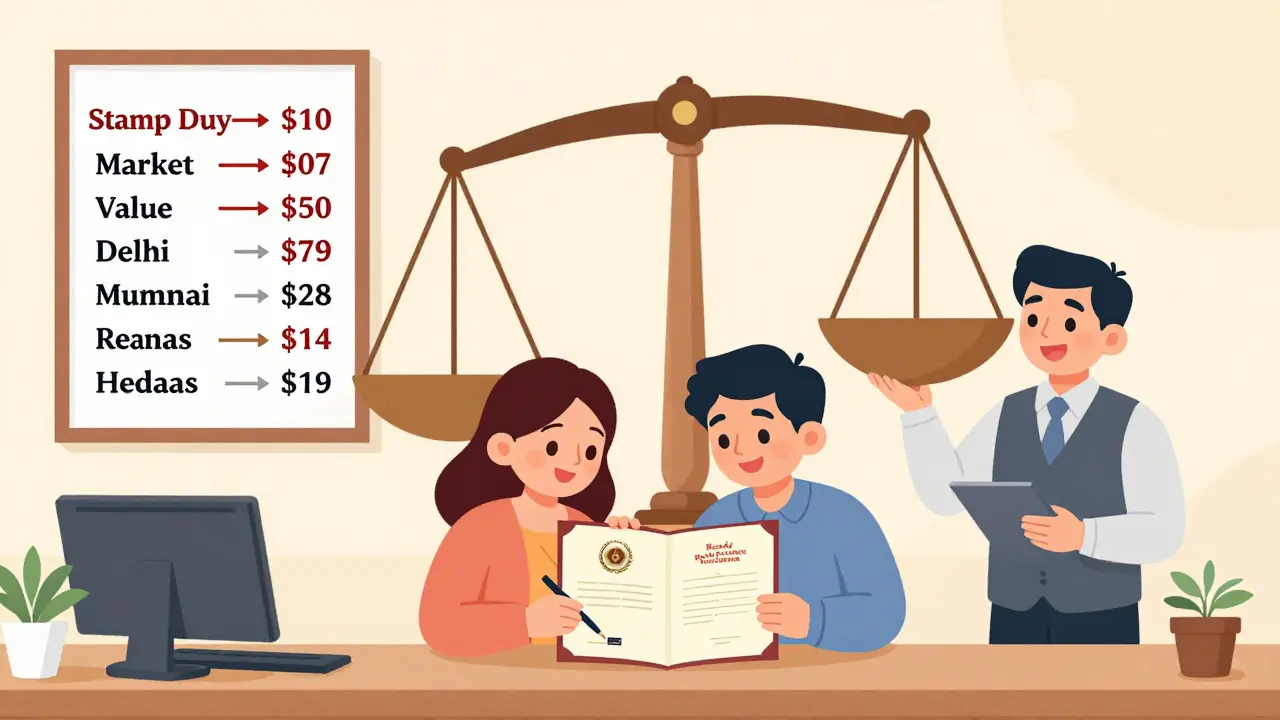
There’s no national stamp duty rate in India. Each state sets its own rates, and they change often. In 2026, here’s what you’re likely to pay:
- Delhi: 6% for men, 4% for women (and 5% for joint ownership if one is a woman)
- Mumbai (Maharashtra): 5% for men, 3% for women (4% for joint ownership with a woman)
- Bangalore (Karnataka): 5% for men, 3% for women (4% for joint ownership)
- Chennai (Tamil Nadu): 7% for men, 6% for women (6.5% for joint ownership)
- Hyderabad (Telangana): 5% flat rate for all buyers
- Uttar Pradesh: 8% for men, 6% for women (7% for joint ownership)
These rates apply to the higher of either the market value or the consideration amount stated in the sale deed. Many buyers assume the agreement price is what counts-but if the government’s ready reckoner rate (guideline value) is higher, you pay stamp duty on that instead.
Registration Charges: The Other Half of the Cost
Registration fees are simpler: they’re usually 1% of the property value across most states. But there are exceptions:
- Delhi: ₹10,000 maximum
- Mumbai: ₹30,000 maximum
- Hyderabad: ₹10,000 maximum
- Most other states: 1% of property value, capped at ₹20,000-₹30,000
For example, if you buy a ₹50 lakh property in Karnataka, registration costs ₹50,000 (1% of ₹50 lakh). But if you buy a ₹35 lakh flat in Delhi, you pay only ₹10,000-because that’s the cap.
Ready Reckoner Rates: The Hidden Benchmark
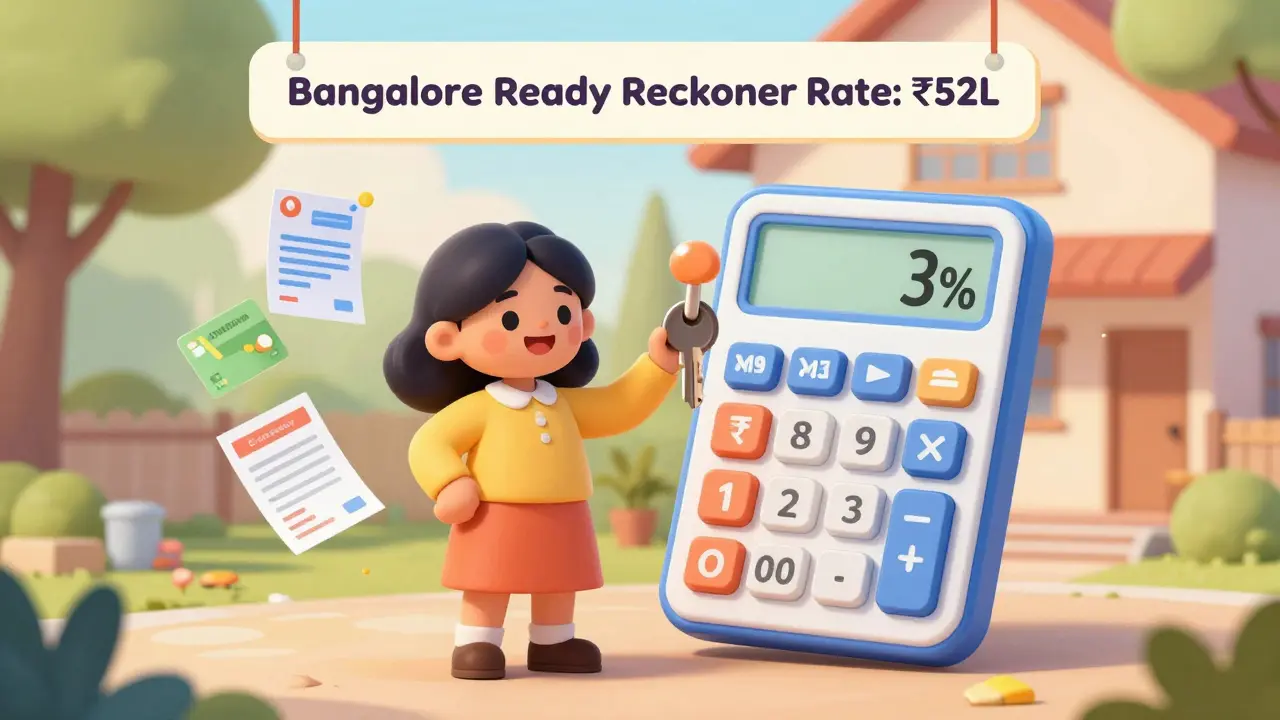
Every state publishes a “ready reckoner” or “guideline value” for every locality. This is the government’s estimated market value for properties in that area. If your sale agreement says ₹45 lakh, but the ready reckoner says ₹52 lakh-you pay stamp duty on ₹52 lakh.
Why does this matter? Because developers often quote prices below market value to reduce tax burden. Buyers think they’re getting a deal. But the government doesn’t care about your agreement price. It cares about what the property is officially worth.
You can check your area’s ready reckoner rate online. Most state revenue departments have portals where you can search by district, street, or even pin code. In Mumbai, you can visit the GRAS portal. In Delhi, use the Stamp Duty and Registration Portal. Don’t guess-look it up.
Who Pays? Buyers, Sellers, or Both?
By law, the buyer pays both stamp duty and registration charges. But in practice, it’s negotiable. In some cities, especially where the market is buyer-driven, sellers cover part or all of these costs to close the deal faster.
However, if the seller agrees to pay, it must be written into the sale agreement. Otherwise, the law still holds you responsible. And if you don’t pay, your property title remains vulnerable. Courts won’t protect your claim if there’s no stamped and registered deed.
Discounts and Concessions: Who Gets Relief?
Many states offer reduced rates to encourage certain buyers:
- Women buyers: 1-3% discount across most states
- Joint ownership with a woman: Discount applies even if only one co-owner is female
- Senior citizens: Some states like Karnataka offer 1% reduction for those over 60
- First-time buyers: No national scheme yet, but states like Telangana and Haryana have offered temporary relief
- Low-income groups: In some rural areas, stamp duty is waived for plots under 300 sq. meters
Always ask: Is my buyer profile eligible for any discount? You might save thousands just by declaring your gender or age at the time of registration.
What Happens If You Don’t Pay?
Not paying stamp duty or skipping registration isn’t just risky-it’s illegal.
- You can’t sell, mortgage, or transfer the property later without a valid deed.
- If there’s a dispute, the court won’t recognize your ownership.
- You may be fined up to 10 times the unpaid stamp duty.
- Some states impose penalties of ₹1,000 per day for delayed registration.
Even if you’ve lived in the house for 10 years, if the deed was never registered, the original owner can still claim it back. This has happened in multiple court cases across Delhi, Pune, and Lucknow.
Real-World Example: Calculating Costs in Bangalore
Let’s say you’re buying a ₹80 lakh apartment in Bangalore as a woman. Here’s what you pay:
- Stamp duty: 3% of ₹80 lakh = ₹2,40,000
- Registration: 1% of ₹80 lakh = ₹80,000 (but capped at ₹20,000 in Karnataka)
- Additional charges: ₹1,000 for document processing, ₹500 for e-stamping
- Total extra cost: ₹2,61,500
That’s over ₹2.6 lakh added to your purchase price. If you’d bought it as a man, stamp duty would’ve been ₹4 lakh. The difference? ₹1.6 lakh.

How to Pay and Where to Do It
Most states now use e-stamping. You can pay online through government portals using net banking, UPI, or credit card. After payment, you get a digital receipt and a unique stamp duty number.
Registration happens at the Sub-Registrar’s office. You need:
- Original sale deed (signed by both parties)
- Stamped receipt
- Identity proof (Aadhaar, PAN)
- Property documents (title deed, Khata, layout approval)
- Two witnesses
Book an appointment online. Walk-ins are rare, and delays can cost you time and money.
Pro Tips to Save Money
- Buy jointly with a woman-most states give you a 1-2% discount.
- Check ready reckoner rates before negotiating price.
- Pay stamp duty within 30 days of signing the agreement to avoid penalties.
- Use e-stamping-it’s faster, secure, and leaves a digital trail.
- Don’t accept verbal promises from builders about “waived charges.” Get everything in writing.
Frequently Asked Questions
Is stamp duty the same for residential and commercial properties?
No. Commercial properties usually attract higher stamp duty-often 5-7% more than residential. In Mumbai, commercial stamp duty is 6%, while residential is 5% for men. Always confirm the property classification before signing.
Can I pay stamp duty after registration?
No. You must pay stamp duty before registration. The Sub-Registrar will not accept your deed without a valid stamp duty receipt. Some states allow a 30-day window after signing the agreement, but not after the deed is presented for registration.
Do I pay stamp duty on under-construction properties?
Yes. Even if you’re paying in installments, stamp duty is due on the total agreement value. Some builders collect it upfront. Others wait until possession. Either way, you’re liable. Don’t assume you’re exempt just because the building isn’t finished.
What if the property is inherited or gifted?
Gift deeds and inheritances still require stamp duty, but rates are lower. In Delhi, a gift deed between family members costs 3%. Inheritance from immediate relatives (spouse, parent, child) is often exempt from stamp duty, but registration is still mandatory.
Can I claim tax benefits on stamp duty and registration fees?
Yes. Under Section 80C of the Income Tax Act, you can claim a deduction of up to ₹1.5 lakh for stamp duty and registration fees paid on your first home. This deduction is part of the overall ₹1.5 lakh limit under Section 80C, which includes PF, insurance, and ELSS. Keep all receipts and the registration certificate for filing.
Next Steps: What to Do Today
- Find your state’s official stamp duty calculator online.
- Look up the ready reckoner rate for your target area.
- Calculate your total cost: stamp duty + registration + processing fees.
- Compare it to the asking price. If the difference is over 7%, reconsider.
- If you’re a woman or buying jointly with one, make sure the discount is applied.
Don’t let hidden costs derail your investment. Knowing exactly what you owe before you sign means you walk into the deal with control-not confusion.