Rent Agreements in India: Essential Clauses and Registration Requirements
When you rent a home in India, whether it’s a small apartment in Bangalore or a house in Lucknow, the rent agreement is your legal shield. It’s not just a formality-it’s the only thing standing between you and chaos. Without a proper written agreement, you could lose your security deposit, face sudden eviction, or get stuck paying for repairs that aren’t your responsibility. And if you’re a landlord, skipping the paperwork means you have no real way to enforce rent payments or protect your property.
Why a Written Rent Agreement Matters
Oral agreements are common in India, especially in smaller towns. But they’re legally weak. If a tenant stops paying rent or a landlord suddenly increases the rent by 50%, there’s no paper trail to prove what was agreed upon. Courts in India don’t recognize verbal contracts for rentals lasting more than 11 months. That’s not a suggestion-it’s the law under the Transfer of Property Act, 1882.
A written rent agreement gives both sides clarity. It sets the rent amount, payment dates, duration, maintenance duties, and what happens if either party breaks the deal. It also protects your security deposit. Many landlords illegally withhold deposits, claiming damage that never existed. A detailed agreement with move-in photos and condition notes makes it impossible to fake repairs.
Essential Clauses Every Rent Agreement Must Include
Not all rent agreements are equal. Some are vague, handwritten notes on a napkin. Others are full legal documents. Here’s what you need to see in any legitimate agreement:
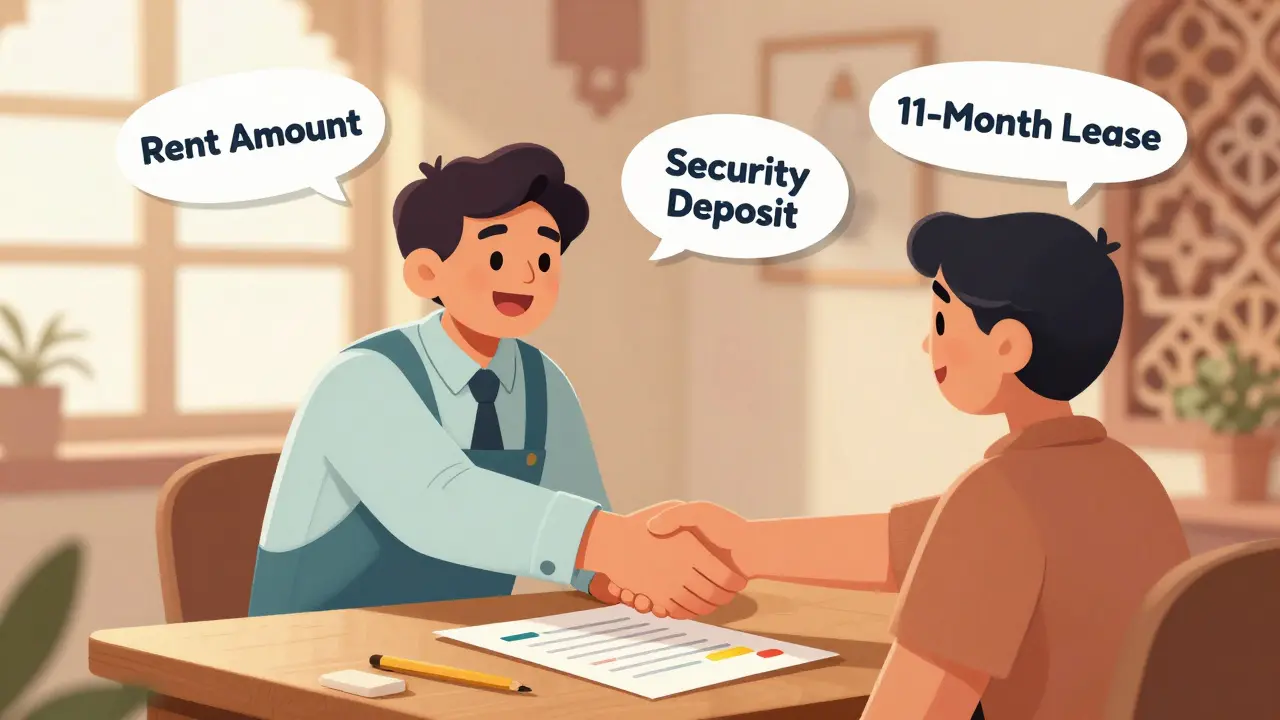
- Rent Amount and Payment Terms - Exact rupee amount, due date (e.g., 5th of every month), and accepted payment methods (bank transfer, cheque, UPI). Late fees must be stated clearly-no surprises.
- Lease Duration - Start and end dates. Most agreements run for 11 months to avoid mandatory registration. Some go for 12 months or longer, but then registration becomes required.
- Security Deposit - The amount (usually 2-5 months’ rent), how it’s held, and under what conditions it will be returned. Any deductions must be itemized with receipts.
- Utilities and Maintenance - Who pays for electricity, water, internet, and garbage? Are repairs for broken ACs or leaking pipes the landlord’s duty? Be specific. Vague terms like "maintenance as needed" lead to fights.
- Use of Property - Is subletting allowed? Can the property be used for business? Many agreements ban commercial use without written permission.
- Notice Period - How much notice must either party give before ending the lease? Standard is 15-30 days. If the landlord wants to sell the property, they can’t kick you out mid-lease unless this clause is included.
- Repairs and Alterations - Tenants can’t paint walls or drill holes without permission. Landlords can’t enter without notice (except in emergencies). These rights must be written down.
- Termination Conditions - What happens if rent is late three times? Can the landlord evict without court order? What if the tenant damages the property? Clear rules prevent abuse.
These aren’t optional. Skipping even one can make the entire agreement unenforceable in court. If you’re unsure, use a template from your state’s rent control authority or a lawyer. Don’t rely on a generic PDF you found online.
When Does a Rent Agreement Need Registration?
Registration isn’t always required-but when it is, skipping it makes the agreement useless in court. Here’s the rule: if the lease lasts more than 11 months, it must be registered under the Registration Act, 1908.
Why 11 months? Because leases under 12 months are exempt from mandatory registration. That’s why most landlords in India offer 11-month agreements. It’s a legal loophole-but it works. However, if you sign a 12-month or longer lease and don’t register it, you can’t use it as evidence if the tenant refuses to leave or stops paying.
Registration means:
- Signing the agreement on non-judicial stamp paper (value varies by state)
- Visiting the Sub-Registrar Office in the district where the property is located
- Paying a registration fee (usually 1% of total rent for the lease period, or ₹1,000-₹5,000 depending on state)
- Providing ID proof for both landlord and tenant
- Submitting property documents like title deed or property tax receipt
Some states, like Maharashtra and Karnataka, have online registration portals. Others still require in-person visits. The process takes 1-3 days. Without registration, you risk losing your legal standing. Even if you have a notarized agreement, it’s not the same as a registered one.
What Happens If You Don’t Register?
Unregistered agreements over 11 months are still valid as contracts-but they’re not admissible as evidence in court. That means:
- Landlords can’t legally evict tenants without going through a lengthy court process
- Tenants can’t claim compensation if the landlord breaches the agreement
- Security deposits are harder to recover
- Disputes over rent increases or repairs become "he said, she said" situations
Some landlords avoid registration to dodge taxes. But that’s risky. If the tax department finds out about unregistered rentals, they can impose penalties and demand back taxes. Tenants also lose out-they can’t use the agreement to prove residency for a passport, voter ID, or school admission.
State-Specific Rules You Can’t Ignore
India doesn’t have one national rent law. Each state has its own Rent Control Act. For example:
- In Maharashtra, rent increases are capped at 4% per year unless the property is over 10 years old.
- In Tamil Nadu, landlords must give 30 days’ notice before eviction, even if the tenant is late on rent.
- In Delhi, the rent agreement must be registered if it’s for 12 months or more, and the security deposit can’t exceed two months’ rent.
- In Kerala, the agreement must include a clause about water and electricity bills being paid separately.
Always check your state’s rules. A template from Mumbai won’t work in Chennai. Local tenant unions and housing departments often publish free guides online. If you’re unsure, ask a local lawyer-most offer a free 15-minute consultation.

Common Mistakes Landlords and Tenants Make
Even with good intentions, people mess up. Here are the top errors:
- Not documenting condition - No photos or checklist at move-in. Result? Deposit disputes.
- Using vague language - "Reasonable maintenance" or "as needed" is useless. Be exact.
- Signing without reading - Many tenants just sign the first paper they’re handed. Read every line.
- Ignoring stamp paper - An unsigned or unstamped agreement is invalid in most states.
- Assuming oral agreements work - Courts won’t hear them if the lease is longer than 11 months.
Pro tip: Always keep two signed copies-one for you, one for the other party. Scan and email a copy to yourself. Store it in the cloud. Paper can disappear. Digital backups won’t.
What to Do If There’s a Dispute
Even with a perfect agreement, conflicts happen. If rent is late, repairs are ignored, or eviction threats arise:
- Send a written notice (email or registered post) stating the issue and giving a deadline to fix it.
- Keep all communication records-texts, emails, receipts.
- Try mediation through a local housing association. Many cities have free tenant-landlord mediation services.
- If that fails, file a case in the Rent Control Court. You’ll need your registered agreement, payment proof, and any evidence of breach.
Legal action takes time, but it’s worth it. In 2024, the Delhi Rent Tribunal resolved over 12,000 cases in under 90 days. The system is slow, but it works if you have the right paperwork.
Final Checklist Before Signing
Before you put pen to paper, check this:
- Is the agreement in writing? (No handwritten notes)
- Are both parties’ full names, addresses, and IDs included?
- Is the rent amount, due date, and payment method clearly stated?
- Is the security deposit amount and return conditions defined?
- Are utilities and maintenance responsibilities assigned?
- Is the lease duration exactly stated (start and end dates)?
- Is there a notice period clause?
- Is the agreement printed on non-judicial stamp paper of correct value?
- If lease is 12+ months, is it registered?
- Did you get two signed copies?
If you can answer "yes" to all 10, you’re protected. If not, walk away. A bad agreement is worse than no agreement at all.
Is a rent agreement mandatory in India?
Yes, for leases longer than 11 months. Even for shorter leases, a written agreement is strongly recommended. Oral agreements offer no legal protection and are not admissible in court if a dispute arises.
Can a landlord evict a tenant without a rent agreement?
Technically, yes-but only through a lengthy court process. Without a written agreement, the landlord has no proof of rent terms, payment history, or lease duration. Courts usually side with tenants in such cases unless the landlord can prove ownership and illegal occupancy.
What happens if I don’t register my rent agreement?
If your lease is over 11 months and unregistered, the agreement can’t be used as evidence in court. You can still enforce it as a contract, but you lose the ability to claim damages, force eviction, or recover your deposit legally. It also makes tax compliance harder for both parties.
How much does it cost to register a rent agreement in India?
Registration fees vary by state. Typically, it’s 1% of the total rent for the lease period, or a flat fee between ₹1,000 and ₹5,000. Stamp paper costs depend on the state’s stamp duty rates. Some states cap the fee at ₹500 for agreements under ₹10,000 monthly rent.
Can a tenant make changes to the property without permission?
No. Any structural changes, painting, drilling, or installing fixtures require written consent from the landlord. Without it, the tenant may be forced to restore the property at their own cost or lose part of the security deposit.