
Systematic Transfer Plan (STP) in India: Moving Money from Debt to Equity
Every year, millions of Indian investors put money into debt mutual funds because they feel safe. But over time, they realize that debt funds won’t grow their wealth like equity funds can. The question isn’t whether to move money-it’s how to move it without losing sleep over market swings. That’s where the Systematic Transfer Plan (STP) comes in.
What Is a Systematic Transfer Plan (STP)?
An STP lets you automatically move a fixed amount from one mutual fund to another at regular intervals. Most people use it to shift money from a debt fund into an equity fund. You start by investing a lump sum-say, ₹5 lakh-into a debt fund. Then, every month, ₹10,000 gets transferred into an equity fund of your choice. It’s like setting up a silent, steady pipeline from safety to growth.
This isn’t just a trick. It’s a strategy backed by how markets behave. When you dump a large sum into equities all at once, you risk buying at a peak. STP spreads that risk across months, reducing the chance you’ll catch a market top.
Why Do People Use STP to Move from Debt to Equity?
Debt funds are stable. They don’t jump up or crash down like equity funds. That’s why many investors start here-especially after a bonus, tax refund, or sale of property. But if you leave money in debt too long, inflation eats away at it. Over 10 years, ₹10 lakh in a debt fund might grow to ₹14 lakh. In a balanced equity fund? It could hit ₹28 lakh or more.
But jumping straight into equities? Too scary. You might panic-sell if the market drops 15% in a month. STP solves this. You stay in debt until you’re ready. Then, step by step, you enter the market. No timing. No guesswork.
Take Priya, a 38-year-old teacher in Pune. She got ₹8 lakh from selling her car. She put it all into a liquid fund. Every month, ₹50,000 went into a large-cap equity fund. After 16 months, her entire corpus was in equities. She didn’t feel the pain of the 2025 market dip-because she was already invested gradually.
How STP Works: Step by Step
- Invest your lump sum into a source fund (almost always a debt or liquid fund).
- Choose a target fund (usually an equity fund like a flexi-cap or multi-cap).
- Set the transfer amount (minimum ₹5,000 per transfer).
- Choose frequency: weekly, monthly, or quarterly.
- Let the fund house handle the rest. No action needed from you.
The system works like a scheduled bank transfer. The money leaves your source fund and enters the target fund on the chosen date. You get units in the equity fund based on the NAV that day. Simple. Clean. Automatic.
What Funds Can You Use in an STP?
Not all funds work together. Most fund houses require the source and target funds to be under the same AMC (Asset Management Company). So if you’re with SBI Mutual Fund, you can’t transfer from a Franklin Templeton debt fund. You need both funds from the same house.
Here’s what’s commonly used:
- Source Funds: Liquid funds, ultra-short duration funds, low-duration debt funds. These have low volatility and high liquidity.
- Target Funds: Large-cap, flexi-cap, multi-cap, or balanced advantage funds. These offer growth potential.
You can’t do an STP from equity to debt. That’s called a Systematic Withdrawal Plan (SWP). STP is one-way: debt → equity.
STP vs. Lump Sum vs. SIP
| Feature | STP | Lump Sum | SIP |
|---|---|---|---|
| Initial Investment | Lump sum into debt fund | Lump sum into equity fund | Monthly investment into equity fund |
| Market Timing Risk | Low | High | Low |
| Best For | Large lump sums with long-term goals | Confident investors with market timing skill | Regular income earners |
| Typical Duration | 6-24 months | Immediate | 5+ years |
| Returns Potential | Higher than SIP, lower than perfect lump sum timing | High if timed right, low if timed wrong | Moderate, consistent |
STP sits between SIP and lump sum. It’s better than SIP if you have a big sum to deploy. It’s safer than lump sum if you’re nervous about volatility.
Tax Implications of STP
This is where people get caught off guard. Every transfer from debt to equity is treated as a redemption. That means:
- If the debt fund is held less than 3 years: gains are added to your income and taxed at your slab rate.
- If held more than 3 years: taxed at 20% with indexation benefit.
- The equity fund you receive gets a new cost of acquisition-your transfer amount.
So if you transfer ₹10,000 monthly from a debt fund bought 2 years ago, each transfer triggers a capital gain. You’ll need to track these for tax filing. Most fund houses provide transaction statements, but you still need to calculate gains yourself.
Pro tip: Use a liquid fund as the source. It has almost zero interest rate risk, so gains are tiny. That keeps your tax burden low.
When Should You Use STP?
STP isn’t for everyone. It’s ideal if:
- You’ve received a large windfall-inheritance, property sale, bonus.
- You’re nearing a long-term goal like retirement or a child’s education.
- You want equity exposure but can’t stomach market drops.
- You’ve been sitting in cash or a savings account and want to grow it.
Don’t use STP if:
- You’re investing small monthly amounts (just use SIP).
- You plan to withdraw money within 3 years (debt fund gains will be taxed heavily).
- You’re trying to time the market. STP is about discipline, not prediction.
Common Mistakes to Avoid
- Choosing the wrong source fund: Don’t use long-duration debt funds. They fluctuate. Stick to liquid or ultra-short funds.
- Setting transfers too high: Transferring ₹1 lakh/month into equities when the market is high? You’re just doing a slow lump sum. Keep it under 5% of your total corpus per month.
- Ignoring tax: If you don’t track redemptions, you’ll get a nasty surprise during ITR filing.
- Forgetting to review: After 12-18 months, your entire corpus is in equity. Do you still need the STP? Stop it. Let your equity fund grow.
Real-World Example: Rajesh’s STP Journey
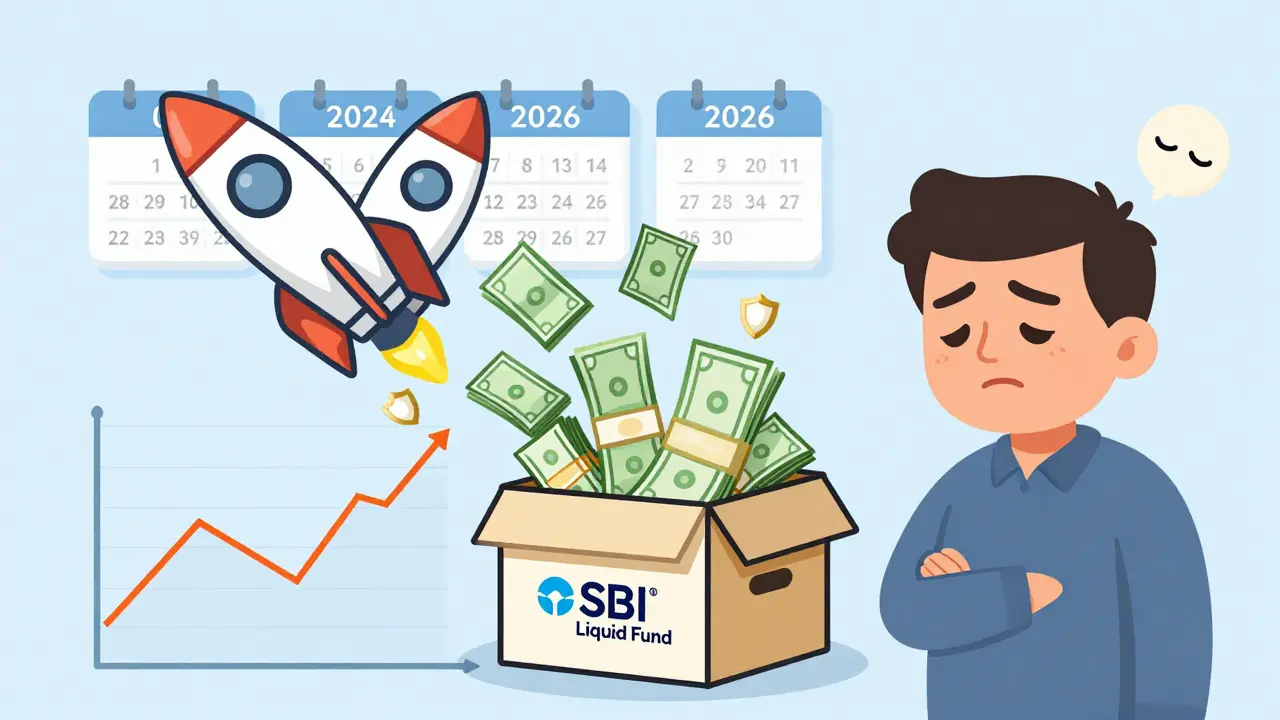
Rajesh, 45, sold his business in late 2024 and got ₹1.2 crore. He didn’t know what to do. He feared the market. He didn’t want to sit in a savings account.
He chose:
- Source: SBI Liquid Fund
- Target: Parag Parikh Flexi Cap Fund
- Transfer: ₹75,000 per month
- Duration: 16 months
By mid-2026, his entire ₹1.2 crore was in the equity fund. He didn’t buy at the peak. He bought through a market correction in late 2025 and again in early 2026. His average cost was 12% lower than if he’d invested everything in January 2025.
He sleeps better now.
How to Set Up an STP
It takes 5 minutes online:
- Log in to your mutual fund account (AMC website or app like CAMS, Kfintech).
- Go to ‘Transactions’ → ‘Systematic Transfer Plan’.
- Select your source fund (debt/liquid).
- Select your target fund (equity).
- Enter transfer amount and frequency.
- Confirm and submit.
You’ll get an email confirmation. The first transfer usually takes 3-5 business days. After that, it runs on autopilot.
Alternatives to STP
If STP doesn’t suit you, here are two other options:
- SWP (Systematic Withdrawal Plan): If you’re retired and want regular income from equity funds, this is your tool. It’s the reverse of STP.
- Dynamic Asset Allocation Funds: These are hybrid funds that automatically shift between debt and equity based on market valuations. You don’t need to manage transfers. But you give up control.
STP gives you control. You choose the timing, the amount, and the funds. That’s why it’s powerful.
Can I do an STP from equity to debt?
No. An STP is designed to move money from debt to equity. If you want to move from equity to debt, you need a Systematic Withdrawal Plan (SWP). SWP lets you withdraw a fixed amount from your equity fund and transfer it to a debt fund. It’s commonly used by retirees who need regular income.
Is STP better than SIP for large lump sums?
Yes, if you have a large sum (₹5 lakh or more) and want to enter equity markets gradually. SIP is for regular monthly income. STP is for deploying a lump sum without timing the market. STP reduces risk and often delivers better returns than SIP for large inflows.
Can I change the transfer amount during STP?
Most fund houses allow you to modify the transfer amount or frequency, but you usually need to cancel the existing STP and create a new one. Check with your AMC. Some platforms like Groww or Zerodha let you edit STP settings directly.
Do I need to pay tax on every STP transfer?
Yes. Each transfer from a debt fund is treated as a redemption. If the debt fund is held less than 3 years, gains are taxed as income. If held longer, you pay 20% with indexation. You must track each transfer for tax filing. Liquid funds minimize this because gains are very small.
Can I use STP across different fund houses?
No. STP only works within the same Asset Management Company (AMC). You can’t transfer from a HDFC Debt Fund to a ICICI Equity Fund. You must choose both funds from the same AMC. Some platforms like MFU or Groww allow you to initiate STP across AMCs, but they still require you to use the same distributor, and the transfer is processed as two separate transactions.
Final Thought
STP isn’t magic. It’s mechanics. It’s discipline. It’s the quiet power of small, consistent steps. If you’ve got a big sum and want to grow it without the fear of market crashes, STP is one of the smartest tools in your mutual fund toolbox. Start with liquid funds. Pick a solid equity fund. Set it and forget it. Let time and compounding do the rest.