
Tax on Mutual Funds in India: LTCG, STCG, and Dividend Tax Explained
When you invest in mutual funds in India, you’re not just buying units-you’re stepping into a tax system that changes how much you actually keep. Many investors think mutual funds are tax-free because they’re managed by professionals or because they’ve heard about long-term gains being tax-free. That’s not true anymore. Since 2018, the rules changed. And in 2025, those rules are still in place, with no signs of reversal. If you don’t understand how LTCG, STCG, and dividend taxes work, you could be paying more than you need to-or worse, missing out on filing corrections that could save you money.
What is LTCG on Mutual Funds?
LTCG stands for Long-Term Capital Gain. It’s the profit you make when you sell mutual fund units after holding them for more than a year. For equity mutual funds-those that invest at least 65% in Indian stocks-LTCG is taxed at 10% without indexation. That means if you bought units worth ₹1 lakh and sold them for ₹1.5 lakh after 18 months, your gain is ₹50,000. You pay 10% tax on that: ₹5,000.
Here’s the catch: the first ₹1 lakh of LTCG in a financial year is tax-free. So if your total gains across all equity funds in 2024-25 were ₹80,000, you pay nothing. If they were ₹1.3 lakh, you pay 10% on ₹30,000 only. This exemption resets every April 1.
For debt mutual funds, LTCG means holding for more than three years. The tax rate is 20% with indexation. Indexation adjusts your purchase cost for inflation using the Cost Inflation Index (CII) published by the government. That lowers your taxable gain. For example, if you bought debt fund units for ₹1 lakh in 2020 and sold them for ₹1.4 lakh in 2025, indexation might raise your cost to ₹1.25 lakh. Your taxable gain drops to ₹15,000, and you pay 20% of that-₹3,000. Without indexation, you’d pay ₹8,000.
What is STCG on Mutual Funds?
STCG is Short-Term Capital Gain. It happens when you sell mutual fund units within a year (for equity) or within three years (for debt). The tax rate here is straightforward: it’s added to your income and taxed at your slab rate.
For equity funds, STCG is taxed at 15%. No slab rate applies. So if you’re in the 30% tax bracket and sell equity fund units you held for 10 months, you still pay only 15% on the gain. That’s a benefit. But if you hold a debt fund for just 11 months and sell it, your gain gets added to your salary or business income. If you’re in the 30% bracket, you pay 30% on that gain. That’s a big difference.
Here’s a real example: You invest ₹5 lakh in a debt fund in January 2025. By October, it’s worth ₹5.6 lakh. You sell. Your gain is ₹60,000. Since you held it less than three years, it’s STCG. If your annual income is ₹12 lakh, you’re in the 30% bracket. You pay ₹18,000 in tax on the gain. If you’d held it until April 2026 (over three years), you’d pay only ₹12,000 with indexation.
Dividend Tax on Mutual Funds: It’s Not What You Think
Many investors still believe mutual fund dividends are tax-free. That changed in 2020. Before that, the fund house paid Dividend Distribution Tax (DDT). Now, the investor pays. Any dividend you receive from a mutual fund-whether equity or debt-is added to your income and taxed at your slab rate.
Let’s say you own ₹10 lakh in an equity mutual fund and receive ₹50,000 in dividends in 2025. That ₹50,000 is treated like salary income. If you’re in the 20% tax bracket, you pay ₹10,000 in tax on the dividend. And you don’t get any credit for tax already paid by the fund house-because there isn’t any.
Why does this matter? Because fund houses still advertise “high dividend yield” funds. They don’t mention that you’ll pay tax on every rupee you get. A 7% dividend yield might look great-but after 20-30% tax, you’re left with 5-5.5%. Growth options often give better net returns because you control when to sell and how much to book as gain.
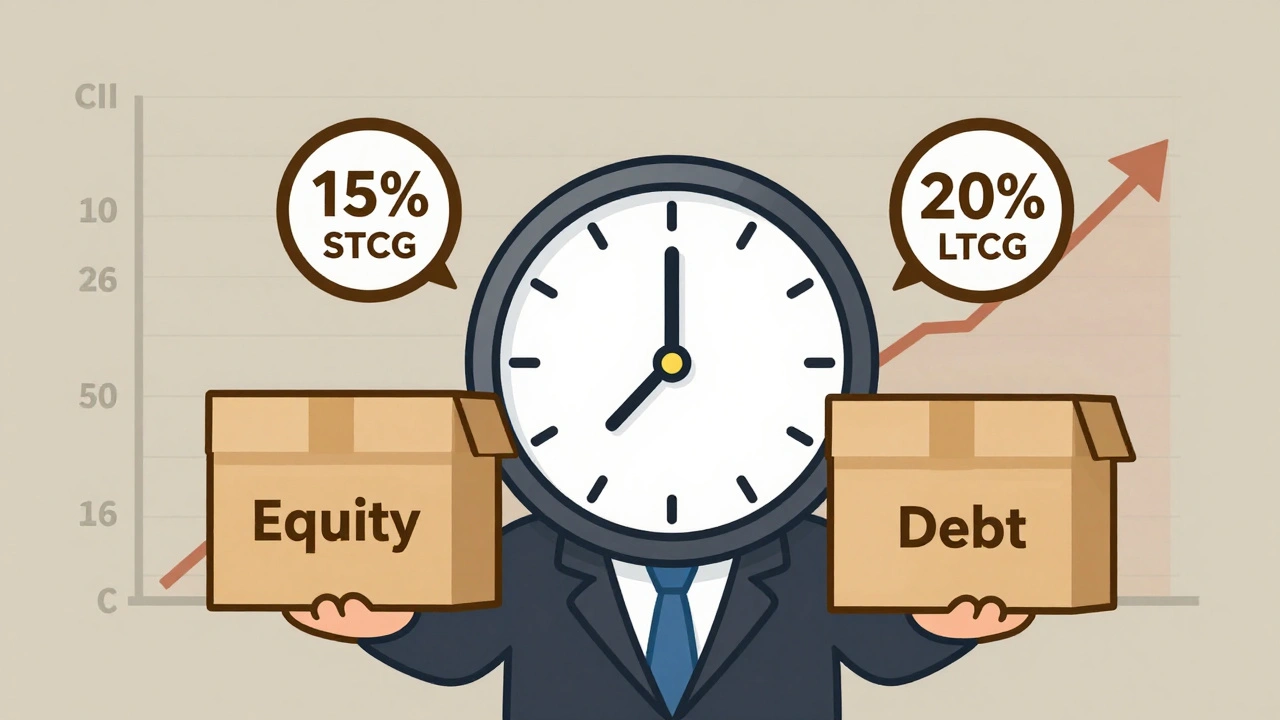
Equity vs Debt Funds: Tax Comparison
Here’s how the tax treatment stacks up for the same ₹1 lakh investment held for different periods:
| Parameter | Equity Fund | Debt Fund |
|---|---|---|
| Hold period for long-term | More than 1 year | More than 3 years |
| LTCG tax rate | 10% (no indexation), ₹1 lakh exemption | 20% with indexation |
| STCG tax rate | 15% | As per income tax slab |
| Dividend tax | As per income tax slab | As per income tax slab |
| Indexation benefit? | No | Yes |
Debt funds are better for long-term holding because of indexation. But if you’re planning to exit within a year, equity funds are simpler-you pay a flat 15% instead of your full slab rate.
When to Use Growth vs Dividend Options
Most mutual fund platforms default to dividend payout. But that’s not always smart. Growth options let your money compound without triggering yearly tax events. You control the timing. You can sell small amounts each year to stay under the ₹1 lakh LTCG exemption. Or wait until retirement when your income-and tax rate-might be lower.
Dividend options might seem appealing if you need regular cash flow. But remember: every dividend is taxable. If you’re in the 30% bracket and need ₹10,000 a year, you have to earn ₹14,286 in dividends to net ₹10,000 after tax. With growth, you can sell ₹10,000 worth of units. If it’s LTCG and you haven’t used your exemption, you pay nothing. Even if it’s STCG, you pay 15% on equity funds-still better than 30%.
How to Track and Report Mutual Fund Taxes
Every fund house sends you a statement at the end of the financial year. It shows your purchases, redemptions, and gains. But it doesn’t calculate your tax liability. You have to do that yourself.
Use the folio number to track each fund. Record the purchase date, units bought, and NAV. When you sell, note the sale date and NAV. Subtract the cost from the sale value to get the gain. Use the CII for debt funds to calculate indexed cost. The Income Tax Department’s portal has a free calculator for this.
Don’t wait until March. Every time you redeem, note it down. Many investors forget they sold a fund in November and then get hit with a big tax bill in April because they didn’t track it.
Common Mistakes and How to Avoid Them
- Mistake: Thinking all mutual funds are the same. Fix: Know if your fund is equity or debt. Check the scheme document. If it invests less than 65% in Indian equities, it’s a debt fund-even if it’s called a “balanced” or “hybrid” fund.
- Mistake: Selling just before the one-year mark to avoid LTCG. Fix: If you’re in a low tax bracket, holding past one year saves you money. A 15% STCG is worse than 10% LTCG if you’re in the 20%+ bracket.
- Mistake: Ignoring dividend reinvestment. Fix: Reinvested dividends count as fresh purchases. They increase your cost base and reduce future gains. Track them like any other buy.
- Mistake: Assuming tax is deducted at source. Fix: No mutual fund deducts tax on capital gains. You pay it yourself during filing. If you don’t, you’ll get a notice from the tax department.
What’s Changing in 2025?
As of 2025, there are no new tax changes for mutual funds. The rules from 2018 and 2020 still stand. But the government is reviewing the indexation benefit for debt funds. Some experts predict it could be removed in the next budget. If that happens, debt fund LTCG will be taxed at 20% without indexation-making them far less attractive for long-term holding.
For now, use indexation. If you have debt funds held for over three years, consider holding until March 2026 to lock in the benefit. If you’re planning to exit soon, do it before the next budget announcement.
Final Tip: Use Tax Harvesting
Tax harvesting is a simple trick: sell your winning equity funds just before the year ends to book gains up to ₹1 lakh. Pay 10% tax (or nothing if you’re under the exemption). Then rebuy the same fund the next day. You reset your cost base. Next year, you get another ₹1 lakh exemption.
This works only for equity funds. And only if you’re confident the fund will keep growing. It’s not gambling-it’s tax planning. Many investors in Delhi, Bengaluru, and Mumbai do this every year. You can too.
Are mutual fund dividends tax-free in India?
No. Since 2020, dividends from mutual funds are taxed in the hands of the investor at their income tax slab rate. The fund house no longer pays Dividend Distribution Tax (DDT). Every rupee you receive as dividend is added to your income and taxed accordingly.
Is LTCG on equity mutual funds tax-free up to ₹1 lakh?
Yes. Long-term capital gains from equity mutual funds are tax-free up to ₹1 lakh in a financial year. Any gain above ₹1 lakh is taxed at 10%. This exemption applies across all equity funds you own. You don’t need to file anything extra to claim it-it’s automatically applied when you report your gains.
How is STCG on debt mutual funds taxed?
Short-term capital gains from debt mutual funds are added to your total income and taxed at your applicable income tax slab rate. For example, if you’re in the 30% tax bracket and make a ₹50,000 gain from selling a debt fund held for less than three years, you pay ₹15,000 in tax on that gain.
Can I avoid tax on mutual funds by switching between schemes?
No. Switching from one mutual fund scheme to another-even within the same fund house-is treated as a sale and purchase. It triggers capital gains tax. If you switch from an equity fund to another equity fund after 11 months, you’ll pay 15% STCG on the gain. Always treat a switch as a redemption.
Do I need to pay advance tax on mutual fund gains?
If your total tax liability (including mutual fund gains) exceeds ₹10,000 in a financial year, you must pay advance tax in installments. Most salaried individuals don’t need to, because TDS covers it. But if you’re self-employed and earn large capital gains, you may need to pay advance tax to avoid penalties.