
Building Retirement Income Buckets in India: Short-Term, Medium-Term, Long-Term
Retiring in India used to mean relying on a single monthly pension or selling off your entire portfolio when the market dipped. That approach is risky, especially with inflation hovering around 6% and life expectancy rising past 70 years. If you lose everything to a market crash right after you stop working, there is no backup plan. The solution isn't just saving more money; it's structuring that money so it serves different purposes at different times.
This is where the income bucket strategy comes in. Instead of dumping all your retirement savings into one account, you split them into three distinct pools: short-term, medium-term, and long-term. Each bucket has a specific job, a specific risk profile, and a specific timeline. This method protects you from sequence-of-returns risk-the danger of having to sell assets during a downturn-and ensures you have cash flow for decades.
Why the Bucket Strategy Works for Indian Retirees
The core problem with traditional retirement planning is volatility. When you are young, you can wait out a bear market. When you are 65, you cannot. You need rent money next month, not in five years. By separating your funds, you insulate your immediate needs from market swings.
In the Indian context, this strategy aligns perfectly with the available financial instruments. We have highly liquid debt instruments for safety, equity-linked savings for growth, and government-backed annuities for stability. The goal is to create a self-sustaining ecosystem where your long-term investments eventually refill your short-term reserves.
What is the primary benefit of using income buckets for retirement?
The primary benefit is protection against sequence-of-returns risk. It ensures you do not have to sell depreciated assets during a market crash to pay for daily expenses, preserving capital for future growth.
Bucket 1: The Safety Net (Short-Term)
Your first bucket covers your immediate living expenses for the next 1 to 3 years. This is your "sleep well at night" fund. You should never touch this money unless absolutely necessary, and you should never invest it in volatile assets like stocks. Its only job is liquidity and capital preservation.
Fixed Deposits (FDs) are the cornerstone of the short-term bucket in India, offering guaranteed returns and principal safety. As of 2026, major banks offer interest rates between 7% and 8% for senior citizens. While this barely beats inflation, it provides certainty. For a retiree needing ₹50,000 per month, you would keep approximately ₹18 lakhs to ₹24 lakhs here.Other options for this bucket include:
- Savings Accounts: Keep 3-6 months of expenses here for instant access. Interest rates are low (around 3-4%), but the liquidity is unmatched.
- Arrears Fixed Deposits: Instead of one large FD, create 12 smaller FDs maturing each month. This gives you regular cash flow without breaking larger deposits early, which attracts penalties.
- Treasury Bills: Government securities with maturities of 91, 182, or 364 days. They are tax-free up to certain limits and virtually risk-free.
The rule here is simple: if you need the money within three years, it does not belong in the stock market. Market corrections can last longer than that, and you cannot afford to time the bottom.
Bucket 2: The Growth Engine (Medium-Term)
Once your immediate needs are covered, look at the next 3 to 10 years. This bucket replaces the money spent from Bucket 1. It carries moderate risk because you have a buffer of time. If the market drops today, you still have two years of spending money in Bucket 1, allowing you to wait for recovery.
In India, this bucket typically consists of balanced asset classes. You want growth that outpaces inflation but with less volatility than pure equity.
- Balanced Advantage Funds (BAFs): These mutual funds dynamically shift between equity and debt based on market valuations. They are designed specifically for this middle ground, offering downside protection while capturing upside potential.
- Corporate Bond Funds: These invest in high-quality corporate debt. Returns are generally higher than FDs (8-9%) but carry slightly more credit risk. Diversification across multiple issuers is key.
- Hybrid Mutual Funds: Aggressive hybrid funds (equity-heavy) or conservative hybrid funds (debt-heavy) depending on your risk appetite.
Every year, you should review this bucket. If it has grown significantly due to market gains, you can harvest some profits and move them back into Bucket 1 to replenish your short-term cash. This process, known as rebalancing, keeps your income stream steady regardless of market conditions.
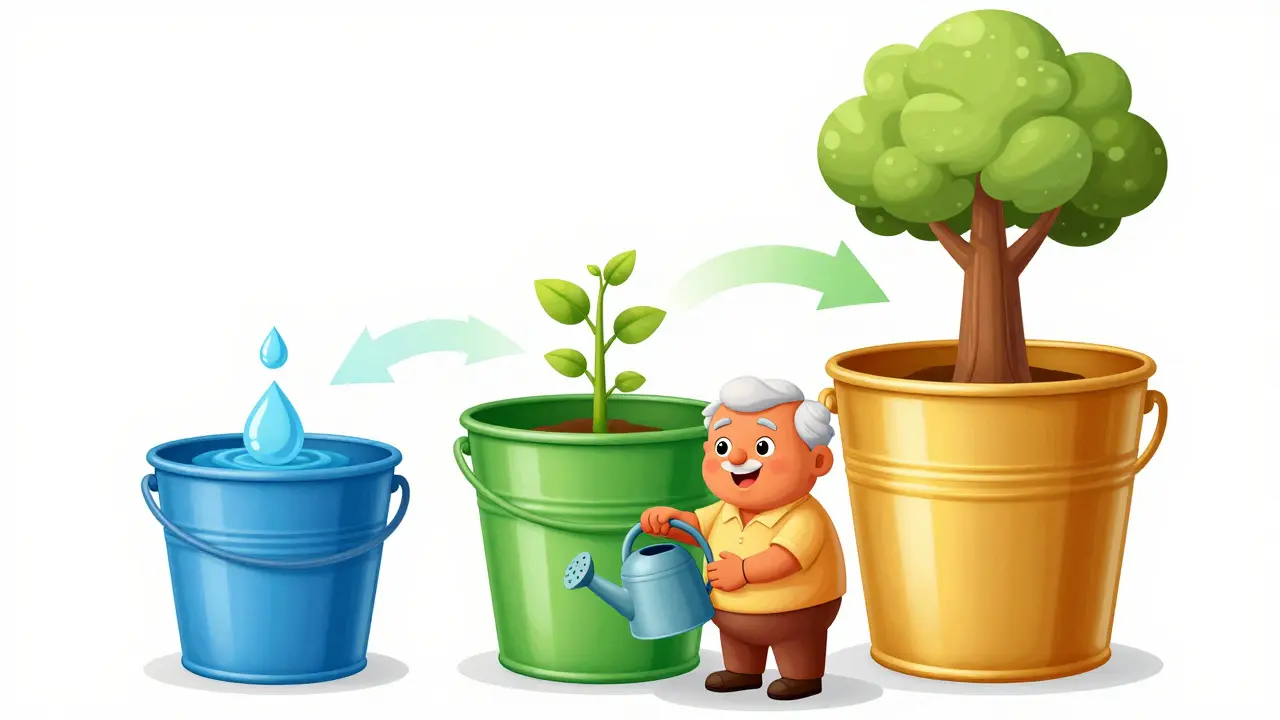
Bucket 3: The Legacy Pool (Long-Term)
This bucket is for anything beyond 10 years. It includes money for medical emergencies, travel, gifts to grandchildren, or leaving an inheritance. Since you won't touch this money for a decade, you can afford to take higher risks for higher rewards.
National Pension System (NPS) is a government-regulated retirement investment scheme that allows for significant tax benefits under Section 80CCD(1B). At retirement, you can withdraw 60% of the corpus tax-free. The remaining 40% must be used to buy an annuity, providing a lifelong pension. This structure makes NPS ideal for the long-term bucket, forcing discipline and ensuring a baseline income.Other components for this bucket include:
- Equity Mutual Funds: Index funds tracking the Nifty 50 or Sensex, or diversified large-cap funds. Historically, Indian equities have returned 12-14% annually over long periods, beating inflation by a wide margin.
- Real Estate: If you own rental property, the rental income can feed into your short-term bucket. However, real estate is illiquid, so ensure you have enough cash elsewhere.
- Gold ETFs or Sovereign Gold Bonds (SGBs): Gold acts as a hedge against currency depreciation and geopolitical instability. SGBs offer 2.5% annual interest plus capital appreciation, making them attractive for long-term holding.
The goal of Bucket 3 is capital appreciation. Over 10+ years, even a 15% drop in the market is recoverable. In fact, these deep corrections often present buying opportunities if you have the patience to hold.
Managing the Flow Between Buckets
A static allocation doesn't work forever. Your buckets need to interact. Here is how the lifecycle works:
- Annual Replenishment: Once a year, check the balance of Bucket 1. If it has dropped below your target (e.g., 1.5 years of expenses), pull funds from Bucket 2 or 3 to top it up.
- Profit Harvesting: If Bucket 3 has had a great year, consider selling a portion of those gains to move into Bucket 2 or 1. This locks in profits and reduces risk exposure.
- Inflation Adjustment: Increase your withdrawal amount from Bucket 1 by the inflation rate (CPI) each year. If you spent ₹6 lakhs last year, aim for ₹6.36 lakhs this year (assuming 6% inflation).
Many retirees make the mistake of drawing down their principal too quickly. By using the bucket system, you force yourself to live off the "fruits" of your investments rather than eating the "tree." Only dip into the principal of Bucket 3 if absolutely necessary.
| Feature | Bucket 1 (Short-Term) | Bucket 2 (Medium-Term) | Bucket 3 (Long-Term) |
|---|---|---|---|
| Time Horizon | 1-3 Years | 3-10 Years | 10+ Years |
| Primary Goal | Liquidity & Safety | Growth & Stability | Capital Appreciation |
| Risk Level | Very Low | Moderate | High |
| Indian Instruments | FDs, Savings, T-Bills | BAFs, Corporate Bonds | Equity MFs, NPS, Gold |
| Expected Return | 7-8% | 9-11% | 12-14%+ |

Tax Efficiency in Retirement Withdrawals
Taxes can eat away at your retirement corpus faster than inflation. In India, the tax treatment of withdrawals varies significantly by instrument. Structuring your buckets with tax efficiency in mind can save lakhs over time.
- Equity Gains: Long-term capital gains (LTCG) above ₹1.25 lakh are taxed at 12.5%. Short-term gains are taxed at 20%. Since Bucket 3 is held for long periods, LTCG is the relevant metric.
- Debt Instruments: Interest from FDs is added to your income and taxed at your slab rate. This is why FDs are better for Bucket 1, where amounts are smaller and likely fall within lower tax brackets or exemptions.
- NPS Annuity: The annuity income from NPS is fully taxable as per your slab rate. However, the initial 60% lump sum withdrawal is tax-free. Plan your cash flows to minimize taxable annuity income if possible.
- Public Provident Fund (PPF): PPF withdrawals are completely tax-free. If you have a matured PPF, it can serve as a powerful component of Bucket 1 or 2 due to its tax-free status.
Consider your total taxable income. If your pension or annuity income pushes you into a higher tax bracket, withdrawing from tax-efficient sources (like PPF or LTCG) first can help manage your overall tax liability.
Common Pitfalls to Avoid
Even with a solid plan, behavioral mistakes can derail your retirement. Here are the most common traps Indian retirees fall into:
- Over-allocation to Real Estate: Many Indians prefer physical property. But if 70% of your wealth is in one house, you are exposed to location-specific risks. Liquidity is also poor; selling a house takes months.
- Ignoring Health Insurance: A major health event can wipe out Bucket 1 overnight. Ensure you have adequate health coverage (₹10-20 lakh base cover) before relying on savings for medical bills.
- Panic Selling: When the market crashes, the urge to sell Bucket 3 to protect capital is strong. Resist this. Remember, Bucket 1 is there for exactly this reason. Stay invested in Bucket 3.
- Underestimating Inflation: Assuming 4% inflation when it averages 6% means your purchasing power halves in 18 years instead of 17. Always budget for higher inflation in healthcare and education.
Next Steps for Implementation
If you are currently working, start building these buckets now. Automate transfers to your emergency fund (Bucket 1) until it reaches 1.5 years of expenses. Direct your SIPs towards equity (Bucket 3) and balanced funds (Bucket 2). As you approach retirement age, gradually shift allocations from Bucket 3 to Bucket 2 and then to Bucket 1.
If you are already retired, audit your current holdings. Do you have enough cash for the next two years? If not, consider shifting some equity positions to debt or fixed deposits immediately. Don't wait for the next correction to realize you are overexposed.
Retirement is not a destination; it's a phase of life that requires active management. By using the income bucket strategy, you gain control over your finances, reduce stress, and ensure that your hard-earned savings last as long as you do.
How much should I keep in my short-term bucket?
Aim for 1.5 to 2 years of essential living expenses. For example, if your monthly expense is ₹50,000, keep ₹9 to ₹12 lakhs in highly liquid, low-risk instruments like Fixed Deposits or Savings Accounts.
Can I use Equity Linked Savings Schemes (ELSS) in my retirement buckets?
Yes, ELSS fits well in the long-term bucket (Bucket 3). They offer tax benefits under Section 80C and have a short lock-in period of 3 years, making them suitable for growth-oriented retirement savings.
What happens if the market crashes right after I retire?
This is where the bucket strategy shines. You continue to spend from Bucket 1 (cash/FDs) and Bucket 2 (moderate risk). You do not sell any assets from Bucket 3 (equity) during the crash, allowing it to recover when markets rebound.
Is it too late to start bucketing if I am already 60?
It is never too late. Even if you are close to retirement, you can restructure existing assets. Move immediate needs to safe havens and keep growth assets for the long haul. Consult a fee-only financial planner for personalized advice.
How often should I rebalance my buckets?
Review your buckets annually. Check if Bucket 1 is depleted and needs replenishment from Bucket 2 or 3. Also, assess if Bucket 3 has grown excessively and requires profit harvesting to maintain your desired risk profile.