
Section 80C vs 80D in India: Know the Difference Between Investment and Health Insurance Tax Deductions
Every year, millions of salaried Indians scramble to file their taxes before March 31. Many focus on saving tax through investments and health insurance, but they mix up Section 80C and Section 80D. These are two of the most used tax-saving tools under the Income Tax Act, but they serve completely different purposes. One is for building wealth over time. The other is for protecting your family’s health. Confusing them can cost you money - either by missing out on deductions or by investing in the wrong place.
What Section 80C Actually Covers
Section 80C lets you reduce your taxable income by up to ₹1.5 lakh per year by investing in approved instruments. It’s not just about fixed deposits or life insurance - it’s a broad list of options designed to encourage long-term savings. The goal? To help you build assets like retirement funds, education savings, or home ownership.
Common 80C investments include:
- Public Provident Fund (PPF)
- Employee Provident Fund (EPF)
- Life insurance premiums (for self, spouse, or children)
- Equity Linked Savings Scheme (ELSS) mutual funds
- Fixed deposits with five-year lock-in
- Tuition fees for up to two children
- Principal repayment on home loans
- National Savings Certificate (NSC)
Here’s the catch: all these investments have lock-in periods. PPF locks your money for 15 years. ELSS has three years. Even though ELSS gives better returns than fixed deposits, you can’t pull your money out early. That’s intentional - the government wants you to save for the future, not spend it.
Let’s say you earn ₹12 lakh a year. If you invest ₹1.5 lakh under 80C, your taxable income drops to ₹10.5 lakh. That could save you ₹30,000-₹45,000 in taxes, depending on your slab. But you don’t get that cash back - you get a lower tax bill. The money you invest stays locked in, growing over time.
What Section 80D Is For
Section 80D is all about health. It gives you a deduction for premiums paid toward health insurance policies - for yourself, your family, or your parents. Unlike 80C, this isn’t about building wealth. It’s about avoiding huge medical bills.
The deduction limits changed in 2025. Here’s what you can claim:
- Up to ₹25,000 for health insurance for yourself, spouse, and dependent children
- Additional ₹25,000 if you insure your parents (if they’re under 60)
- Up to ₹50,000 if your parents are senior citizens (60+)
- Up to ₹5,000 for preventive health check-ups (included in the overall limit)
So if you’re 35, married, with two kids and both your parents are 62, you can claim:
- ₹25,000 - for your family’s policy
- ₹50,000 - for your parents’ senior citizen policy
- ₹5,000 - for annual health check-ups
Total deduction: ₹80,000 under Section 80D. That’s separate from your ₹1.5 lakh under 80C. You can claim both.
Important: Only premiums paid via bank transfer, cheque, or digital payment qualify. Cash payments don’t count. And you can’t claim deductions for medical expenses you paid out of pocket - only insurance premiums.
Section 80C vs 80D: The Real Differences
People often think both sections are just ways to reduce tax. But that’s like saying a car and a helmet are both ‘vehicle parts’ - true, but they do very different jobs.
Here’s a clear breakdown:
| Feature | Section 80C | Section 80D |
|---|---|---|
| Primary Purpose | Long-term savings and wealth creation | Health protection through insurance |
| Max Deduction Limit | ₹1.5 lakh per year | Up to ₹75,000 (₹25,000 + ₹50,000) |
| Eligible Expenses | Investments: PPF, ELSS, EPF, life insurance, home loan principal | Health insurance premiums for self, family, parents |
| Lock-in Period | Yes - 3 to 15 years depending on instrument | No - policy term is annual or multi-year, but no lock-in on deduction |
| Payment Mode | Any mode accepted by the institution | Must be via digital or bank transfer - cash not allowed |
| Return on Investment | Yes - grows over time (e.g., ELSS gives 12-15% CAGR) | No - it’s a risk hedge. You get nothing back unless you claim medical bills |
| Can You Claim Both? | Yes - they are independent deductions | |
The biggest mistake people make? Using 80C to buy health insurance. That’s not allowed. Life insurance premiums qualify under 80C - but only if it’s a pure life cover. If you buy a health insurance plan, even if it’s from the same company, it goes under 80D. Mixing them up means you lose the deduction.
How to Maximize Both Deductions
You don’t have to choose between 80C and 80D. Smart taxpayers use both together. Here’s how:
- Start with 80D. Buy health insurance for yourself, your spouse, and your parents. If your parents are seniors, go for a policy with ₹50,000 coverage. Don’t forget the ₹5,000 for annual check-ups - it’s easy to overlook.
- Then fill your 80C limit. If you’re not already contributing to EPF, start. If you are, consider topping up with PPF or ELSS. ELSS funds often give the best returns with the shortest lock-in (3 years).
- Track your payments. Keep digital receipts for every premium paid. If you pay cash for a health policy, you won’t get the deduction - no matter how much you spend.
- Review every year. Your family size changes. Your parents age. Your income changes. Adjust your insurance and investments accordingly.
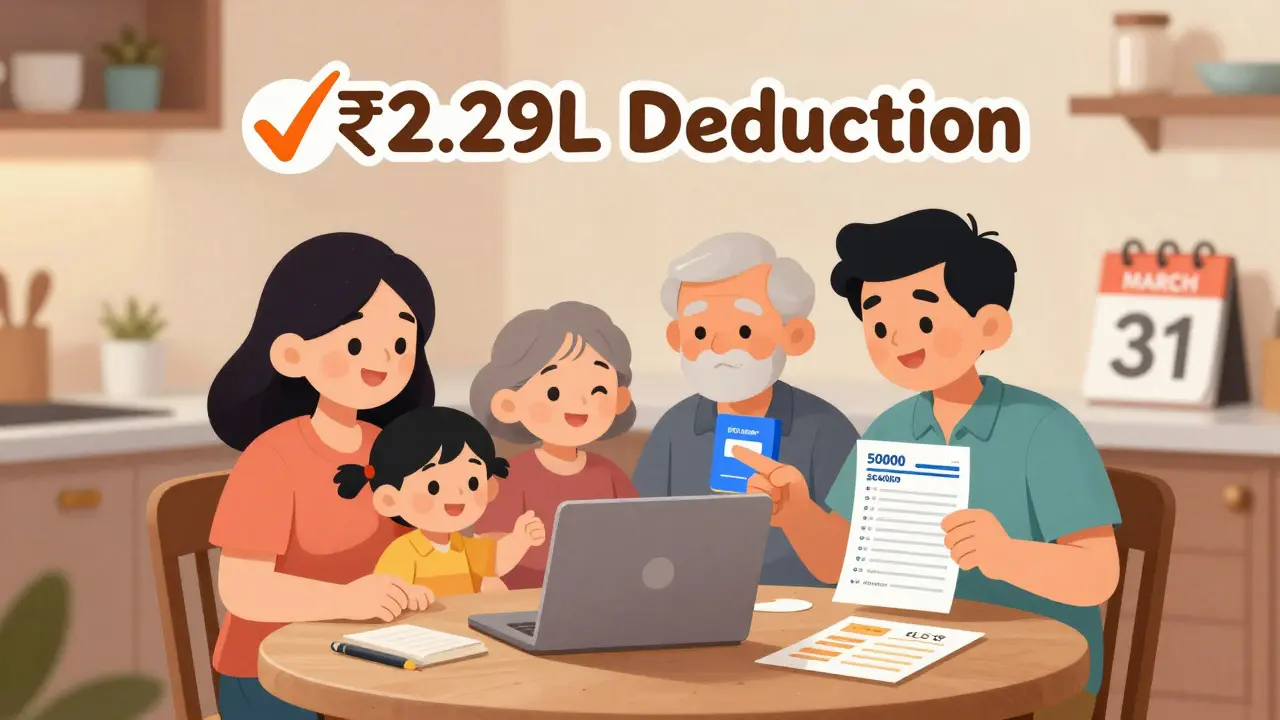
Example: Raj, 38, earns ₹14 lakh. He invests ₹1.5 lakh in ELSS and PPF (80C). He also pays ₹25,000 for his family’s health plan and ₹50,000 for his 65-year-old parents’ policy. He spends ₹4,000 on check-ups. Total deduction: ₹1.5 lakh + ₹79,000 = ₹2.29 lakh. That’s a tax saving of over ₹68,000 in the highest slab. He didn’t just reduce his tax - he secured his family’s health and future.
Common Mistakes to Avoid
Even experienced filers trip up here. Here are the top errors:
- Buying a health insurance policy and claiming it under 80C - it doesn’t work. Only life insurance qualifies under 80C.
- Using cash to pay premiums - no deduction. Always use net banking, UPI, or cheque.
- Forgetting parents’ coverage - if your parents are senior citizens, you can claim ₹50,000. Many miss this.
- Thinking all life insurance qualifies - only pure term plans and traditional endowment plans count. ULIPs with high charges? Often don’t qualify fully.
- Not keeping records - if the IT department asks for proof, you need bank statements or policy receipts.
Also, don’t assume your employer’s group health plan counts. It doesn’t. Only premiums you personally pay for individual or family floater policies qualify under 80D.

What Happens If You Overclaim?
Claiming more than you’re entitled to is risky. The Income Tax Department cross-checks with insurers and banks. If you claim ₹1.8 lakh under 80C but only invested ₹1.5 lakh, you’ll get a notice. You might have to pay back taxes, plus interest and penalties.
Same goes for 80D. If you claim ₹1 lakh for health insurance but only paid ₹50,000, the system flags it. Your refund gets delayed. You might even get audited.
Always use your actual payment records. Don’t guess. Don’t inflate. The system knows.
What’s Next After 80C and 80D?
Once you’ve maxed out both, you still have options. Section 80CCD(1B) gives you an extra ₹50,000 deduction if you invest in the National Pension System (NPS). That’s on top of your ₹1.5 lakh under 80C. So your total tax-saving potential jumps to ₹2 lakh.
And if you have medical bills beyond insurance coverage, you can claim them under Section 80DDB - for specific critical illnesses like cancer or kidney failure. But that’s a separate rule, with strict conditions.
Don’t treat tax saving as a one-time task. It’s a yearly habit. Review your investments, update your insurance, and track every rupee. The goal isn’t just to pay less tax - it’s to build security for your family’s future.
Can I claim both Section 80C and Section 80D in the same year?
Yes. They are completely separate deductions. You can claim up to ₹1.5 lakh under 80C for investments and up to ₹75,000 under 80D for health insurance premiums. Together, that’s ₹2.25 lakh in deductions before you even consider NPS or other sections.
Is health insurance covered under Section 80C?
No. Health insurance premiums are only eligible under Section 80D. Section 80C covers life insurance premiums, not health. If you try to claim health insurance under 80C, your return will be rejected or flagged during scrutiny.
Can I claim tax deduction for medical expenses paid in cash?
No. Under Section 80D, only premiums paid via digital payment, bank transfer, or cheque qualify. Cash payments for medical bills - even for serious illnesses - don’t count unless they’re part of a specific claim under Section 80DDB, which has its own rules and limits.
What if my parents are over 80? Can I claim more?
Yes. If your parents are super senior citizens (80 years or older), the deduction limit under Section 80D increases to ₹50,000 for their health insurance - same as for seniors aged 60-79. There’s no higher limit for those over 80. But you can still claim ₹25,000 for your own family, so total remains ₹75,000.
Does NPS come under Section 80C?
Partly. Contributions to NPS under Section 80CCD(1) count toward your ₹1.5 lakh limit under 80C. But there’s an extra ₹50,000 deduction available under Section 80CCD(1B), which is over and above the ₹1.5 lakh. So NPS gives you two layers of tax benefit.