Claiming Stamp Duty and Registration Fees Under Section 80C: A Homebuyer's Guide
Quick Takeaways for Homebuyers
- You can claim stamp duty and registration charges as a deduction under Section 80C.
- The total deduction limit for 80C is ₹1.5 lakh per financial year.
- You must claim these costs in the same year you pay them.
- These benefits apply whether the property is for your own use or for renting.
Let's get the basics straight. When you buy a house, you don't just pay the seller. You pay the government a tax to legally transfer the property title to your name. This is Stamp Duty is a legal tax imposed by the government on legal documents, primarily used for the transfer of assets like real estate. Beside that, there's the Registration Fee, which is the cost of recording the transaction in the government's records. Both of these can be quite steep-often ranging from 2% to 8% of the property value depending on the state.
Now, here is where the Section 80C of the Income Tax Act, 1961 comes into play. This section is like a giant bucket where you can throw various investments and expenses to reduce your taxable income. The most common items in this bucket are LIC premiums, PPF contributions, and ELSS funds. However, the cost of stamp duty and registration is also eligible for this deduction. This means if you paid ₹1 lakh in stamp duty, you can subtract that from your total income before calculating your tax.
The Timing Trap: When to Claim Your Deduction
One of the biggest mistakes people make is trying to claim these charges in the year they get possession of the house. Tax law is very specific here: you must claim the deduction in the financial year in which the payment was actually made. If you paid your stamp duty in March 2025 but the builder handed over the keys in June 2025, you must file the claim for the 2024-25 assessment year. If you miss this window, you can't just carry it forward to the next year. It's a 'use it or lose it' situation.
Imagine you're buying a flat in Bangalore. You pay a stamp duty of ₹1,20,000 and registration fees of ₹30,000 in February 2026. That's ₹1.5 lakh right there. If you've already invested in Public Provident Fund (PPF) or Life Insurance Corporation (LIC) policies, you might find that your 80C limit is already full. Since the cap is ₹1.5 lakh, you can't claim an extra ₹1.5 lakh for the house. You'll have to prioritize which deduction to take. Pro tip: If you have a choice, claim the stamp duty first because it's a mandatory expense, whereas PPF is a voluntary investment.
Comparing 80C Benefits Across Home-Buying Expenses
It's easy to confuse Section 80C with Section 24(b). While 80C deals with the 'entry cost' of the house, Section 24(b) is all about the loan interest. To make it clear, here is a breakdown of how different home-related costs are treated for tax purposes.
| Expense Type | Tax Section | Maximum Benefit | Nature of Benefit |
|---|---|---|---|
| Stamp Duty & Registration | Section 80C | ₹1.5 Lakh (Shared) | Deduction from Total Income |
| Home Loan Principal | Section 80C | ₹1.5 Lakh (Shared) | Deduction from Total Income |
| Home Loan Interest | Section 24(b) | ₹2 Lakh (Self-occupied) | Deduction from House Property Income |
| First-time Buyer Benefit | Section 80EEA | ₹1.5 Lakh | Additional Interest Deduction |

The Conflict Between Principal Repayment and Stamp Duty
Here's a tricky part. Many homeowners use their Home Loan principal repayments to fill up their 80C limit. If you are paying back ₹1 lakh a year in principal and you also have ₹1 lakh in stamp duty, you've hit ₹2 lakh. But remember, the ceiling is ₹1.5 lakh.
You have to decide how to allocate this. Usually, the stamp duty is a one-time hit, while the principal repayment happens every year for 20 years. For the first year of your home purchase, it almost always makes sense to claim the stamp duty and registration fees first. This maximizes your immediate tax savings.
Does this apply to rented properties? Yes. Whether you move into the house or rent it out to a tenant, the stamp duty and registration costs remain deductible under 80C. The tax law doesn't care about the usage of the property for this specific deduction; it only cares that you paid the tax to the government.
Common Pitfalls to Avoid
Don't assume that every fee paid during a home purchase is deductible. For example, the 'processing fee' charged by your bank for the home loan is not covered under Section 80C. Similarly, the money you pay for a legal consultant to verify the title deeds or the brokerage fee paid to a real estate agent cannot be claimed here. Only the official government taxes-stamp duty and registration-count.
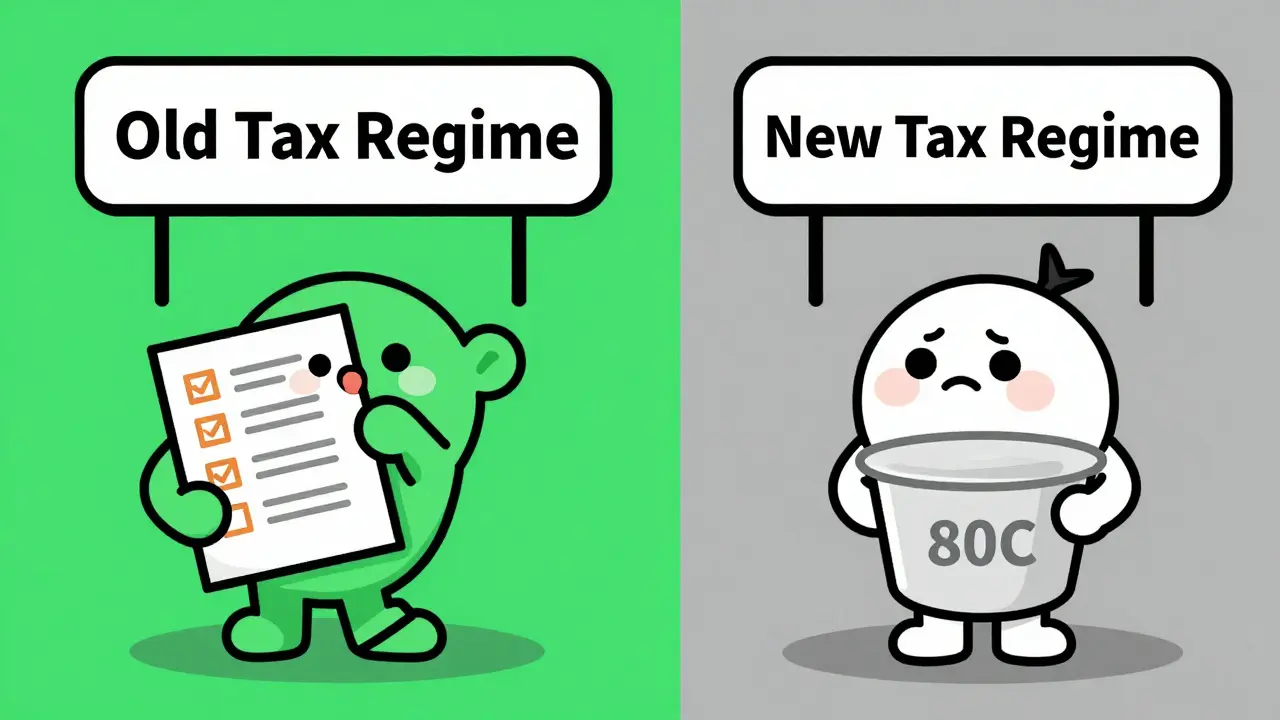
Another common error is claiming the benefit under the New Tax Regime. If you've opted for the New Tax Regime (introduced by the Indian government to simplify taxes with lower rates), you forfeit almost all 80C deductions, including stamp duty. You have to stay in the Old Tax Regime to enjoy these benefits. Before you switch regimes to get a lower base rate, do the math. If you're buying a house and have high 80C investments, the Old Regime often saves you more money.
Step-by-Step: How to Claim the Benefit
- Gather Documentation: Keep your registered sale deed and the payment receipts for stamp duty and registration. The government needs proof that the money left your account and went to the state treasury.
- Calculate Total 80C: Add up your LIC, PPF, ELSS, and school fees for your children.
- Apply Stamp Duty: Add the registration and stamp duty costs to this total.
- Cap at ₹1.5 Lakh: If the total exceeds ₹1.5 lakh, only enter ₹1,50,000 in the 80C column of your tax return.
- File Your Return: Ensure you select the 'Old Tax Regime' when filing your Income Tax Return (ITR).

Beyond 80C: Expanding Your Tax Strategy
While 80C is the most talked-about, it's just one piece of the puzzle. If you're a first-time homebuyer, look into Section 80EEA. This allows an additional deduction of up to ₹1.5 lakh on home loan interest for houses valued up to ₹45 lakh. When you combine 80C (for stamp duty), Section 24(b) (for interest), and 80EEA, you can significantly slash your tax liability.
Also, keep an eye on state-specific exemptions. Some Indian states offer reduced stamp duty rates for women buyers to encourage property ownership among females. If you are buying a joint property with your spouse, check if registering the property in her name reduces the initial cost, which in turn changes the amount you can claim under 80C.
Frequently Asked Questions
Can I claim stamp duty and registration if I bought the house with a loan?
Yes, you can. It doesn't matter if you paid the fees from your own savings or if the bank funded it as part of the home loan. As long as the payment was made and you have the receipt, it is deductible under Section 80C.
What happens if the stamp duty exceeds ₹1.5 lakh?
Unfortunately, the ₹1.5 lakh limit is a hard cap for the entire Section 80C category. If your stamp duty alone is ₹2 lakh, you can still only claim ₹1.5 lakh. The remaining amount cannot be carried forward to next year's tax filing.
Do I need to submit the sale deed to the Income Tax Department?
No, you don't need to upload the deed while filing your ITR. However, you must keep the registered sale deed and payment receipts safely in your records. If the department sends a notice or asks for verification during an audit, you will need to produce these documents.
Can I claim these charges for a plot of land?
Yes, Section 80C allows deductions for stamp duty and registration charges for any residential property, including the purchase of a plot of land intended for building a house.
Is this benefit available under the New Tax Regime?
No. The New Tax Regime offers lower tax slabs but removes most exemptions and deductions, including the entire 80C section. To claim stamp duty benefits, you must stick with the Old Tax Regime.