Trading Account vs Demat Account in India: What’s the Difference?
If you're new to investing in the Indian stock market, you've probably heard the terms trading account and demat account thrown around like they're the same thing. They’re not. Confusing them can cost you time, money, and even access to your investments. Let’s cut through the jargon and lay out exactly what each account does, how they work together, and why you need both to trade stocks in India.
What Is a Demat Account?
A demat account is short for dematerialized account. It’s where your shares, bonds, mutual funds, and other securities are stored in digital form-no paper certificates, no filing cabinets. Think of it like a digital locker for your investments.
Before demat accounts, investors held physical share certificates. If you bought 100 shares of Reliance, you got a paper document. Lose it? Good luck proving you owned them. Theft, damage, delays in transfer-those were real problems. In 1996, the National Securities Depository Limited (NSDL) and Central Depository Services (India) Limited (CDSL) launched demat accounts to fix this. Today, nearly all trading in India happens through demat accounts.
When you buy shares, they don’t land in your bank account. They land in your demat account. When you sell, they leave from there. Your demat account holds the ownership record. It’s maintained by a depository participant (DP)-usually your broker, bank, or financial institution registered with NSDL or CDSL.
Key features of a demat account:
- Stores securities in electronic form
- One account can hold shares, ETFs, government bonds, and mutual funds
- Requires a unique 16-digit demat account number
- Charges annual maintenance fees (typically ₹300-₹800/year)
- Linked to your bank account for fund transfers
You don’t trade directly from your demat account. You can’t buy or sell shares just by logging into it. That’s where the trading account comes in.
What Is a Trading Account?
A trading account is your gateway to the stock market. It’s the tool you use to place buy and sell orders. Think of it as your stock market remote control.
When you log into your broker’s platform-Zerodha, Upstox, ICICI Direct, or any other-you’re using your trading account. This account connects you to the exchange (NSE or BSE), sends your order, and confirms execution. Without it, you can’t place a single trade.
It’s not a storage space. It doesn’t hold shares. It doesn’t hold cash. It’s purely a communication channel between you and the market. Once a trade is done, the system automatically updates your demat account (for shares) and your bank account (for money).
Key features of a trading account:
- Used to place buy/sell orders on exchanges
- Linked to your demat account and bank account
- Provides real-time market data, charts, and order tracking
- May offer advanced tools like stop-loss, margin trading, or algo trading
- Usually free to open, but brokers charge brokerage fees per trade
Some brokers bundle both accounts together. You sign up once, and you get both. But they’re still two separate systems with two different jobs.
How Do They Work Together?
Here’s the real-life flow:
- You log into your trading account and place a buy order for 5 shares of Tata Motors.
- The order goes to the NSE, matches with a seller, and executes.
- Money is debited from your linked bank account.
- The 5 shares are credited to your demat account within T+2 days.
Sell process:
- You log into your trading account and sell 5 shares of Tata Motors.
- The shares are debited from your demat account.
- The money from the sale is credited to your bank account in T+2 days.
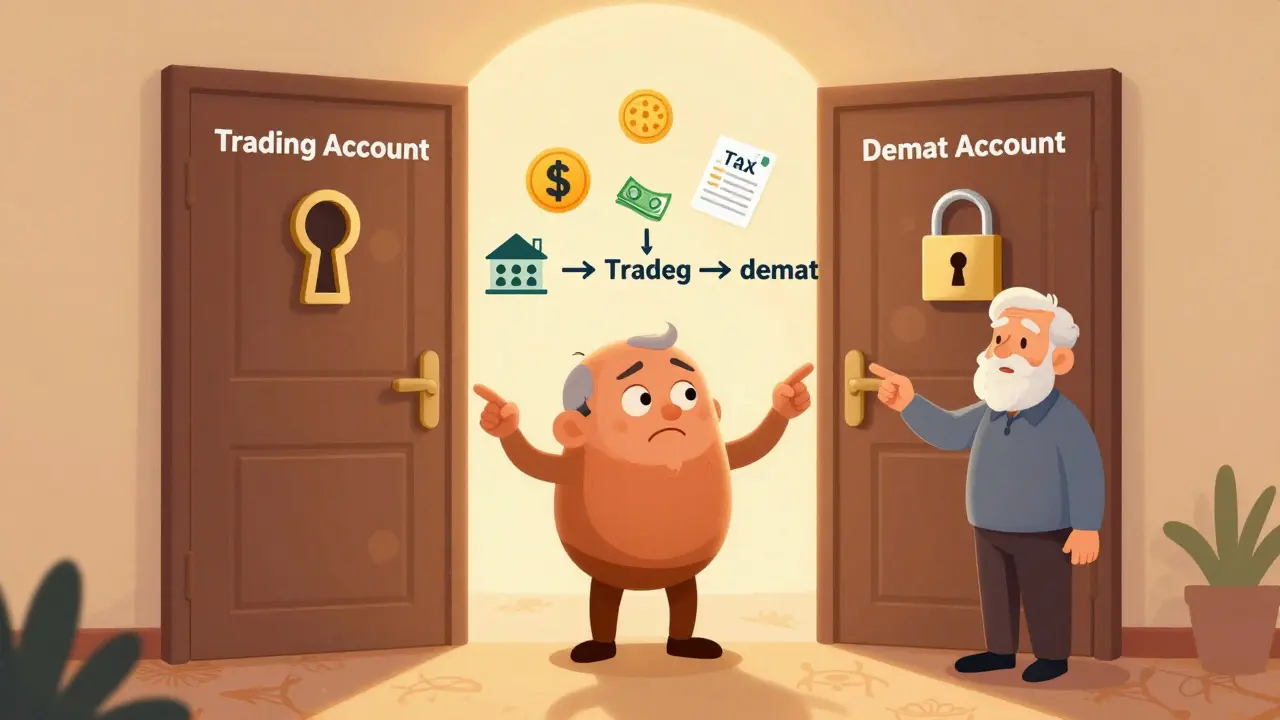
You can’t skip one. You can’t buy shares without a demat account. You can’t trade without a trading account. They’re like a key and a lock-both needed to open the door.
Who Needs Both Accounts?
If you’re buying or selling stocks, ETFs, or IPOs in India, you need both. That includes:
- Individual investors buying shares for long-term growth
- Day traders placing multiple trades a day
- People investing in IPOs (you need a demat account to receive shares)
- Anyone holding mutual funds in digital form (some mutual funds require demat)
But not everyone needs both. If you’re only investing in mutual funds through direct plans on platforms like Groww or Coin by Zerodha, you might not need a demat account-those are held in a separate folio system. But if you’re trading listed securities, demat is mandatory.

Costs and Fees: What You Actually Pay
Many beginners think opening both accounts is expensive. Here’s the truth:
Demat account fees:
- Opening: Usually free
- Annual maintenance charge (AMC): ₹300-₹800/year
- Transaction charges: ₹10-₹25 per debit (when you sell shares)
- Some brokers waive AMC if you trade more than 3 times a month
Trading account fees:
- Opening: Free
- Brokerage: Most discount brokers charge ₹20 per trade or 0.05% of trade value
- Some offer unlimited trades for ₹99/month
- Additional charges: GST, STT, stamp duty, SEBI fees
Compare this to full-service brokers like Motilal Oswal or HDFC Securities, where brokerage can be 0.5% per trade. Discount brokers have made trading affordable for everyday Indians.
Common Mistakes People Make
Here are the top three errors new investors make:
- Thinking your bank account is enough. You can’t buy shares by just transferring money to a broker. You need a demat account to receive them.
- Opening only a trading account. You’ll be able to place orders, but you won’t get shares in your name. Your trade will fail or be reversed.
- Using separate brokers for each account. You can, but it’s messy. Linking both accounts under one broker simplifies everything-funds move faster, statements are unified, and support is easier.
Also, don’t ignore the tax side. Every trade you make through your trading account is recorded. Your demat account shows what you own. Both are used by the Income Tax Department to track capital gains. Keep records of both.
Which Brokers Offer Both in India?
Most major brokers in India offer bundled trading + demat accounts. Here are the top choices as of 2025:
| Broker | Trading Fees | Demat AMC | App Rating (iOS/Android) | Best For |
|---|---|---|---|---|
| Zerodha | ₹20 per trade or ₹0 for equity delivery | ₹300/year | 4.7/5 | Beginners and active traders |
| Upstox | ₹20 per trade | ₹300/year | 4.6/5 | Low-cost trading |
| Groww | ₹0 brokerage for equity delivery | ₹0 | 4.8/5 | Mutual funds + stocks |
| ICICI Direct | 0.55% per trade | ₹750/year | 4.3/5 | Full-service support |
| Paytm Money | ₹20 per trade | ₹0 | 4.5/5 | Mobile-first users |
Groww and Paytm Money stand out for zero demat AMC. Zerodha remains the most popular for its tools and transparency. Choose based on your trading style-not just price.
What Happens If You Don’t Have a Demat Account?
You can’t legally hold shares in India without one. If you try to buy shares without a demat account:
- Your order may be rejected at the exchange level
- If it goes through (rare), you won’t get ownership rights
- You won’t receive dividends, bonus shares, or rights issues
- You won’t be able to sell them later
It’s like ordering a car but refusing to register it. You might have the keys, but you can’t drive it legally.
Can You Have Multiple Accounts?
Yes, but it’s rarely useful. You can open one demat account with NSDL and another with CDSL. You can also open multiple trading accounts with different brokers.
But why? If you’re trading with one broker, there’s no benefit. Multiple accounts mean:
- More paperwork
- Higher fees
- Harder to track your portfolio
- Complicated tax reporting
Unless you’re doing arbitrage between platforms or using different brokers for different strategies, stick to one of each.
How to Open Them
Opening both accounts is simple and can be done online in under 30 minutes:
- Choose a broker (Zerodha, Groww, Upstox, etc.)
- Go to their website or app and click “Open Account”
- Fill in your personal details: name, PAN, address, bank details
- Upload ID proof (Aadhaar, passport) and signature
- Complete e-KYC (video verification or OTP-based)
- Link your bank account
- Sign the agreement digitally
- Receive your demat and trading account numbers via email and SMS
You’ll be ready to trade the next day.
Final Thought: They’re Not Competitors. They’re Partners.
A trading account gets you into the market. A demat account keeps your assets safe and in your name. One is the door. The other is the vault.
You don’t need to understand the technical details of how NSDL processes transfers. You just need to know this: if you want to own shares in India, you need both. Skip one, and you’re not really investing-you’re just guessing.
Start with one broker. Get both accounts. Keep your records. Track your trades. And remember-your demat account holds your wealth. Your trading account helps you grow it.
Do I need a demat account to invest in mutual funds?
Not always. If you invest in mutual funds through direct plans on platforms like Groww, Coin, or MFU, your holdings are tracked in a folio number, not a demat account. But if you buy mutual funds through your broker’s platform as ETFs or if you want to hold them in demat form (for easier trading), then you’ll need a demat account.
Can I use the same bank account for multiple trading and demat accounts?
Yes. You can link the same bank account to multiple demat and trading accounts. But it’s not recommended. Mixing funds across brokers makes tracking your investments harder and increases the risk of errors during transfers. Stick to one broker unless you have a specific reason to use more.
What happens if I don’t use my demat account for a long time?
If your demat account is inactive for 18 months, it becomes dormant. You’ll still own your shares, but you won’t be able to trade until you reactivate it. Reactivation usually requires submitting a form and paying a small fee (₹100-₹500). Some brokers waive this if you have holdings above a certain value.
Is a demat account safe?
Yes. Demat accounts are regulated by SEBI and operated through NSDL or CDSL-two government-approved depositories. Your shares are held electronically and cannot be physically stolen. Even if your broker goes out of business, your holdings are protected and can be transferred to another DP.
Can I open a demat account without a trading account?
Technically yes, but it’s pointless. You can open a demat account with some banks or financial institutions, but without a trading account, you can’t buy or sell shares. You’d be stuck holding nothing. Most people open both at the same time.
Do I need separate accounts for futures and options?
No. Your existing trading account lets you trade futures and options. Your demat account isn’t involved in F&O trades because these contracts are cash-settled, not delivered. You only need a demat account if you plan to hold shares or ETFs.