
Demat Accounts in India Explained: How to Open and Use Your First Demat Account
If you’ve ever heard someone talk about buying shares in India and wondered how they do it without walking into a stock exchange, the answer is a Demat account. It’s not magic. It’s not complicated. It’s just the modern way to hold stocks - like a bank account, but for shares instead of cash. And if you’re new to investing in India, opening one is the very first step you need to take.
What Exactly Is a Demat Account?
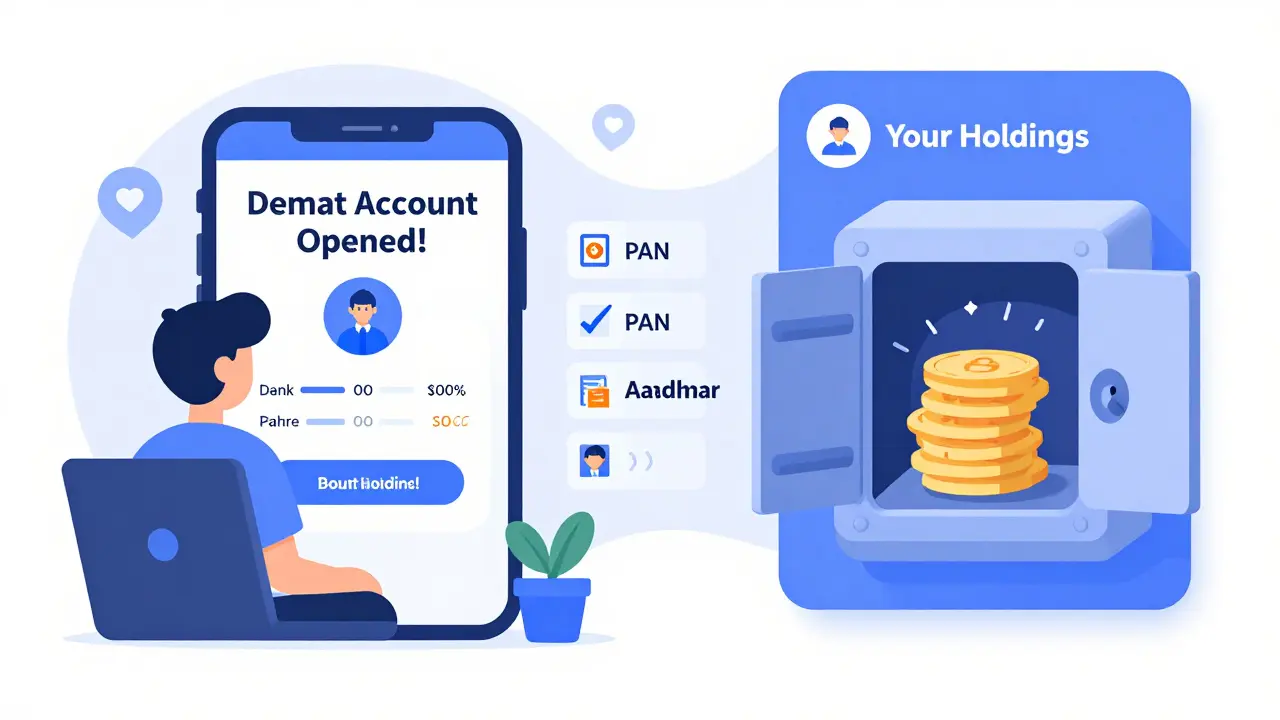
A Demat account - short for dematerialized - is an electronic account that holds your shares, bonds, mutual funds, and other securities in digital form. Before Demat accounts, people received physical share certificates. Imagine having a stack of paper documents for every stock you owned. You’d need to store them safely, mail them to sell, and wait weeks for transfers. That’s the old way. Today, everything happens online.
In India, Demat accounts are regulated by the Securities and Exchange Board of India (SEBI) and managed by two main depositories: National Securities Depository Limited (NSDL) and Central Depository Services Limited (CDSL). Brokers like Zerodha, Upstox, ICICI Direct, and Groww act as intermediaries between you and these depositories. You don’t open a Demat account directly with NSDL or CDSL. You go through a broker.
Think of it this way: your bank holds your rupees. Your Demat account holds your shares. And your trading account lets you buy and sell them. You need all three to start investing.
Why Do You Need a Demat Account in India?
You can’t buy or sell stocks on Indian exchanges like the NSE or BSE without a Demat account. That’s not a suggestion - it’s the law. SEBI made Demat mandatory in 2000 to reduce fraud, speed up settlements, and cut paper costs. Today, over 140 million Demat accounts are active in India, and the number grows every month.
Here’s what happens when you buy 10 shares of Reliance Industries:
- You place the order through your trading account.
- The money is debited from your linked bank account.
- The shares are credited to your Demat account within T+2 days (two business days after the trade).
No paperwork. No courier. No risk of losing certificates. And no one can forge your holdings. That’s the power of digitization.
How to Open a Demat Account in India
Opening a Demat account takes less than 15 minutes if you have your documents ready. Here’s how:
- Choose a broker. Popular ones include Zerodha (low fees), Upstox (user-friendly app), Groww (beginner-friendly), and ICICI Direct (full-service). Compare brokerage charges - some charge ₹0 for equity delivery trades, while others charge ₹20 per trade. Also check if they offer mutual funds, IPO access, and research tools.
- Gather your documents. You’ll need:
- Valid ID proof (Aadhaar card, PAN card, passport)
- Address proof (Aadhaar, utility bill, bank statement)
- Passport-sized photo
- Bank account details (for linking)
- Apply online. Go to your broker’s website or app. Click ‘Open Demat Account’. Fill in your personal details - name, date of birth, contact info.
- Complete KYC. Most brokers now do video KYC. You’ll need to show your PAN and Aadhaar to the camera. Some may ask you to sign a form digitally.
- Link your bank account. Enter your bank details. The broker will verify it through a small test transaction (usually under ₹10).
- Get your Demat ID. Within 24-48 hours, you’ll get an email with your Demat account number (starts with 12 digits) and your client ID. You’re ready to trade.
Some brokers offer free Demat account opening with zero annual maintenance charges (AMC) for the first year. After that, AMC is usually ₹300-500 per year - sometimes waived if you trade more than 3-4 times a month.
How to Use Your Demat Account
Once your account is active, here’s what you can do:
- Buy stocks - through your trading account, shares appear in your Demat account in T+2 days.
- Sell stocks - shares are debited from your Demat account and cash is credited to your bank.
- Hold IPOs - if you apply for an IPO, shares are directly credited to your Demat account upon allotment.
- Receive dividends - companies pay dividends directly to your linked bank account.
- Transfer shares - you can send shares to another Demat account using ISIN codes and DP IDs.
- View holdings - log in anytime to see your portfolio, transaction history, and tax documents.
You’ll also get monthly statements (e-statements) via email. These are legally valid and accepted by tax authorities. No need to print them.
Demat vs Trading Account: What’s the Difference?
People often confuse the two. Here’s the simple breakdown:
| Feature | Demat Account | Trading Account |
|---|---|---|
| Function | Stores your securities (shares, bonds, ETFs) | Places buy/sell orders on stock exchanges |
| What it holds | Digital shares | None - it’s a gateway |
| Who operates it | Depository Participant (broker) | Stockbroker |
| Used for | Safekeeping | Trading |
| Required? | Yes - mandatory | Yes - mandatory |
You need both. Think of the trading account as your shopping cart and the Demat account as your warehouse.
Common Mistakes New Investors Make
Even after opening a Demat account, many people make avoidable errors:
- Not linking a bank account - without this, you can’t transfer money to buy shares.
- Forgetting your DP ID and client ID - you’ll need these to transfer shares or raise complaints.
- Keeping too many Demat accounts - one is enough. Multiple accounts don’t give you benefits and cost more in AMC.
- Ignoring tax implications - short-term capital gains (holding under 1 year) are taxed at 15%. Long-term (over 1 year) is tax-free up to ₹1 lakh gain per year.
- Not checking broker charges - some brokers charge ₹15-20 per trade, others ₹0. Over time, this adds up.
Pro tip: Always download your contract notes after every trade. They’re your legal proof of purchase or sale.
Security and Risks
Demat accounts are secure - but not foolproof. Here’s how to stay safe:
- Use strong passwords and enable two-factor authentication (2FA).
- Never share your Demat login or OTP with anyone - even if they claim to be from your broker.
- Regularly check your holdings. If you see a stock you didn’t buy, report it immediately.
- Use only SEBI-registered brokers. Check their registration on the SEBI website.
- Don’t use public Wi-Fi to access your Demat account.
There’s no risk of losing your shares to broker bankruptcy. All Demat holdings are held in trust by NSDL or CDSL. Even if your broker shuts down, your shares remain safe.

What Can You Hold in a Demat Account?
It’s not just stocks. A Demat account can hold:
- Equity shares (like Tata Motors, Infosys)
- Exchange-Traded Funds (ETFs) - like Nifty 50 ETF
- Government and corporate bonds
- Mutual fund units (if bought directly through the fund house)
- Initial Public Offerings (IPOs)
- REITs and InvITs (real estate and infrastructure funds)
You can’t hold commodities (gold, silver) or currencies here. Those need separate accounts.
Next Steps After Opening
Now that you have your Demat account:
- Start small. Buy 1-2 shares of a company you understand - like HDFC Bank or Reliance.
- Learn the difference between delivery trading (buy and hold) and intraday (buy and sell same day).
- Set up SIPs in mutual funds through your Demat platform - it’s automatic investing.
- Follow financial news. Understand earnings reports and market trends.
- Don’t chase hot tips. Invest based on research, not Instagram influencers.
The Indian stock market has grown fast - from 10 million Demat accounts in 2015 to over 140 million today. You’re not late. You’re just getting started.
Can I open a Demat account without a PAN card?
No. A PAN card is mandatory for opening a Demat account in India. It’s required for KYC and tax reporting. If you don’t have one, apply for it through the NSDL or UTIITSL website - it takes 7-10 days.
Is there a minimum balance required in a Demat account?
No. Unlike bank accounts, Demat accounts don’t require a minimum balance. You can hold zero shares and still keep the account active. But if you don’t trade for over 18 months, some brokers may charge a dormancy fee.
Can I have two Demat accounts with the same broker?
No. SEBI rules allow only one Demat account per person per depository participant (broker). You can open accounts with different brokers, but there’s no benefit to doing so. It only increases your AMC costs.
How long does it take to transfer shares to another Demat account?
It takes 2-3 business days. You need to submit a Delivery Instruction Slip (DIS) or use the online transfer feature on your broker’s platform. The recipient’s Demat ID and DP ID are required. Always double-check these numbers - a wrong digit can delay the transfer.
Do I pay tax just for having a Demat account?
No. You only pay tax when you sell shares and make a profit. The Demat account itself doesn’t trigger any tax. But if you earn dividends over ₹5,000 in a year, they are taxable in your hands at your income tax slab rate.
Can NRIs open a Demat account in India?
Yes. Non-Resident Indians (NRIs) can open Demat accounts under the Portfolio Investment Scheme (PIS). They need to link it to an NRE or NRO bank account. The process is similar to residents, but brokers may ask for additional documents like visa copies and proof of overseas address.
Final Thoughts
A Demat account isn’t a fancy financial tool. It’s a basic necessity - like having a bank account if you want to use digital payments. If you’re serious about investing in India’s stock market, this is your starting line. Don’t wait for the perfect time. Don’t wait to know everything. Start with one share. Learn as you go. The market won’t wait for you - but your account can.