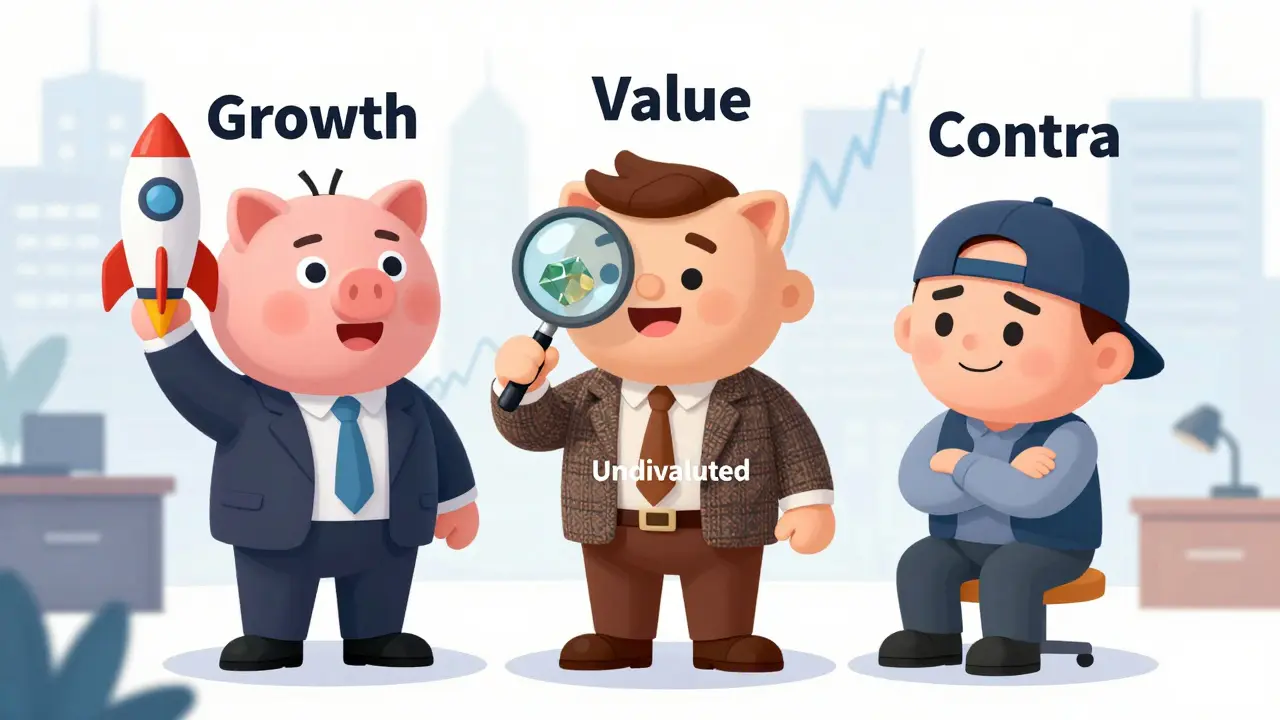
Contra vs Value vs Growth Funds in India: A Practical Guide for Investors
Walk into any financial advisor’s office in Mumbai or Bangalore, and you’ll hear the same three buzzwords thrown around like confetti at a wedding: Growth, Value, and increasingly, Contra. It sounds simple enough. You want your money to grow, right? So why does picking the right fund feel like solving a complex puzzle where the pieces keep changing shape?
The truth is, these aren’t just marketing labels. They represent fundamentally different philosophies on how to make money in the stock market. In the Indian context, where sentiment swings wildly between euphoria over tech startups and fear over global recession, understanding these styles isn’t just academic-it’s the difference between sleeping well at night and watching your portfolio tumble.
What Are These Investment Styles, Really?
To understand the battle of the funds, we first need to strip away the jargon. Think of these styles as different personalities at a dinner party. The Growth investor is the optimistic visionary who believes the future will be bigger and better than today. The Value investor is the pragmatic bargain hunter looking for diamonds in the rough. And the Contra investor? That’s the skeptic sitting in the corner, betting against the crowd because they believe everyone else is wrong.
Growth Funds focus on companies that are expanding faster than the average industry rate. Think of the early days of Reliance Industries when it pivoted to retail and telecom, or the explosion of digital payments with Paytm (before its recent struggles). These funds chase momentum. They buy stocks that are already going up, expecting them to go higher. The risk? If the growth slows down, the stock price can crash hard because expectations were sky-high.
Value Funds do the opposite. They look for companies that are trading below their intrinsic worth. Maybe the company had a bad quarter, or an entire sector is out of favor. The fund manager buys these "cheap" stocks, waiting for the market to realize their true value. This requires patience. Sometimes, a cheap stock stays cheap for years because the business model is actually broken. But when it works, the returns can be massive and less volatile than growth stocks.
Contra Funds are the newest kid on the block in India. Unlike value or growth, which are about *what* you buy, contra is about *when* and *why* you buy relative to the crowd. A contra fund manager actively avoids stocks that are popular, hyped, or overbought. Instead, they buy stocks that are ignored, hated, or temporarily out of favor due to negative news. The core belief is that markets are efficient only in the long run, but in the short term, they are driven by emotion-and emotions are often wrong.
The Case for Growth: Chasing the Sun
Growth investing has been the darling of the Indian middle class for the last decade. Why? Because India is a growing economy. We have a young population, rising disposable incomes, and a digital revolution. Companies like Tata Consultancy Services (TCS), Infosys, and newer players in the renewable energy space fit this mold perfectly.
When you invest in a growth fund, you are essentially betting on innovation and expansion. These funds typically hold stocks with high Price-to-Earnings (P/E) ratios. Yes, they are expensive. But if the company earns more next year, and the year after that, the high price looks justified.
However, there is a catch. Growth funds are highly sensitive to interest rates. When the Reserve Bank of India raises rates, borrowing becomes expensive for companies, and future earnings become less valuable in today’s terms. This causes growth stocks to sell off sharply. If you have a low tolerance for volatility, growth funds might keep you awake at night during market corrections.
The Case for Value: Buying the Dip
If growth is about chasing the sun, value is about finding shelter in the shade until the storm passes. Value funds have seen a resurgence in India recently, especially as the market corrected from its all-time highs. Fund managers like those at Quantum Long Short or traditional houses like ICICI Prudential have shifted focus to sectors that were previously unloved.
Consider the banking sector during the NBFC crisis of 2018-2019. While panic sold off bank stocks, value investors saw banks with strong balance sheets trading at historic lows. They bought. Two years later, those stocks delivered multi-bagger returns. This is the power of value: buying quality at a discount.
But value investing requires a specific temperament. You need to be comfortable holding a stock that underperforms the broader market for months, even years. There is a concept called "value trap," where a stock looks cheap but continues to decline because the underlying business is deteriorating. Distinguishing between a temporary setback and a permanent decline is the hardest skill in value investing.

The Rise of Contra: Betting Against the Crowd
This is where things get interesting. Contra funds are not just "value" funds with a fancy name. While value focuses on fundamentals (is the stock cheap?), contra focuses on sentiment (is the stock hated?). A stock can be fairly priced but still be a great contra pick if the market sentiment is overly negative.
In India, contra funds gained prominence as the market became crowded in certain themes like EVs, renewables, and PSUs. When everyone is buying the same stocks, valuations stretch beyond reason. Contra fund managers step in and buy the losers-the stocks that missed earnings targets, faced regulatory hurdles, or are in cyclical downturns.
For example, during the peak of the PSU rally in 2023-2024, many private sector stocks were ignored. A contra fund would have avoided the overheated PSU stocks and accumulated shares in private companies that were undervalued simply because they weren't "in fashion." When the rotation happened, these funds outperformed significantly.
The key metric for contra funds is often the "crowdedness" of a trade. If a stock is held by too many institutions, it’s vulnerable to a stampede exit. Contra funds avoid these crowded trades and seek safety in obscurity.
Head-to-Head: How Do They Compare?
Let’s break down the differences in a way that helps you decide. It’s not just about returns; it’s about risk, time horizon, and market conditions.
| Feature | Growth Funds | Value Funds | Contra Funds |
|---|---|---|---|
| Core Philosophy | Buy winners that will keep winning | Buy undervalued assets | Buy what others hate/sell |
| Risk Profile | High (Volatility) | Medium (Value Traps) | Medium-High (Sentiment Risk) |
| Best Market Condition | Bull Markets, Low Interest Rates | Corrective Phases, Stable Economy | Irrational Exuberance, Crowded Trades |
| Typical Holdings | Tech, Consumer Discretionary, New Age | Banking, Infrastructure, Commodities | Out-of-favor sectors, Small/Mid caps |
| Patience Required | Low-Medium (Momentum driven) | High (Mean reversion) | Medium (Sentiment shift) |

Which Style Fits Your Portfolio?
There is no single "best" style. Even the greatest investors in history struggled with timing. Warren Buffett is a value investor, but he bought Apple-a growth stock-because it offered value at that entry point. Peter Lynch mixed both. The key is alignment with your goals.
If you are a young professional with a 15-year horizon and a high risk appetite, growth funds can deliver compounding magic. You can ride out the volatility because you know India’s long-term trajectory is upward. However, don’t put all your eggs in one basket. Pure growth portfolios can suffer drawdowns of 30% or more during recessions.
If you are nearing retirement or prefer steady wealth preservation, value funds offer a margin of safety. You are buying assets for less than they are worth, which limits downside risk. The returns may not be flashy every year, but they tend to be consistent over decades.
Contra funds are best used as a satellite allocation. They work exceptionally well in markets dominated by speculation, which Indian markets have experienced in recent years. Adding 10-20% of your portfolio to a contra fund can act as a hedge against bubble bursts. When the crowd panics and sells, the contra fund manager is likely buying, positioning the fund for the next upcycle.
The Hybrid Approach: Why You Don’t Have to Choose
Most successful investors don’t stick to one pure style. They blend them. This is known as a "multi-cap" or "flexi-cap" approach, but you can build your own hybrid.
Imagine a portfolio split 50% in a diversified large-cap fund (which naturally mixes growth and value), 30% in a focused growth fund targeting emerging sectors, and 20% in a contra/value fund to provide stability. This diversification ensures that when growth is hot, you participate. When value shines, you benefit. And when sentiment turns irrational, your contra allocation protects you.
Remember, market cycles repeat. What works in 2024 might fail in 2026. By understanding the mechanics of each style, you stop reacting to noise and start making strategic decisions. You’re not just buying funds; you’re buying exposure to specific economic behaviors. And in the chaotic beauty of the Indian market, that clarity is your greatest asset.
Are Contra funds risky?
Yes, Contra funds carry risk. Since they bet against market sentiment, if the market remains irrational longer than expected, the fund can underperform significantly. They require a medium-term horizon (3-5 years) to allow sentiment to correct. They are not suitable for short-term trading.
Can I invest in Growth and Value funds simultaneously?
Absolutely. In fact, it’s recommended. Allocating to both styles helps smooth out volatility. When growth stocks fall, value stocks often rise, and vice versa. This correlation helps maintain portfolio stability during market transitions.
Which style performed better in India in 2025?
In 2025, as interest rates stabilized and inflation cooled, Value and Contra funds saw a resurgence after a few years of Growth dominance. Sectors like banking and infrastructure led the charge, benefiting value-oriented portfolios. However, past performance is not indicative of future results.
Is a Contra fund the same as a Short Selling strategy?
No. Mutual funds in India generally cannot short sell stocks directly. Contra funds achieve their goal by avoiding overvalued stocks and heavily overweighting undervalued, unpopular stocks. They make money by holding assets that appreciate as sentiment improves, not by profiting from immediate price drops.
How much should I allocate to each style?
It depends on your risk profile. A common rule of thumb is 60% Core (Large Cap/Flexi Cap), 20% Growth (for alpha), and 20% Value/Contra (for defense). Adjust these percentages based on your age, income stability, and market outlook. Younger investors might lean heavier into growth.