ELSS Lock-in Period in India: Why the 3-Year Restriction Makes It Unique
Most investment options in India let you pull your money out anytime. But ELSS mutual funds? You can’t touch them for three years. That’s not a bug - it’s the whole point. If you’re looking to save tax under Section 80C and still want market-linked returns, ELSS is the only instrument that forces you to stay invested. And that’s exactly why it works better than fixed deposits, PPF, or even NSC for long-term wealth building.
What Exactly Is the ELSS Lock-in Period?
ELSS stands for Equity Linked Savings Scheme. It’s a type of mutual fund that invests mostly in stocks. In return for taking on market risk, you get two big perks: the potential for high returns and a tax break under Section 80C of the Income Tax Act. But here’s the catch - once you invest, your money is locked in for exactly three years from the date of each purchase.
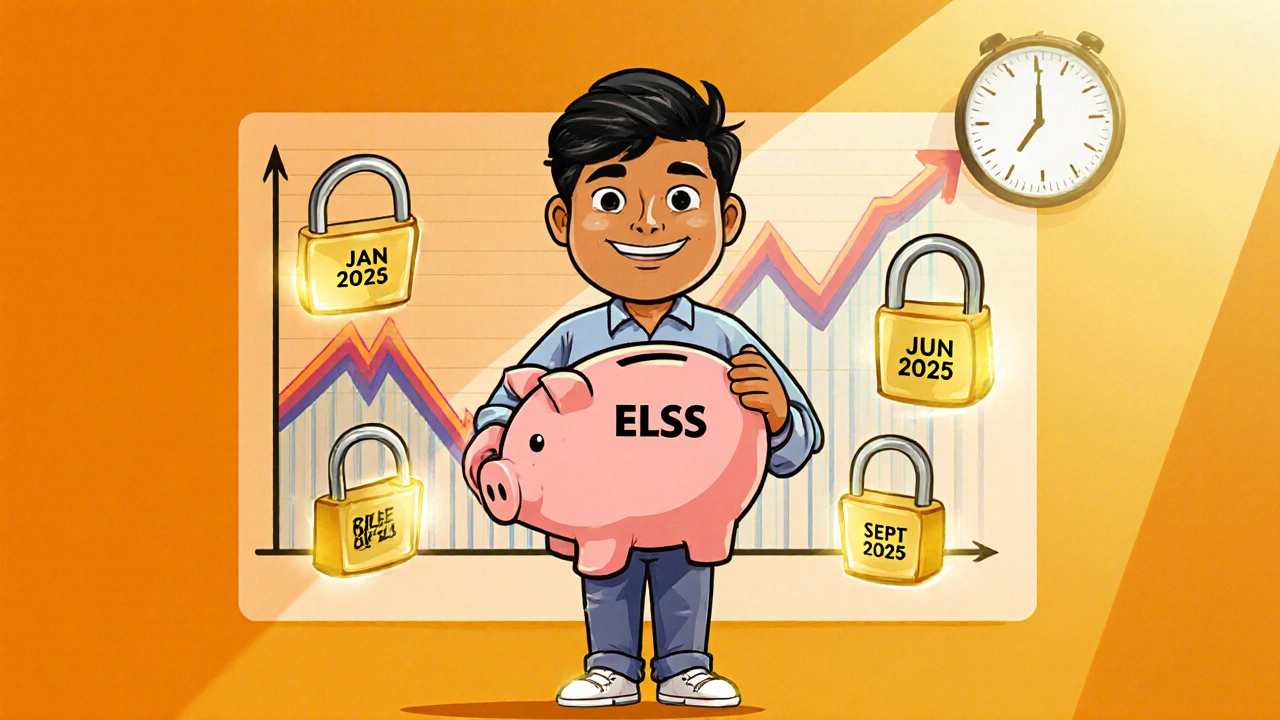
That means if you invest ₹50,000 in January 2025, you can’t withdraw any of it until January 2028. If you make another ₹20,000 investment in June 2025, that chunk gets locked until June 2028. Each SIP installment has its own lock-in clock. This isn’t like PPF, where the entire account locks for 15 years. ELSS locks each unit individually. It’s flexible, but only if you understand how it works.
Why Three Years? The Logic Behind the Rule
Why not two years? Or five? The three-year lock-in wasn’t chosen randomly. It was designed to balance two goals: encouraging long-term investing and keeping the tax benefit from being abused.
Before ELSS came along, people would park money in fixed deposits or insurance policies just to claim tax deductions - then cash out right after the deduction. That didn’t help the stock market grow. The government wanted investors to stay in equities long enough to ride out volatility. Three years is the sweet spot: long enough to smooth out market cycles, short enough to feel manageable.
Studies from the Association of Mutual Funds in India (AMFI) show that investors who stay in ELSS beyond the lock-in period see returns that are 2-3 times higher than those who exit right at three years. The real gains come after year five. The lock-in isn’t meant to trap you - it’s meant to train you.
How ELSS Compares to Other Section 80C Options
Section 80C lets you claim up to ₹1.5 lakh in tax deductions every year. You can split it across multiple instruments: PPF, NSC, life insurance, tuition fees, home loan principal, and more. But here’s the problem - most of them don’t grow your money the way ELSS does.
Take PPF. It’s safe. It gives you around 7.1% interest (as of 2025). But it locks your money for 15 years. You can withdraw partial amounts after year 7, but you can’t fully exit until the end. That’s great for conservative savers, terrible if you want growth.
NSC? Fixed returns, 5-year lock-in. Life insurance policies? High fees, low returns, complex terms. Fixed deposits? Taxable interest, no capital appreciation. ELSS is the only one that gives you exposure to the stock market, tax savings, and a reasonable lock-in period - all in one.
Here’s how they stack up:
| Instrument | Lock-in Period | Average Annual Return | Risk Level | Best For |
|---|---|---|---|---|
| ELSS | 3 years | 12-15% | High | Growth-focused investors |
| PPF | 15 years | 7-7.5% | Low | Retirees, risk-averse savers |
| NSC | 5 years | 7-7.5% | Low | Conservative tax savers |
| FD (Tax-saving) | 5 years | 6-7% | Low | Zero-risk seekers |
| Life Insurance (ULIP) | 5 years | 5-8% | Moderate | Those needing insurance |
ELSS doesn’t just win on returns - it wins on flexibility. You can start with as little as ₹500 a month. You can stop SIPs anytime. And once the lock-in ends, you can switch to another fund or keep growing your corpus. No other 80C option gives you that combo.

What Happens After the Lock-in Ends?
Many investors panic when their three years are up. They think, “I’ve saved tax - now I should cash out.” But that’s often the worst move.
Here’s the truth: the real power of ELSS isn’t in the tax break. It’s in compounding. If you invest ₹10,000 a month for 10 years in an ELSS fund averaging 13% returns, you’ll end up with over ₹23 lakh. If you stop after three years and just leave that money alone, it’ll grow to nearly ₹11 lakh by year 10 - even without adding more.
That’s why smart investors keep their ELSS funds running. They treat the lock-in as a forced discipline, not a deadline. After three years, they don’t withdraw - they rebalance. Maybe they shift part of it to a large-cap fund or move into a debt fund as they near a goal. But they never just pull the plug.
Common Mistakes People Make With ELSS
Even experienced investors mess up with ELSS. Here are the top three mistakes:
- Chasing last year’s top performer - ELSS funds change managers, strategies, and portfolios. A fund that returned 22% last year might return 6% this year. Pick based on consistency, not hype.
- Investing right before the lock-in ends - If you invest ₹1.5 lakh on March 30, you’re locking it in for three years. But you’re also missing out on the full year’s growth. Start early. Spread it out.
- Ignoring exit loads - Most ELSS funds charge a 1% exit load if you redeem within a year after lock-in ends. Wait at least 13-14 months after lock-in to avoid it.
Also, don’t confuse ELSS with regular equity funds. They look similar. But only ELSS qualifies for Section 80C. If you’re not claiming tax savings, you’re better off picking a direct equity fund with lower expense ratios.

Who Should Invest in ELSS?
ELSS isn’t for everyone. But it’s perfect for:
- People in the 20-35 age group who want to build wealth fast
- Salaries above ₹8 lakh/year who pay 20%+ tax and want to reduce liability
- Those who understand that markets go up and down - and aren’t scared by short-term dips
- Anyone who already has emergency savings and wants to start investing in equities
If you’re close to retirement, or you need the money in the next 2-3 years, skip ELSS. Stick to fixed deposits or PPF. But if you’re young, earning, and willing to ride out volatility, ELSS is the most efficient tax-saving tool you have.
How to Start Investing in ELSS
Getting started is simple:
- Choose a fund - Look for funds with 5+ years of consistent performance, low expense ratio (below 1.5%), and a strong fund house (like Axis, ICICI Prudential, or SBI).
- Decide on mode - SIP (recommended) or lump sum? SIPs reduce timing risk and make discipline easier.
- Complete KYC - If you haven’t done it yet, upload your PAN and address proof online. Takes 10 minutes.
- Invest - Use platforms like Groww, Zerodha, or directly through the fund house’s website.
- Track - Use your demat or mutual fund app to see your holdings and lock-in dates.
Pro tip: Set up auto-debit. Don’t think about it. Just let it happen. The lock-in will do the rest.
Final Thought: The Lock-in Is Your Advantage
Most people hate restrictions. They want freedom. But in investing, freedom is dangerous. The three-year lock-in in ELSS isn’t a punishment - it’s a gift. It stops you from panicking during market crashes. It stops you from chasing trends. It forces you to think long-term.
That’s why ELSS outperforms other tax-saving options - not because it’s risk-free, but because it makes you stick around long enough to win.
Can I withdraw money from ELSS before 3 years?
No. ELSS has a mandatory lock-in period of exactly three years from the date of each investment. Early withdrawal is not allowed, even in emergencies. This rule is enforced by the fund house and the AMC (Asset Management Company). If you try to redeem before the lock-in ends, the transaction will be rejected.
Is ELSS better than PPF for tax saving?
It depends on your goals. If you want safety and guaranteed returns, PPF is better. If you want higher growth potential and shorter lock-in, ELSS wins. PPF locks your money for 15 years, while ELSS locks each installment for only 3 years. ELSS also has historically higher returns - around 12-15% annually vs. PPF’s 7-7.5%. But ELSS comes with market risk. Choose PPF if you’re risk-averse; choose ELSS if you’re investing for long-term wealth.
Do I need to reinvest after the lock-in ends?
No, you’re not required to reinvest. You can withdraw your entire amount after the lock-in period ends. But reinvesting - or at least leaving the money in the fund - is usually smarter. The power of compounding works best over time. Many investors who withdraw right after three years miss out on the bulk of their gains, which typically happen between years 5 and 10.
Can I invest more than ₹1.5 lakh in ELSS?
Yes, you can invest any amount in ELSS. But only the first ₹1.5 lakh per financial year qualifies for tax deduction under Section 80C. Any amount above that is treated like a regular equity mutual fund - no tax benefit, but still eligible for market returns. So you can invest ₹5 lakh, but only ₹1.5 lakh reduces your taxable income.
Are ELSS returns tax-free after lock-in?
The gains from ELSS are tax-free if held for more than one year after the lock-in ends. Long-term capital gains (LTCG) above ₹1 lakh in a financial year are taxed at 10%. But since ELSS funds are equity-oriented, they benefit from the LTCG exemption on the first ₹1 lakh. So if your gains are under ₹1 lakh, you pay zero tax. That makes ELSS one of the most tax-efficient investment options in India.