
Free Float vs Total Market Cap in India: How NIFTY 50 Indices Are Constructed
Have you ever looked at the NIFTY 50 and wondered why a massive company like Reliance Industries holds such a dominant position, while other huge firms seem to have less influence? It’s not just about who has the most money. The answer lies in a specific calculation method that filters out shares you can’t actually buy or sell. This is the difference between Total Market Capitalization and Free Float Market Capitalization.
If you are trying to understand how Indian stock indices work, you need to grasp this distinction. It changes everything from how benchmarks are calculated to how your mutual fund performs. Let’s break down exactly how these metrics differ and why the National Stock Exchange (NSE) chose one over the other for its flagship index.
The Core Difference: What Can You Actually Trade?
To get started, let’s look at the two main concepts. Total Market Capitalization is simply the total value of all outstanding shares of a company. If a company has 1 billion shares and each trades at ₹100, the total market cap is ₹100 billion.
Free Float Market Capitalization, on the other hand, only counts the shares available for public trading. It excludes shares held by promoters, government bodies, strategic investors, or locked-in shares. These restricted shares aren't part of the daily liquidity pool. Since an index is meant to be investable-meaning you should theoretically be able to replicate it by buying the underlying stocks-it makes sense to ignore shares that aren't for sale.
Think of it like a restaurant. Total market cap is the entire building, including the kitchen and storage rooms where customers don't go. Free float is the dining area where people actually sit and order food. If you want to measure customer traffic, you only care about the seats available in the dining area.
How NIFTY 50 Uses Free Float Weighting
The NIFTY 50 is the benchmark index for the Indian equity market. Managed by India Index Services and Products (IISL), a joint venture between NSE and S&P Dow Jones Indices, it tracks the top 50 companies listed on the NSE based on free float market capitalization.
Here is how the weighting works step-by-step:
- Calculate Free Float: Determine the percentage of shares available for public trade. For example, if a company has 100 crore shares but the promoter holds 51 crore, the free float is 49%.
- Apply Market Price: Multiply the number of freely floating shares by the current market price.
- Determine Weight: Divide the company's free float market cap by the total free float market cap of all 50 stocks in the index.
This means that even if Company A has a higher total market cap than Company B, Company B might have a higher weight in the NIFTY 50 if Company A has very few publicly tradable shares. This prevents illiquid stocks from distorting the index performance.
Why Not Use Total Market Cap?
You might ask, why not just use total market cap? It seems simpler. The problem is investability. An index should represent what an investor can actually buy. If a large portion of a company’s shares are locked with the government or founders, those shares won't react to daily supply and demand dynamics in the same way.
Using total market cap could lead to significant tracking errors for passive funds. If a fund tries to replicate an index weighted by total market cap, it would have to hold shares it cannot easily buy or sell, leading to liquidity issues and higher costs. Free float weighting ensures the index remains a realistic benchmark for portfolio performance.
| Feature | Total Market Cap | Free Float Market Cap |
|---|---|---|
| Definition | Total value of all outstanding shares | Value of only publicly tradable shares |
| Includes Promoter Shares? | Yes | No |
| Liquidity Reflection | Poor | High |
| Used in NIFTY 50? | No | Yes |
| Best For | Theoretical valuation | Investment benchmarking |
The Role of Capping and Adjustments
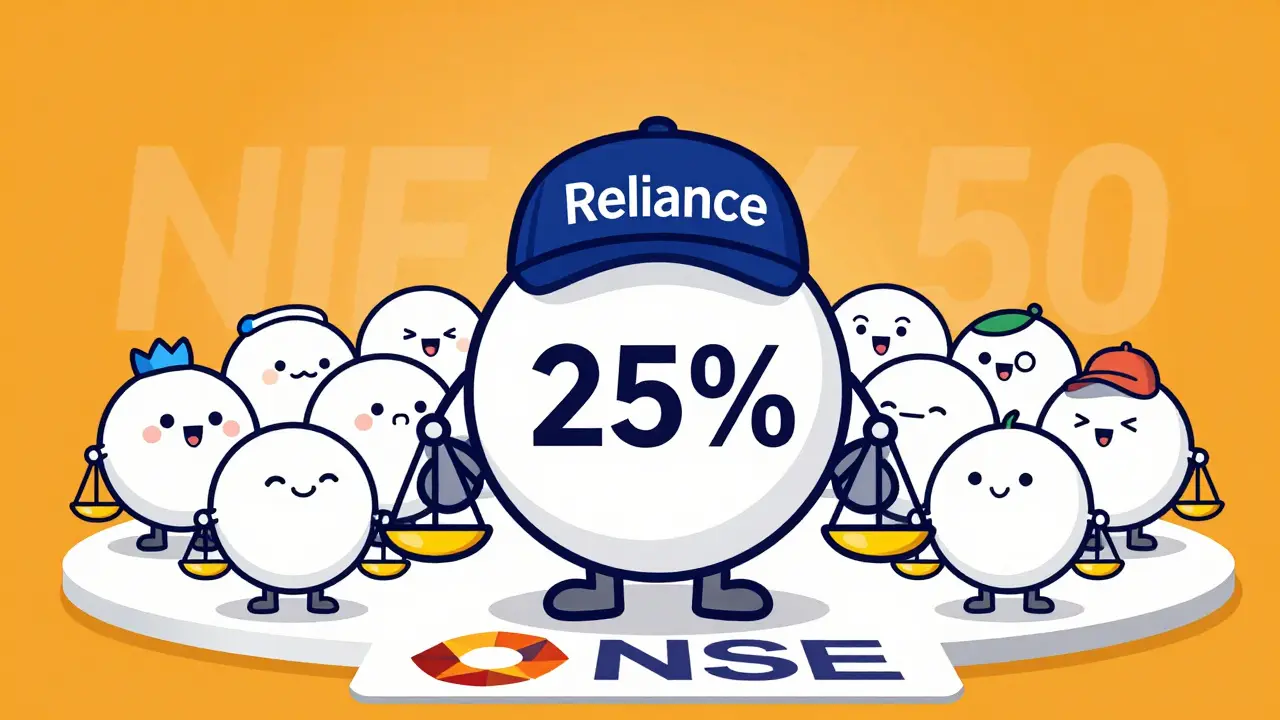
Even with free float weighting, the NIFTY 50 applies additional rules to prevent any single stock from dominating too much. This is known as capping. Currently, the maximum weight for a single constituent in the NIFTY 50 is capped at 25%. This rule was introduced to reduce concentration risk.
For instance, if Reliance Industries’ free float market cap naturally calculates to 30% of the index, it will be artificially reduced to 25%, and the excess weight is distributed among other constituents. This ensures diversification and prevents the index from behaving too much like a single-stock bet.
IISL also adjusts the free float factor periodically. If a company announces a lock-in period expiry or a change in promoter holding, the free float percentage is updated. This happens quarterly during the rebalancing process, ensuring the index reflects current ownership structures.
Impact on Investors and Mutual Funds
Understanding free float matters because most index funds and ETFs in India track the NIFTY 50. When you buy a Nifty BeES ETF or a Nifty 50 Index Fund, you are buying a basket of stocks weighted by their free float market cap.
This means your exposure to volatile, highly liquid stocks will be higher than to stable but illiquid ones. It also explains why small movements in heavyweight stocks like HDFC Bank or Infosys can swing the entire index. These companies have large free floats, so their prices heavily influence the benchmark.
For active fund managers, knowing the free float structure helps in identifying mispricings. If a stock has a low free float but high demand, its price might be inflated relative to its fundamental value. Conversely, a stock with a high free float might be undervalued if institutional investors avoid it due to perceived lack of growth.

Other Indices and Variations
While NIFTY 50 uses free float, not all indices do. Some sectoral indices or thematic baskets might use equal weighting or price weighting. However, major broad-market indices globally, including the S&P 500 in the US and FTSE 100 in the UK, also use free float adjustments. This creates a global standard for comparing markets.
In India, the BSE Sensex also uses free float market capitalization for its weighting scheme. Both NIFTY 50 and Sensex generally move in tandem because they share many of the same large-cap constituents. However, differences in free float percentages for specific stocks can cause slight divergence in performance.
Common Misconceptions About Market Cap
A common mistake is assuming that a higher total market cap always means a larger index weight. As discussed, this isn't true. Another misconception is that free float is static. It changes frequently based on corporate actions like bonus issues, rights issues, or block deals.
Also, some investors confuse "float" with "liquidity." While related, they are not identical. A stock can have a large free float but still trade thinly if there is low interest. Conversely, a stock with a smaller free float might be highly liquid if it attracts significant speculative trading. Indices rely on the former, but traders watch both.
Conclusion: Why This Matters for Your Portfolio
Knowing the difference between free float and total market cap helps you read the market more accurately. It explains why certain stocks dominate the news and the index, while others remain hidden. For anyone investing in India, understanding how the NIFTY 50 is constructed provides a clearer picture of market health and individual stock impact.
Next time you see the NIFTY 50 move, remember it’s not just about the biggest companies. It’s about the biggest companies whose shares are actually up for grabs in the open market.
What is the formula for free float market cap?
The formula is: Number of Publicly Tradable Shares × Current Share Price. To find the number of publicly tradable shares, subtract promoter holdings, government stakes, and other locked-in shares from the total outstanding shares.
Does NIFTY 50 include all large-cap stocks?
No, it includes the top 50 companies by free float market capitalization. There are hundreds of large-cap stocks in India, but only the largest 50 make it into the NIFTY 50 index.
How often is the NIFTY 50 rebalanced?
The NIFTY 50 is reviewed semi-annually, typically in May and November. During these reviews, IISL assesses eligibility and adjusts weights based on current free float data.
Can a stock have a higher weight than its total market cap suggests?
Yes. If a company has a relatively small total market cap but a very high percentage of free float compared to peers, its index weight might be disproportionately high relative to its size.
Who manages the NIFTY 50 index?
The NIFTY 50 is managed by India Index Services and Products (IISL), which is a joint venture between the National Stock Exchange of India (NSE) and S&P Dow Jones Indices.