
Mutual Fund Exit Load and Lock-in Periods in India: A Complete Guide for Investors
You put your hard-earned money into a mutual fund, watch it grow for six months, and then decide you need the cash. You click 'redeem,' expecting an instant transfer. Instead, you see a small deduction from your total amount. That’s not a system error. It’s called an exit load. But wait-what if you can’t redeem at all? What if your money is stuck for three years? That’s a lock-in period.
In the Indian mutual fund landscape, these two concepts are the gatekeepers of your liquidity. They protect the fund manager from sudden withdrawals that could destabilize the portfolio, but they also restrict your access to capital. Understanding the difference between a penalty fee (exit load) and a mandatory waiting time (lock-in) is crucial before you invest a single rupee.
The Difference Between Exit Loads and Lock-ins
Many new investors confuse exit loads with lock-in periods because both feel like barriers to getting your money back. However, they work on completely different principles.
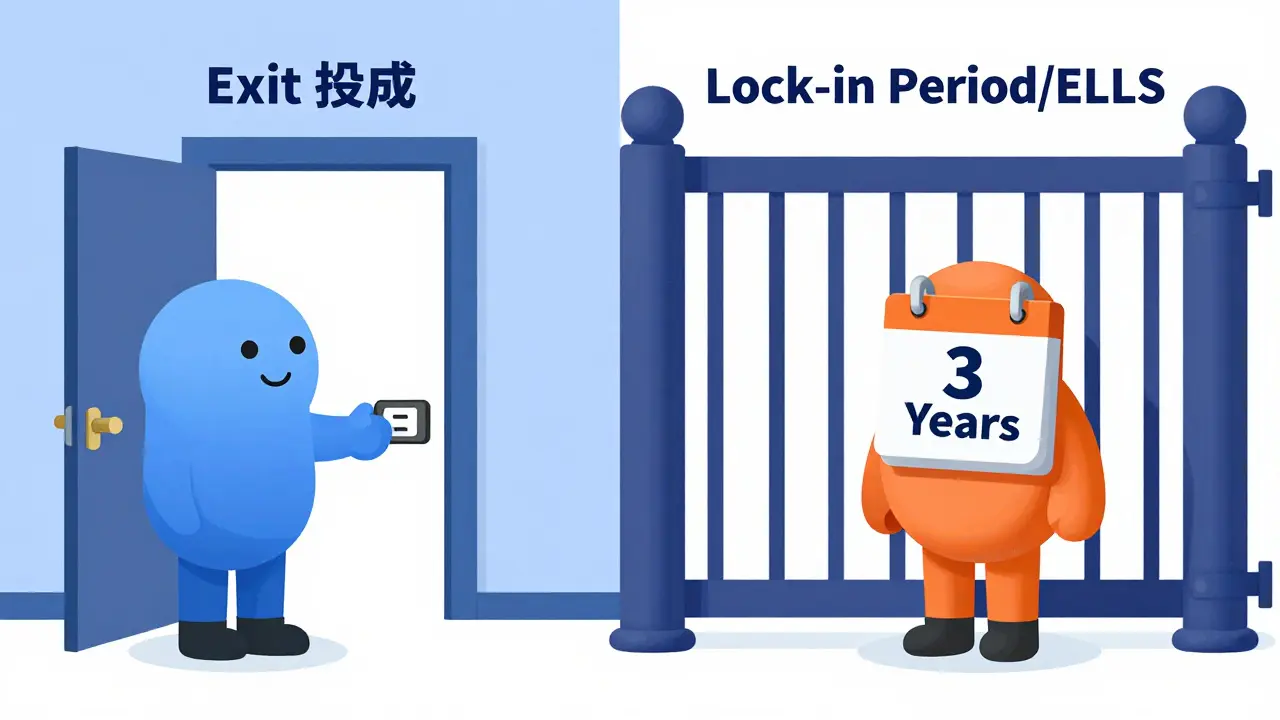
An exit load is a fee. You pay it to leave early, but you still get your money. Think of it like breaking a lease on an apartment; you pay a penalty, but you move out immediately. A lock-in period is a restriction. You cannot withdraw your money until a specific date passes, regardless of how much you are willing to pay. This is more like a fixed-term deposit where the bank won’t let you touch the principal until maturity.
| Feature | Exit Load | Lock-in Period |
|---|---|---|
| Definition | A percentage fee charged on redemption | A mandatory holding period before withdrawal |
| Liquidity | Immediate (after paying fee) | Blocked until period ends |
| Applicable Funds | Most equity and hybrid funds | ELSS, Retirement Funds, Children's Funds |
| Regulatory Limit | Max 2% (SEBI cap) | Varies by scheme type (1-5 years) |
| Purpose | Deter short-term speculation | Ensure long-term commitment/Tax benefit |
How Exit Loads Work in Indian Mutual Funds
The Securities and Exchange Board of India (SEBI) introduced exit loads in 2010 to curb frequent switching by investors. Before this, many people treated mutual funds like trading stocks, buying and selling within days. This churn hurt long-term holders because the fund manager had to sell assets at unfavorable prices to meet redemption requests.
Today, most open-ended equity funds in India charge an exit load if you redeem your units within a specified window. The standard structure looks like this:
- Equity Funds: Typically 1% if redeemed within 1 year. Some aggressive growth funds may charge 0.5% for redemptions within 6 months.
- Hybrid/Balanced Funds: Usually 1% if redeemed within 1 year.
- Debt Funds: Often 0.25% to 0.50% if redeemed within 30 to 90 days. Short-duration funds have lower exit loads because their underlying assets are more liquid.
- Index Funds: Generally lower, around 0.1% to 0.5% within 30 days, as tracking errors are minimal.
It is important to note that the exit load is calculated on the Net Asset Value (NAV) of the units redeemed, not your original investment amount. If your investment has grown significantly, the absolute value of the exit load will be higher, even though the percentage remains the same.
Understanding Lock-in Periods
While exit loads are financial disincentives, lock-in periods are structural constraints. These are primarily found in tax-saving instruments and goal-based funds.
The most common example is the Equity Linked Savings Scheme (ELSS, which is a tax-saving mutual fund category under Section 80C of the Income Tax Act). ELSS funds have a strict three-year lock-in period. This is the shortest lock-in among all tax-saving options in India, making them popular for investors who want liquidity sooner than Public Provident Fund (PPF) or National Pension System (NPS) accounts allow.
Beyond ELSS, other schemes with lock-ins include:
- Retirement Funds: These typically have a lock-in until the investor reaches the age of 58 or 60. Partial withdrawals may be allowed after a certain period, but full redemption is restricted.
- Children’s Funds: Designed to build a corpus for education or marriage, these usually lock in until the child turns 18 or 21.
- Closed-Ended Funds: Unlike open-ended funds, these have a fixed tenure (e.g., 3 years, 5 years). You cannot redeem during the tenure unless there is a secondary market listing, which is rare and often illiquid.
Calculating Your Actual Returns After Exit Loads
Before you redeem, do the math. An exit load eats into your returns, especially if you have held the fund for a short period. Here is a simple way to visualize the impact.
Imagine you invested ₹1,00,000 in an equity fund. After 8 months, the NAV appreciates by 15%. Your current value is ₹1,15,000. The fund charges a 1% exit load for redemptions within one year.
Exit Load Amount = ₹1,15,000 × 1% = ₹1,150. Net Redemption Amount = ₹1,15,000 - ₹1,150 = ₹1,13,850.
Your effective return drops from 15% to approximately 13.85%. While this might seem small, in high-frequency trading scenarios, these costs compound rapidly. For debt funds, where annual returns might only be 7-8%, a 0.5% exit load represents a significant chunk of your profit if you exit too early.
Exceptions and Special Cases
Not all redemptions attract exit loads. There are specific scenarios where you can withdraw without penalty:
- Systematic Withdrawal Plans (SWP): Most funds waive exit loads for SWP transactions, provided the withdrawal amount is consistent and scheduled. Check the scheme information document (SID) for specifics.
- Switching Within the Same Fund House: If you switch from one scheme to another within the same asset management company (AMC), exit loads are often waived. This is beneficial if you want to change strategy without incurring fees.
- Death of Unit Holder: In unfortunate events, exit loads and lock-in periods are typically waived for legal heirs upon submission of necessary documentation.
- Specific Debt Categories: Overnight funds and liquid funds generally have no exit load, as they are designed for immediate liquidity.

Strategic Advice for Investors
Knowing the rules is one thing; using them to your advantage is another. Here is how to navigate exit loads and lock-ins effectively.
Align Investment Horizon with Fund Type. If you need money in less than a year, avoid equity funds with 1% exit loads. Stick to liquid funds or arbitrage funds. If you are investing for retirement, ignore the exit load-it becomes negligible over a 15-year period.
Use ELSS for Tax Saving, Not Just Returns. Since ELSS has a 3-year lock-in, treat it as a forced savings mechanism. Do not invest money you might need for an emergency. The lock-in protects you from yourself, preventing panic selling during market dips.
Read the Scheme Information Document (SID). Every mutual fund scheme publishes an SID that details the exit load structure and lock-in periods. This document is legally binding. Never assume; always verify. The exit load terms can change, though AMCs must notify existing investors.
Consider the Cost of Waiting. Sometimes, paying a 1% exit load is cheaper than missing out on a bull run. If the market is rallying and you urgently need cash, calculate whether the potential future gains outweigh the immediate penalty. However, this should be a last resort, not a strategy.
Common Mistakes to Avoid
One major mistake investors make is ignoring the compounding effect of exit loads on SIPs. If you have been running a Systematic Investment Plan (SIP) for two years and suddenly stop, redeeming all accumulated units, you will face exit loads on every installment redeemed within the specified window. This can erode a significant portion of your wealth.
Another pitfall is confusing 'maturity' with 'lock-in.' In closed-end funds, the maturity date is when the fund dissolves and returns capital. In open-end funds with lock-ins (like ELSS), the lock-in applies per unit. Each SIP installment in an ELSS has its own 3-year clock. You can redeem the first installment after 3 years, while the latest one is still locked. This rolling lock-in provides partial liquidity over time.
What is the maximum exit load allowed by SEBI?
SEBI caps the exit load for equity-oriented mutual funds at a maximum of 2%. However, most funds charge between 0.5% and 1% for redemptions within 1 year. Debt funds typically have lower caps, often ranging from 0.25% to 0.50%.
Does a Systematic Withdrawal Plan (SWP) attract exit load?
In most cases, no. Many asset management companies waive exit loads for SWP transactions to encourage regular income planning. However, this varies by scheme, so you must check the specific terms in the Scheme Information Document (SID).
Can I break the lock-in period of an ELSS fund in an emergency?
No, the 3-year lock-in period for ELSS is strict and non-negotiable. There are no provisions for early redemption due to emergencies. This makes ELSS unsuitable for emergency funds. Only use surplus cash that you can afford to park for three years.
How is the exit load calculated?
The exit load is calculated as a percentage of the Net Asset Value (NAV) of the units being redeemed at the time of exit. It is not based on your initial investment amount. For example, if you redeem units worth ₹10,000 and the exit load is 1%, you will pay ₹100, receiving ₹9,900.
Do index funds have exit loads?
Yes, but they are usually lower than actively managed funds. Index funds often charge an exit load of 0.1% to 0.5% if redeemed within 30 days. This is because index funds have lower turnover and operational costs, allowing them to offer better liquidity terms.