NPS Annuity Options in India: Picking the Best Pension Plan for Retirement
The Big Picture: How the NPS Exit Works
Before picking a plan, you need to understand the math. When you hit the age of 60 (or your chosen retirement age), the NPS allows you to withdraw up to 60% of your total accumulated wealth as a tax-free lump sum. The remaining 40% must be invested in an Annuity, which is a financial product that converts a lump sum payment into a guaranteed stream of income. This is the part that keeps most retirees awake at night because once you sign that contract with an Annuity Service Provider (ASP), you usually can't go back and change your mind.
If your total corpus is small-specifically, if the total value is less than 5 lakh rupees-you can actually opt to withdraw the entire amount. But for most, the 60/40 split is the law of the land. The goal here isn't just to get a check every month; it's to ensure that the monthly amount covers your electricity, groceries, and healthcare without eating into your emergency savings.
Breaking Down Your Annuity Choices
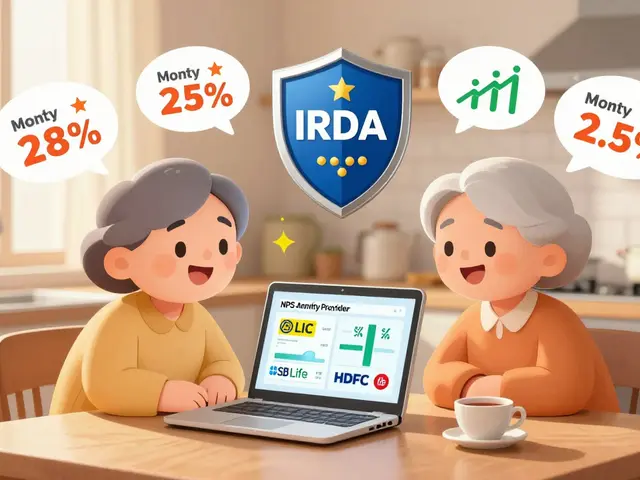
Not all pensions are created equal. Depending on whether you want to leave a legacy for your kids or maximize your own monthly spending, your choice will differ. Here are the most common options offered by providers like LIC of India or HDFC Life.
- Annuity for Life: This is the simplest version. You get a fixed amount every month for as long as you live. The moment you pass away, the payments stop. This usually offers the highest monthly payout because the insurance company doesn't have to worry about paying anyone else after you're gone.
- Life Annuity with Return of Purchase Price (ROP): This is the most popular choice in India. You get a monthly pension for life, and when you pass away, the original amount you used to buy the annuity (the 40% corpus) is returned to your nominees. The trade-off? Your monthly pension will be slightly lower than the "Life Only" option because the company has to save up that lump sum for your heirs.
- Joint Life Annuity: This is designed for couples. The pension is paid to the subscriber for life, and after their death, it continues to be paid to the spouse. This provides a safety net so the surviving partner isn't left without income.
- Annuity Certain for a Period: You get payments for a fixed number of years (say 10 or 15). If you pass away during this period, the remaining payments still go to your nominee. After the period ends, the payments stop regardless of whether you are alive or not.
Comparing Annuity Options Side-by-Side
Choosing the right one depends on your specific financial goals. Are you the sole breadwinner? Do you have children who are already financially independent? Use this table to see how the different paths stack up.
| Option | Monthly Payout | Death Benefit | Best For... |
|---|---|---|---|
| Life Annuity | Highest | None | Single retirees with no dependents |
| Return of Purchase Price | Medium | Full Principal to Nominee | Those wanting to leave an inheritance |
| Joint Life | Lower | Spouse continues to receive | Married couples for long-term security |
| Annuity Certain | Variable | Payments for fixed term | Short-term income bridging |

The Hidden Factors That Influence Your Pension
Picking the "type" of annuity is only half the battle. The actual amount of money that hits your bank account is decided by three major levers: the annuity rate, the provider's reputation, and your age at the time of purchase.
First, look at the annuity rates. These are not fixed across the industry. One provider might offer 6.2% while another offers 6.8% for the exact same product. Even a 0.5% difference can result in thousands of rupees in lost income over 20 years. You should shop around and compare the current rates offered by different ASPs.
Second, consider the solvency of the provider. Since an annuity is a long-term promise-potentially lasting 30 years-you need a company that will still be around in 2056. This is why many retirees stick with government-backed giants or top-tier private insurers with high solvency ratios.
Third, be aware of inflation. Most NPS annuities provide a fixed amount. If you get 20,000 rupees a month today, that same 20,000 will buy much less in ten years. Some providers offer "increasing annuities" where the payout grows by a small percentage each year, though this means your starting pension will be significantly lower.
Common Pitfalls to Avoid
One of the biggest mistakes people make is choosing the "Return of Purchase Price" option simply because it feels safer. While it's great to leave money to your children, if you are struggling to meet your monthly bills, sacrificing a higher monthly payout for a future lump sum is a bad trade. Your priority should be your own survival and dignity in old age.
Another trap is ignoring the tax implications. While the 60% lump sum withdrawal is tax-free, the monthly pension you receive from the annuity is taxable as "income from other sources." This means if you are in a higher tax bracket, a chunk of your pension will go to the government. It's worth talking to a tax planner to see if you can optimize your withdrawals to stay in a lower slab.
Finally, don't rush the process. The NPS portal allows you to select your annuity provider and option electronically, but the decision is permanent. Take a week to run the numbers through a calculator, compare at least three providers, and discuss the nominee structure with your family.

Step-by-Step Guide to Executing Your Exit
- Evaluate Your Corpus: Check your current NPS account balance and determine if you fall under the 5 lakh rule for full withdrawal.
- Define Your Income Need: Calculate your monthly expenses including medical insurance and inflation. Subtract any other income sources like rental properties or dividends.
- Compare ASP Rates: Visit the websites of different Annuity Service Providers to check their current yields for the specific option you want (e.g., Joint Life with ROP).
- Select Your Split: Decide if you want to take the maximum 60% lump sum or leave more in the annuity to increase your monthly check.
- Submit the Request: Log into the CRA-NPS portal, select your chosen ASP, and pick your annuity variant.
- Verify the Payout: Ensure your bank details are updated so the first pension payment arrives without a glitch.
Can I change my annuity provider after I start receiving the pension?
Is the annuity payout from NPS taxable?
What happens to the annuity if I die shortly after retirement?
Can I withdraw the annuity corpus as a lump sum later?
Which is better: Life Annuity or Joint Life Annuity?
Next Steps for Your Retirement Journey
If you are still a few years away from retirement, start by experimenting with different asset allocations in your NPS account. Shifting from aggressive equity to more conservative government bonds as you approach 60 can protect your corpus from a sudden market crash right before you exit. For those already at the retirement threshold, your next move should be to map out your "retirement bucket"-use the 60% lump sum for immediate needs or high-interest debt, and let the annuity handle your basic monthly survival costs.