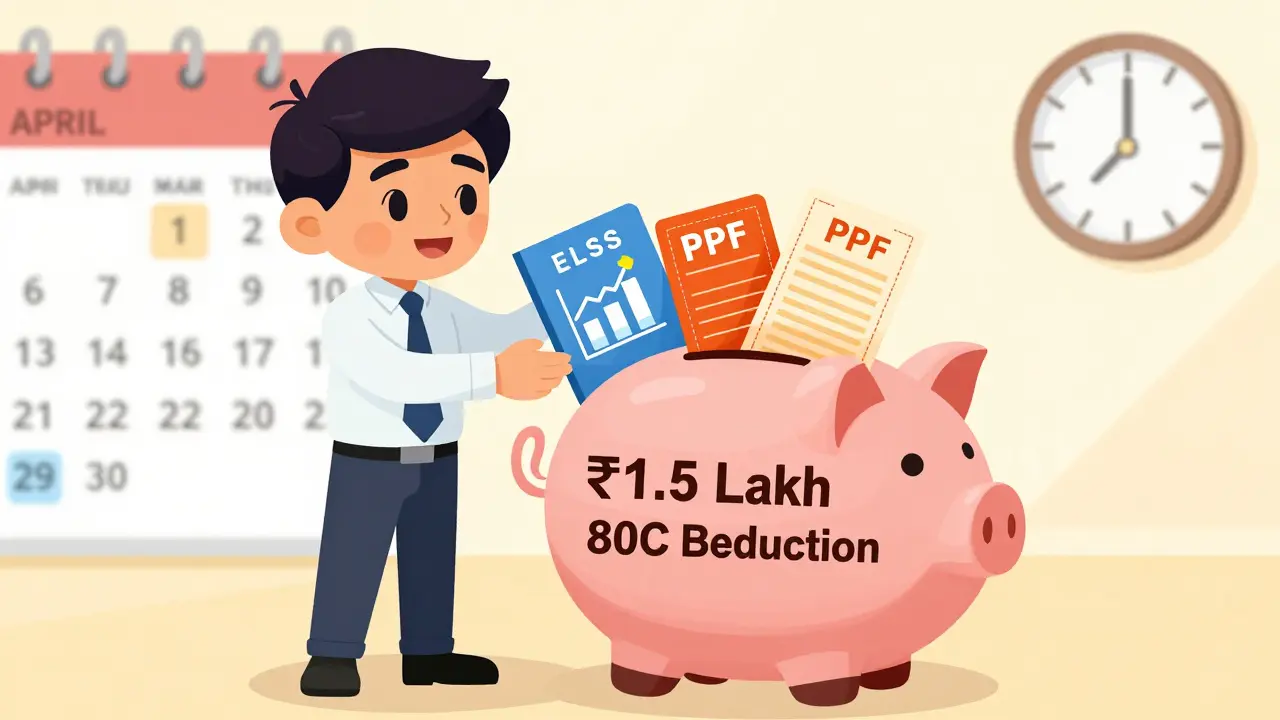
Section 80C Deduction in India: How to Maximize Tax Savings Up to ₹1.5 Lakh
Every year, millions of salaried professionals in India miss out on saving thousands in taxes-not because they don’t earn enough, but because they don’t know how to use Section 80C properly. You’re allowed to reduce your taxable income by up to ₹1.5 lakh every year. That’s not a small amount. If you’re in the 30% tax bracket, that’s ₹45,000 back in your pocket. Yet, most people only invest in fixed deposits or life insurance without checking if they’re getting the best returns or maximizing the deduction. This isn’t about guessing. It’s about knowing exactly what qualifies, how much you can claim, and which options actually make financial sense.
What Is Section 80C and How Does It Work?
Section 80C of the Income Tax Act, 1961, lets you reduce your taxable income by investing in specific instruments. The total limit is ₹1.5 lakh per financial year (April 1 to March 31). This isn’t a tax credit-it’s a deduction. That means you subtract these investments from your gross income before tax is calculated.
For example, if you earn ₹12 lakh a year and invest ₹1.5 lakh under 80C, your taxable income drops to ₹10.5 lakh. If you’re in the 30% tax slab, you save ₹45,000. If you’re in the 20% slab, you save ₹30,000. The higher your income, the more you benefit.
It’s not just about putting money aside. It’s about choosing the right tools that give you tax savings and growth. Many people lock money into traditional options like LIC policies or PPF without realizing they’re earning less than 6% annually. That’s not smart investing-it’s just tax avoidance.
Eligible Investments Under Section 80C
Not everything you invest in counts. Only specific instruments qualify. Here’s the full list of approved options:
- Public Provident Fund (PPF): Long-term, government-backed, currently pays 7.1% interest (as of Q4 2025). Lock-in: 15 years.
- Employee Provident Fund (EPF): Mandatory for salaried employees. Your contribution (12% of basic + DA) qualifies. Employer’s part doesn’t.
- Equity-Linked Savings Scheme (ELSS): Mutual funds with equity exposure. Best for growth. Lock-in: 3 years. Average returns: 12-15% over 5 years.
- Fixed Deposits (FDs): 5-year tax-saving FDs from banks or post offices. Interest is taxable, but principal qualifies.
- National Savings Certificate (NSC): Post office scheme. 5-year tenure. Interest rate: 7.7% (2025). Interest is reinvested and also eligible for deduction.
- Life Insurance Premiums: Premiums paid for yourself, spouse, or children. Not for parents.
- Tuition Fees: For up to two children. Only for full-time education in India.
- Home Loan Principal Repayment: Only the principal portion of EMI qualifies, not interest (that’s under Section 24).
- Sukanya Samriddhi Yojana (SSY): For girl children. Interest rate: 8.2% (2025). Lock-in: 21 years.
- Senior Citizens Savings Scheme (SCSS): For individuals 60+ (or 55+ if retired). Interest: 8.2% (2025). Max investment: ₹15 lakh per person.
That’s 11 options. But you don’t need to use all of them. You just need to hit ₹1.5 lakh total across any combination.
Which 80C Investments Give You the Best Returns?
Let’s cut through the noise. Some options are just for safety. Others are for growth. Here’s how they stack up:
| Investment | Lock-in Period | Expected Return (Annual) | Risk Level | Tax on Returns |
|---|---|---|---|---|
| ELSS Mutual Funds | 3 years | 12-15% | High | None (long-term capital gains exempt up to ₹1 lakh/year) |
| PPF | 15 years | 7.1% | Very Low | None (EEE status) |
| NSC | 5 years | 7.7% | Very Low | Interest taxed annually |
| 5-Year Tax-Saving FD | 5 years | 6.5-7% | Low | Interest fully taxable |
| Sukanya Samriddhi Yojana | 21 years | 8.2% | Very Low | None (EEE status) |
ELSS stands out. It’s the only option that gives you market-linked returns with a short lock-in. Historically, ELSS funds have outperformed PPF and NSC by 5-8% annually over 10-year periods. If you’re under 40 and can handle some volatility, ELSS should be your primary 80C tool.
PPF and SSY are great for conservative investors. But their long lock-in means your money is tied up. Use them if you’re building long-term wealth, not just for tax saving.
Common Mistakes People Make With Section 80C
Most people follow the crowd. They invest in whatever their bank advisor pushes. That’s how they end up with underperforming policies or FDs that barely beat inflation.
Mistake 1: Over-investing in life insurance. Many buy policies just for the 80C benefit. But if you don’t need life cover, you’re paying high charges for a low return. A ₹1 lakh premium on a ULIP might only give you ₹85,000 in actual investment after fees.
Mistake 2: Ignoring the timing. You can claim 80C only for investments made between April 1 and March 31. If you invest in April 2026, it counts for FY 2026-27, not 2025-26. Don’t wait until March 30. Banks get overwhelmed. Mutual fund platforms crash. You might miss the deadline.
Mistake 3: Not tracking your total. You might invest ₹50,000 in EPF, ₹30,000 in PPF, and ₹40,000 in ELSS. That’s ₹1.2 lakh. But you also paid ₹60,000 in life insurance premiums. Now you’re over the limit. You can’t claim more than ₹1.5 lakh. The extra ₹10,000 doesn’t give you extra tax benefit.
Mistake 4: Forgetting children’s tuition fees. If you have two kids in school, paying ₹50,000 in tuition fees? That counts. Many forget this. It’s a simple way to fill the gap without locking money away.

How to Plan Your 80C Investments for Maximum Benefit
Here’s a practical plan based on your age and goals.
For young professionals (25-35):
- Invest ₹75,000 in ELSS (split into 2-3 funds for diversification)
- Put ₹50,000 in EPF (your contribution)
- Use ₹25,000 for tuition fees or home loan principal
You’re at ₹1.5 lakh. You’ve got growth, liquidity (ELSS can be redeemed after 3 years), and no unnecessary insurance.
For mid-career (36-45):
- ₹50,000 in ELSS
- ₹50,000 in PPF
- ₹30,000 in home loan principal
- ₹20,000 in NSC or tax-saving FD
This balances growth with safety. PPF and NSC give you stable returns and predictable tax treatment.
For nearing retirement (46-60):
- ₹1.5 lakh in SCSS (if eligible)
- Or split between PPF and NSC
SCSS offers 8.2% interest and quarterly payouts. It’s ideal if you want regular income without touching your corpus.
What Doesn’t Count Under Section 80C?
Don’t waste time on these:
- Health insurance premiums (that’s Section 80D)
- Donations to charities (Section 80G)
- Interest earned on PPF or NSC (already tax-free, but doesn’t add to your 80C limit)
- Investments in mutual funds that aren’t ELSS (regular equity funds don’t qualify)
- Gold ETFs or physical gold
- Real estate purchases (only home loan principal qualifies, not the property value)
Section 80C is specific. Mixing it up with other sections leads to errors in your tax filing.
How to Claim Section 80C Deduction
You don’t need to file forms. But you must keep records.
When you file your ITR (Income Tax Return), go to the ‘Deductions’ section under Chapter VI-A. Select ‘80C’ and enter the total amount you invested. The system auto-calculates the reduction.
Keep these documents:
- EPF statement (from EPFO portal)
- ELSS folio statements
- PPF passbook or receipt
- Bank receipts for tax-saving FDs
- Tuition fee receipts with school stamp
- Life insurance premium receipts
If your employer deducts TDS, submit proof of investments before February. Most companies have a deadline in January. Missing it means you pay tax upfront and wait for a refund later.

Can You Carry Forward Unused 80C Limit?
No. Unlike capital losses, unused 80C deductions don’t roll over. If you only invested ₹1 lakh this year, you lose the remaining ₹50,000. There’s no carry-forward. That’s why planning ahead matters.
Start early. Set up SIPs in ELSS in April. Automate PPF deposits. Track your spending monthly. Don’t wait until March.
What’s New in 2025?
The ₹1.5 lakh limit hasn’t changed since 2014. But interest rates have. PPF rose to 7.1% in Q1 2025. SCSS and SSY jumped to 8.2%. ELSS funds have delivered 14.3% average returns over the past 5 years, according to AMFI data.
There’s talk of increasing the limit to ₹2 lakh in the 2026 budget. But nothing is confirmed. Don’t wait. Act on what’s valid today.
Final Tip: Don’t Just Save Tax-Build Wealth
Section 80C isn’t a tax trick. It’s a forced savings tool. The real win isn’t the ₹45,000 you save in tax. It’s the ₹1.5 lakh you invest that compounds over time.
Invest ₹1.5 lakh in ELSS at age 30. At 12% annual return, it becomes ₹7.5 lakh by age 50. Do the same in PPF at 7.1%? It becomes ₹4.1 lakh. That’s ₹3.4 lakh difference-just from choosing the right instrument.
Use 80C to build wealth, not just to avoid tax. The deduction is the bonus. The growth is the real reward.
Can I claim Section 80C deduction if I’m self-employed?
Yes. Section 80C applies to all taxpayers, whether salaried or self-employed. You can invest in PPF, ELSS, NSC, life insurance, tuition fees, or home loan principal to claim the ₹1.5 lakh deduction. Just keep proper records for your ITR filing.
Can I claim 80C for my parents’ life insurance premium?
No. Only premiums paid for yourself, your spouse, or your children qualify. Premiums paid for parents, siblings, or in-laws are not eligible under Section 80C.
Is the interest earned on PPF taxable?
No. PPF has EEE status-Exempt, Exempt, Exempt. The investment, interest earned, and maturity amount are all tax-free. That’s why it’s one of the most efficient 80C options.
Can I invest more than ₹1.5 lakh under 80C?
Yes, you can invest more than ₹1.5 lakh. But only the first ₹1.5 lakh will get tax deduction. Any extra amount won’t reduce your taxable income. So, investing ₹2 lakh gives you the same tax benefit as ₹1.5 lakh.
Do I need to submit proof to the income tax department?
No, you don’t submit documents when filing ITR. But you must keep all investment proofs for at least 6 years. The department can ask for them during an audit or scrutiny assessment.