
How to Read a Mutual Fund Factsheet in India: Key Metrics and Ratios
Ever stared at a mutual fund factsheet and felt like you’re reading a foreign language? You’re not alone. In India, over 80 million people invest in mutual funds, but fewer than 1 in 5 truly understand what’s on that one-page document. That factsheet holds the keys to whether your money grows-or quietly disappears. It’s not marketing fluff. It’s your financial report card. And if you don’t know how to read it, you’re flying blind.
What Exactly Is a Mutual Fund Factsheet?
A mutual fund factsheet is a standardized, regulatory-mandated document issued every month by fund houses in India. It’s published by AMFI (Association of Mutual Funds in India) and approved by SEBI. Think of it as a clean, factual snapshot of how your fund is doing right now. No ads. No promises. Just numbers. It includes the fund’s portfolio, past returns, risk levels, fees, and who’s managing it.
Every fund house-whether it’s HDFC, ICICI Prudential, Axis, or a smaller player like Parag Parikh-must follow the same format. That’s good news. Once you learn how to read one, you can read them all.
Top 5 Metrics You Must Check Every Month
Don’t get lost in the details. Focus on these five numbers. They tell you everything you need to know about whether your fund is working for you.
- Net Asset Value (NAV) - This is the price per unit of the fund. It changes daily. But don’t chase high NAVs. A fund with NAV ₹150 isn’t better than one at ₹25. What matters is how much it’s grown over time.
- Return Over Different Time Periods - Look at 1-year, 3-year, 5-year, and since-inception returns. If a fund shows 25% returns in the last year but only 6% over 5 years, it’s likely a short-term outlier. Consistency beats spikes.
- Expense Ratio - This is the annual fee the fund charges you, expressed as a percentage of your investment. For equity funds in India, anything above 2.25% is high. Index funds should be under 0.5%. Every 0.5% extra in fees cuts your long-term returns by thousands of rupees.
- Sharpe Ratio - This tells you how much return you’re getting for each unit of risk. A Sharpe ratio above 1 is good. Above 1.5 is excellent. A fund with 15% returns and a Sharpe of 0.7 is riskier than one with 12% returns and a Sharpe of 1.3. Risk-adjusted returns matter more than raw numbers.
- Standard Deviation - This measures volatility. If a fund has a standard deviation of 12%, it means its returns swing by 12% up or down from its average over the past year. High standard deviation = higher stress. If you’re a conservative investor, avoid funds with standard deviation over 15%.
Understanding the Portfolio: Where Your Money Is Really Going
The factsheet shows you the top 10 holdings. That’s where your money lives. Look at three things:
- Concentration - If 40% of the fund is in just three stocks, it’s risky. A healthy equity fund spreads exposure across 25-40 stocks.
- Sector Exposure - Is 60% in tech? Or 50% in banking? That tells you what’s driving the returns. If you already have a lot of banking stocks in your portfolio, adding another banking-heavy fund isn’t diversification-it’s doubling down.
- Large-cap, Mid-cap, Small-cap Split - This shows the fund’s style. A large-cap fund is safer. A mid-cap fund can grow faster but swings harder. If your factsheet says 80% in small-cap stocks and you’re 60 years old, that’s a red flag.
Also check the top 5 holdings. If you see the same five companies across three different funds you own, you’re not diversified-you’re just paying multiple management fees for the same stocks.
Risk Ratios: Beyond the Basics
Two more ratios separate the good funds from the ones that look good on paper but fall apart when markets dip.
- Alpha - This tells you how well the fund manager outperformed the benchmark. Positive alpha = manager added value. Negative alpha = they underperformed the index. A consistent alpha of +1% to +2% over 5 years is solid.
- Beta - This shows how sensitive the fund is to market swings. A beta of 1 means it moves exactly like the index. A beta of 1.2 means it’s 20% more volatile than the market. If you’re risk-averse, stick with funds under 0.9 beta.
For example, a fund with 18% returns, alpha of +1.8, beta of 0.85, and Sharpe of 1.4 is doing better than a fund with 22% returns, alpha of -0.3, beta of 1.3, and Sharpe of 0.9. The second fund took way more risk for less real reward.

What About SIPs and Taxation?
The factsheet doesn’t directly show your SIP performance, but you can calculate it. Look at the “since inception” return. If you started your SIP 3 years ago, compare that return to the 3-year return on the factsheet. If they’re close, your timing wasn’t bad. If your SIP return is way lower, you might have started near a peak.
For taxation, check the fund type. Equity funds (with 65%+ in Indian stocks) are taxed at 10% on gains over ₹1 lakh after one year. Debt funds are taxed as per your income slab if held less than 3 years. The factsheet always labels the fund as “Equity” or “Debt.” Don’t assume.
Red Flags to Watch Out For
Here’s what to avoid:
- Funds with consistently negative alpha over 3+ years
- Expense ratios over 2.5% for active equity funds
- Sharpe ratio below 0.5
- Top 10 holdings making up more than 50% of the portfolio
- Changes in fund manager in the last 6 months-especially if the fund’s performance dropped after
- Large-cap funds suddenly shifting to mid/small-cap without disclosure
Also, never pick a fund just because it had the highest returns last year. That’s like buying a car because it won a race last month. You want reliability, not luck.
How Often Should You Check the Factsheet?
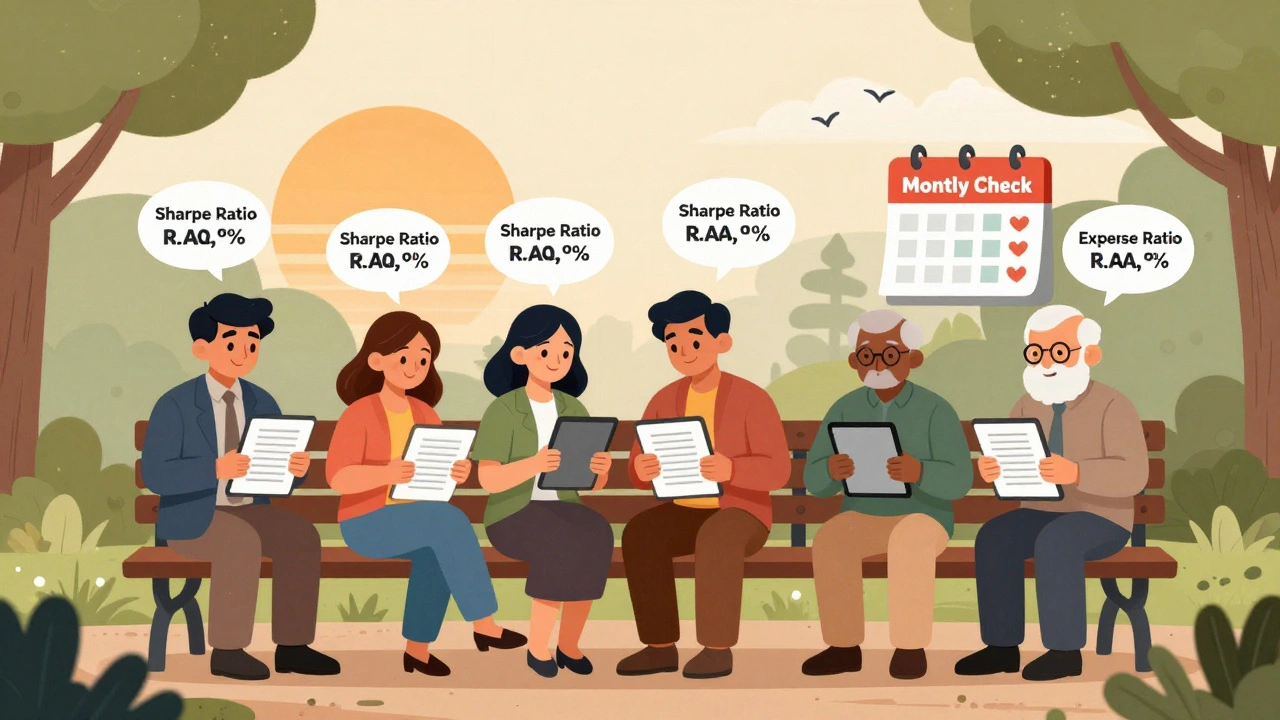
Once a month is enough. Don’t check daily. Don’t panic over a 2% dip. Look at trends. If the fund’s Sharpe ratio drops from 1.4 to 0.8 over 6 months, or the expense ratio jumps by 0.3%, that’s a signal. If returns stay steady, risk metrics stay flat, and holdings don’t shift suddenly-you’re fine.
Set a calendar reminder. Treat it like checking your bank statement. No drama. Just facts.
Where to Find the Factsheets
You can get them from:
- The fund house’s official website (search for “factsheet” + fund name)
- AMFI’s website (amfiindia.com)
- Your investment platform-Zerodha, Groww, Paytm Money, or Upstox all display them in the fund’s details section
Bookmark the page for your top 3 funds. Make it a habit.
Real Example: Reading a Factsheet in Practice
Let’s say you own the Parag Parikh Flexi Cap Fund. Here’s what you see:
- NAV: ₹132.45
- 3-year return: 14.2%
- 5-year return: 16.8%
- Expense ratio: 0.85%
- Sharpe ratio: 1.5
- Standard deviation: 10.1%
- Alpha: +1.9
- Beta: 0.78
- Top 5 holdings: Asian Paints, HDFC Bank, ITC, Reliance, Infosys (total 28%)
- Equity exposure: 85%
What does this mean? Low fees. Low volatility. Strong risk-adjusted returns. Diversified holdings. Outperformed the benchmark. This is a fund you can hold for 10 years.
Now compare it to a fund with 18% returns, 2.4% expense ratio, Sharpe of 0.6, and top 5 holdings at 60%. That fund looks flashy but is actually riskier and more expensive. The factsheet tells you which one is truly better.
Final Tip: Don’t Compare Apples to Oranges
Never compare a large-cap fund to a small-cap fund. Never compare a debt fund to an equity fund. Always compare funds within the same category. Use AMFI’s classification: Large Cap, Flexi Cap, Mid Cap, Hybrid, Liquid, etc.
And remember: the goal isn’t to find the fund with the highest returns. It’s to find the fund that matches your risk level, goals, and time horizon-and keeps performing without drama.
Once you learn to read a factsheet, you stop trusting ads. You stop following influencers. You start making decisions based on data. And that’s when your money starts working for you-not against you.
What is the most important metric on a mutual fund factsheet?
The most important metric is the risk-adjusted return, measured by the Sharpe ratio. A high return with high risk isn’t better than a moderate return with low risk. The Sharpe ratio tells you if the fund is earning its returns efficiently. A Sharpe ratio above 1 is good. Above 1.5 is excellent.
How often should I check my mutual fund factsheet?
Once a month is enough. Mutual funds are long-term investments. Daily or weekly checks lead to emotional decisions. Look for trends over 3-6 months. If key metrics like expense ratio, Sharpe ratio, or portfolio allocation change suddenly, investigate further.
Is a higher NAV better for a mutual fund?
No. A higher NAV doesn’t mean the fund is better. It just means the fund has been around longer or has had higher past returns. A fund with NAV ₹100 and a 15% annual return is doing better than a fund with NAV ₹200 and a 5% return. Focus on percentage returns, not the NAV number.
What does expense ratio mean for my returns?
Every 1% in expense ratio reduces your final returns by about 10-15% over 20 years. For example, if you invest ₹5,000 monthly for 20 years at 12% annual return, a 2% expense ratio will cost you over ₹28 lakh in lost gains compared to a 0.5% fund. Low fees = more money in your pocket.
Can I trust a fund just because it’s from a big brand like HDFC or ICICI?
No. Big brands have many funds, and not all are good. Some HDFC funds have high fees and poor risk-adjusted returns. Always check the factsheet. A small fund house with low fees, strong alpha, and low volatility can outperform a giant. Reputation doesn’t replace data.
What’s the difference between alpha and beta?
Alpha measures how well the fund manager beat the benchmark. Positive alpha means they added value. Beta measures how much the fund moves with the market. A beta of 1 means it moves like the index. A beta of 1.2 means it’s 20% more volatile. You want high alpha and low beta.
Should I switch funds if one month’s return is low?
Never. One bad month means nothing. Markets go up and down. Look at 3-year and 5-year returns. If the fund’s long-term performance, risk ratios, and portfolio are stable, hold on. Selling after a short dip locks in losses and often leads to buying high later.