
Understanding Circuit Breakers on NSE and BSE: Market-Wide and Stock-Specific Halts
When the stock market suddenly stops trading-no buying, no selling, just silence-it’s not a crash. It’s a circuit breaker. On both the National Stock Exchange (NSE) and the Bombay Stock Exchange (BSE), these halts aren’t random. They’re built-in safety valves designed to stop panic from turning into a full-blown collapse. If you’ve ever seen the NSE index drop 10% in minutes and wondered why trading froze, this is why.
What Exactly Is a Circuit Breaker?
A circuit breaker in the stock market is a rule that pauses trading when prices move too far, too fast. Think of it like an electrical circuit breaker that cuts power when there’s a surge. In markets, it’s triggered by sharp drops in major indices like the Nifty 50 or Sensex. The goal isn’t to stop losses-it’s to give traders a moment to breathe, re-evaluate, and avoid knee-jerk selling.
India’s circuit breakers were introduced in 2001 after the global tech bubble burst and markets crashed without warning. Since then, they’ve been refined. Today, they’re based on percentage drops from the previous day’s closing index value. There are three levels: 10%, 15%, and 20%. Each level triggers a different response.
How Market-Wide Circuit Breakers Work
Market-wide circuit breakers apply to the entire exchange. They’re triggered when the Nifty 50 or Sensex falls by 10%, 15%, or 20% in a single trading day. The timing of the drop matters.
- If the index falls 10% before 1:00 PM, trading halts for 45 minutes.
- If it falls 10% between 1:00 PM and 2:00 PM, trading stops for 15 minutes.
- If it falls 10% after 2:00 PM, trading continues without a halt.
For a 15% drop, the rules are similar: a 45-minute halt if before 1:00 PM, 15 minutes if between 1:00 PM and 2:00 PM, and no halt if after 2:00 PM.
At 20%, trading is suspended for the rest of the day-no matter the time. This is the nuclear option. It’s rare. Since 2001, India has seen fewer than 10 full-day halts due to a 20% drop. The last one was in March 2020 during the early days of the pandemic.
These halts aren’t just about price. They’re about psychology. When traders see the market drop 10%, fear kicks in. People rush to sell. Orders pile up. The circuit breaker gives everyone a reset button. It stops the feedback loop where falling prices cause more selling, which causes more falling prices.
Stock-Specific Circuit Breakers: When One Stock Freezes
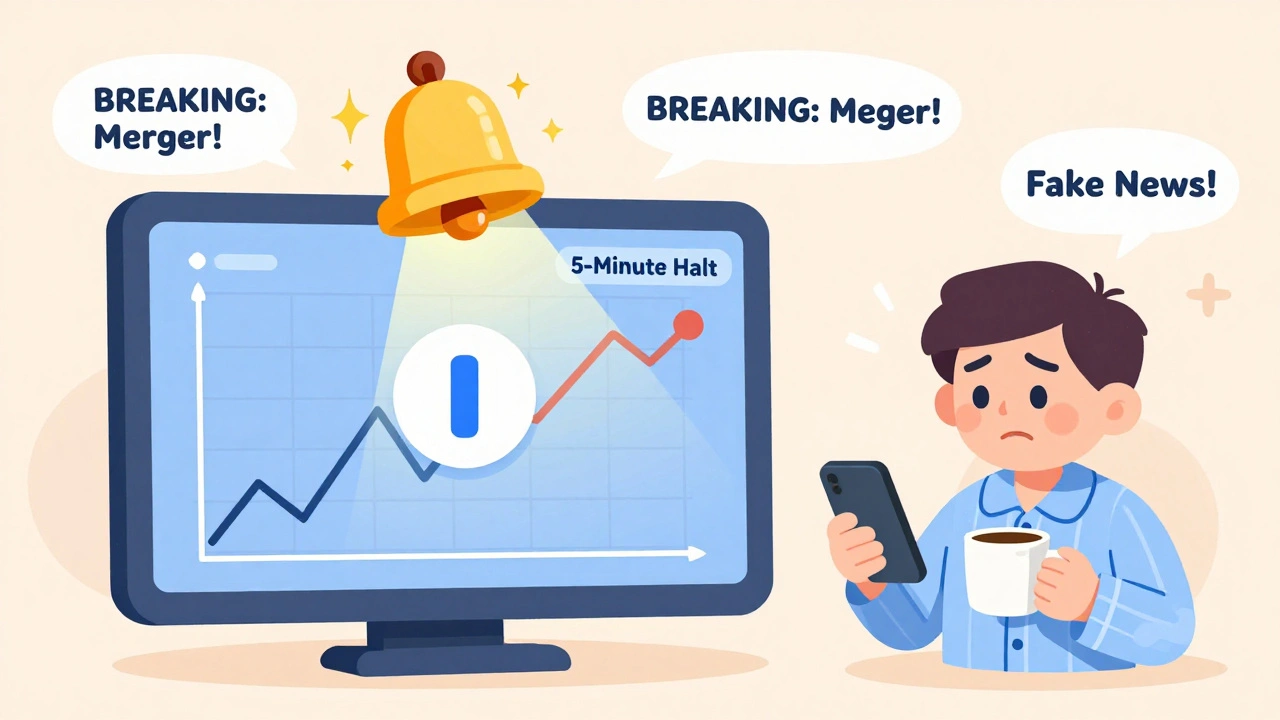
Not all halts affect the whole market. Sometimes, just one stock stops trading. These are called stock-specific circuit breakers. They’re triggered when a single stock’s price moves more than 10% in either direction within five minutes.
For example, if Reliance Industries jumps from ₹3,000 to ₹3,300 in five minutes, trading on that stock pauses for five minutes. Same if it crashes to ₹2,700. After the pause, trading resumes with a new 5% price band around the last traded price. This band expands gradually over the next 15 minutes.
Stock-specific halts are designed to prevent manipulation. They stop pump-and-dump schemes, flash crashes caused by algorithmic errors, or rumors spreading too fast. In 2023, over 2,000 stock-specific halts occurred on NSE alone. Most were minor-just a five-minute pause. But some, like the halt on a small-cap stock after a fake takeover rumor, saved investors from massive losses.
These halts apply to all stocks listed on NSE and BSE, but they’re most common in mid-cap and small-cap stocks. Large caps like HDFC Bank or TCS rarely trigger them because their trading volume is too high for a single trade to move the price that fast.
Why These Rules Matter for Retail Investors
If you’re buying stocks on your phone, circuit breakers are your silent bodyguard. They don’t guarantee you won’t lose money. But they stop you from getting crushed by a sudden, irrational plunge.
Imagine you own shares in a company that just announced a new product. The stock surges 12% in two minutes. Without a circuit breaker, traders might panic and dump other stocks, dragging the whole market down. With the halt, you get time to check the news, read analyst reports, and decide if the move makes sense.
Or imagine you’re watching your portfolio drop 8% in 10 minutes. You’re about to sell everything. Then-halt. The market stops. You take a breath. You realize the drop was triggered by a global oil price shock, not your company’s performance. You hold on. A few hours later, the market recovers.
Circuit breakers give you space to think instead of react. They turn emotional decisions into rational ones.
What Happens During a Halt?
When a circuit breaker triggers, trading doesn’t just freeze. The exchange’s systems shift into a special mode.
- All new buy and sell orders are held in a queue.
- Existing orders remain active but cannot be executed.
- Market data still flows-prices update, volumes are tracked.
- Traders can still cancel orders, but they can’t place new ones.
After the halt ends, trading resumes with a new price band. For market-wide halts, the band is usually set at ±10% of the last traded index value. For stock-specific halts, it’s ±5% initially, then expands.
There’s no guarantee prices will bounce back. But the pause ensures that when trading restarts, it’s based on real demand and supply-not fear.
Common Myths About Circuit Breakers
Many investors believe circuit breakers are a sign the market is broken. That’s wrong. They’re a sign the system is working.
Myth 1: Circuit breakers prevent losses. They don’t. They delay them. If the market is going to fall 20%, it will still fall 20%-just over two days instead of one.
Myth 2: Halts mean the market is rigged. No. Circuit breakers are transparent. The rules are published on NSE and BSE websites. They’re reviewed annually by SEBI.
Myth 3: Only big investors benefit. False. Retail investors benefit the most. They’re the ones most likely to panic-sell. Circuit breakers give them time to avoid mistakes.
Myth 4: Circuit breakers cause more volatility. Studies from SEBI show the opposite. After circuit breakers were introduced, daily volatility in Indian markets dropped by nearly 30%.

What You Should Do When a Halt Happens
If you’re trading and a circuit breaker triggers, don’t panic. Here’s what to do:
- Check the index level. Is it a 10%, 15%, or 20% drop? That tells you how serious it is.
- Look at the time. If it’s before 1:00 PM, expect a long pause. If it’s after 2:00 PM, it might not matter.
- Check news sources. Was it a global event? A policy change? A company scandal?
- Don’t place new orders during the halt. Wait until trading resumes.
- Use the time to review your portfolio. Is your position still aligned with your goals?
Most halts are over within an hour. The market usually recovers. But if it’s a 20% drop, be prepared for a longer recovery. That’s when you need to think long-term, not short-term.
How Circuit Breakers Compare Between NSE and BSE
There’s no difference between NSE and BSE circuit breakers. Both exchanges use the same rules, set by SEBI. The Nifty 50 and Sensex are calculated differently, but the halt triggers are identical.
Some traders think NSE is more responsive because it has higher volume. But the rules are the same. A 10% drop in Sensex triggers the same halt as a 10% drop in Nifty 50. The only difference is which index you’re watching.
For most retail investors, it doesn’t matter. If you trade through a broker, you’ll see both indices on your app. Just watch whichever one you’re tracking.
What’s Next for Circuit Breakers in India?
SEBI is always reviewing the rules. In 2024, they proposed adding a new trigger: a 5% drop in the first 30 minutes of trading. That would catch early panic before it spreads. The proposal is still under review.
They’re also looking at real-time monitoring of algorithmic trading to prevent flash crashes. But the core idea remains: give the market a pause when it’s losing control.
For now, the system works. It’s not perfect. But it’s one of the few things in the stock market that actually protects you.
What triggers a circuit breaker on NSE and BSE?
A circuit breaker is triggered when the Nifty 50 or Sensex index falls by 10%, 15%, or 20% in a single trading day. The timing of the drop determines how long trading halts. A 20% drop ends trading for the day. Stock-specific halts occur when any single stock moves more than 10% in five minutes.
Do circuit breakers stop the market from falling?
No. Circuit breakers don’t prevent price drops-they slow them down. They give traders time to reassess instead of panicking. If the market is going to fall 15%, it still will. But the halt prevents a chaotic, uncontrolled crash.
Can I trade during a circuit breaker halt?
No. During a halt, you cannot place new buy or sell orders. Existing orders stay in the queue but won’t execute. You can cancel orders, but you can’t trade until the exchange resumes normal operations.
Why do stock-specific circuit breakers exist?
They prevent manipulation and flash crashes in individual stocks. If a rumor causes a small-cap stock to spike 15% in minutes, the halt stops traders from rushing in blindly. It gives time for facts to surface and prevents irrational price swings.
How often do circuit breakers trigger in India?
Market-wide circuit breakers are rare. A 10% drop happens a few times a year. A 15% drop is uncommon. A 20% drop has happened fewer than 10 times since 2001. Stock-specific halts occur hundreds of times annually, mostly in small-cap stocks.