Understanding Face Value, Market Value, and Book Value in Indian Stocks
When you buy a stock in India, you see a price on your screen - maybe ₹450, maybe ₹2,100. But that number doesn’t tell you the whole story. Behind every stock price are three different values that matter more than you think: face value, market value, and book value. Knowing the difference between them helps you avoid overpaying, spot hidden value, and make smarter decisions in the Indian stock market.
What Is Face Value?
Face value is the original cost of a share as printed on the stock certificate. It’s set when the company first goes public and rarely changes. In India, most companies issue shares with a face value of ₹1, ₹2, ₹5, or ₹10. For example, if you buy a share of Reliance Industries with a face value of ₹10, that number stays ₹10 even if the stock trades at ₹3,000.
Face value doesn’t reflect how much the market thinks the company is worth. It’s mostly a legal and accounting formality. But it matters when companies split or consolidate shares. If a company with a ₹10 face value does a 1:5 split, each new share will have a ₹2 face value. This doesn’t change your investment value - you just own five times more shares at a lower price per share.
Some investors confuse high face value with "expensive" stocks. That’s wrong. A ₹10 face value stock at ₹5,000 is not "more valuable" than a ₹1 face value stock at ₹1,200. The face value alone tells you nothing about performance.
What Is Market Value?
Market value is what investors are willing to pay right now for one share. It’s the number you see flashing on your trading app. For Indian stocks, this changes every second based on supply, demand, news, earnings reports, and even social media trends.
For example, in January 2026, Tata Motors had a market value of ₹1,850 per share. A week later, after strong EV sales numbers, it jumped to ₹2,100. That’s market value in action - it’s real-time sentiment turned into price.
Market value is calculated by multiplying the current share price by the total number of outstanding shares. This gives you the company’s total market capitalization. If Tata Motors has 1.2 billion shares outstanding, its market cap is ₹2.52 trillion (₹2,100 × 1.2 billion).
Market value is the most visible number, but also the most volatile. It can swing wildly on rumors, global oil prices, or even a tweet from a celebrity investor. Don’t let it fool you into thinking it’s the "true" value of the company.
What Is Book Value?
Book value is what the company is worth on paper - its assets minus liabilities. It comes from the balance sheet. Think of it as the net worth of the company if it sold everything and paid off all debts.
For example, if a company has ₹500 crore in assets and ₹200 crore in debt, its book value is ₹300 crore. Divide that by the number of shares, and you get book value per share. If there are 10 crore shares, book value per share is ₹30.
In India, book value is especially useful for value investors. If a stock trades below its book value - say, ₹25 when book value is ₹30 - it might be undervalued. This is called a "price-to-book" ratio under 1.0. Companies like State Bank of India or Bank of Baroda often trade near or below book value because they’re seen as stable, low-growth businesses.
But book value isn’t perfect. It uses historical costs, not current market prices. A factory bought for ₹100 crore in 2005 might be worth ₹800 crore today. Book value doesn’t capture that. Still, it’s a solid anchor when you’re trying to avoid overhyped stocks.
How These Three Values Relate
Here’s how they typically compare:
- If market value > book value → Investors expect growth. This is normal for tech or fast-growing companies like Zomato or Nykaa.
- If market value ≈ book value → The market sees little growth ahead. Common in banks or infrastructure firms.
- If market value < book value → The stock might be undervalued. Could be a bargain, or a sign of deeper trouble.
Face value usually sits far below both. A ₹10 face value stock can easily have a ₹500 market value and ₹120 book value. That’s normal. Don’t use face value to judge if a stock is "cheap" or "expensive." It’s irrelevant for investment decisions.
Real-World Example: HDFC Bank
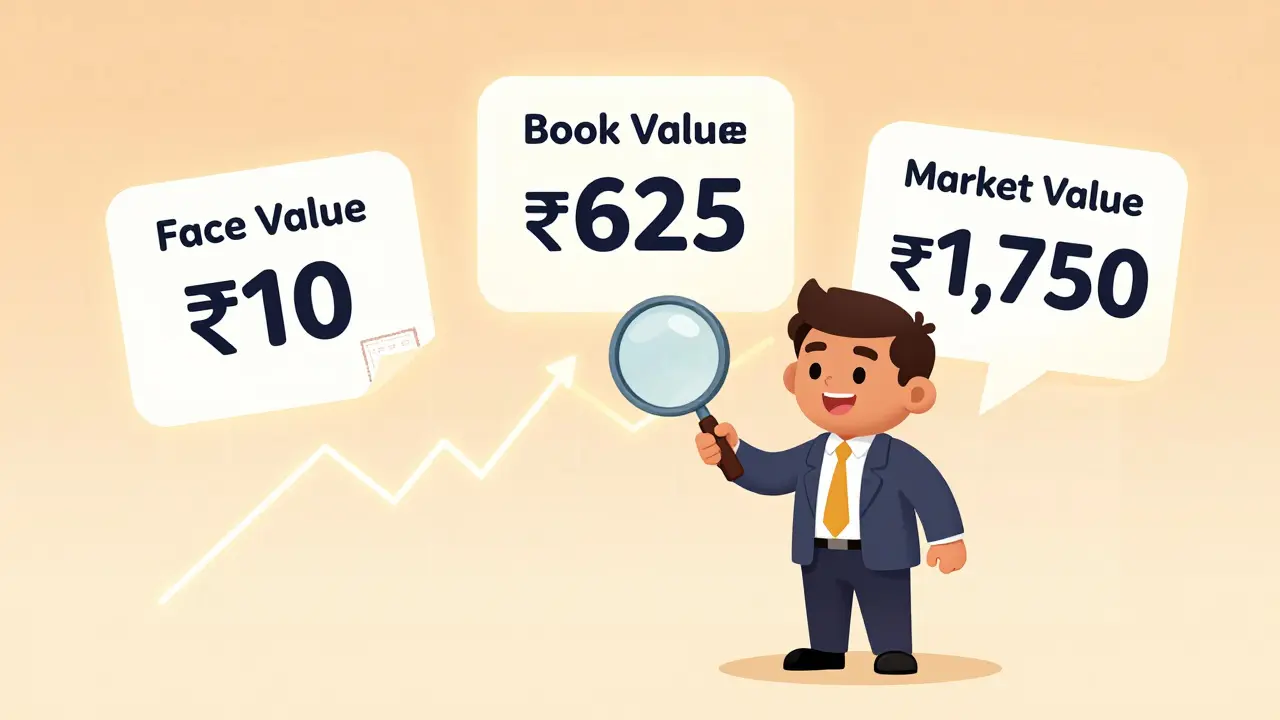
As of February 2026, HDFC Bank had:
- Face value: ₹10 per share
- Book value: ₹625 per share
- Market value: ₹1,750 per share
Market value is nearly 3 times book value. That means investors believe HDFC Bank will keep growing profits, expanding loans, and maintaining its market leadership. The face value? Just a number on paper. It doesn’t affect your returns.
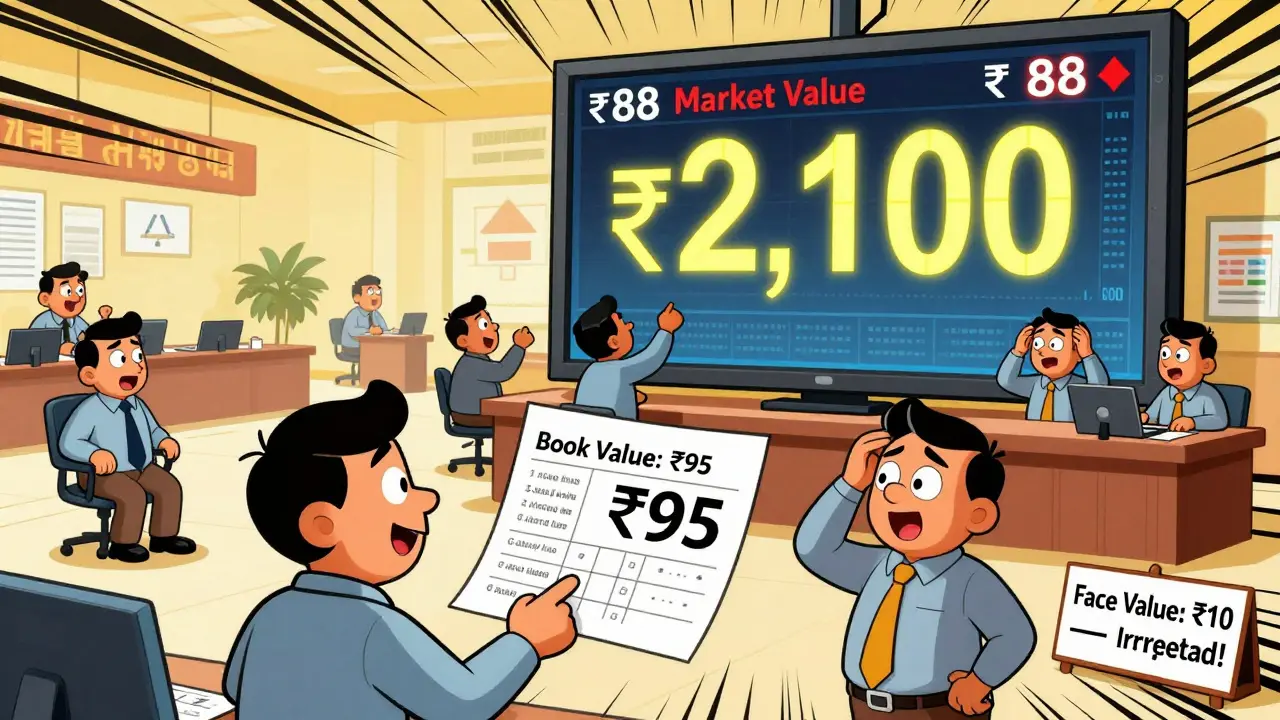
Compare that to a company like Bharat Heavy Electricals Limited (BHEL). In early 2026, BHEL had:
- Face value: ₹10
- Book value: ₹95
- Market value: ₹88
Market value is below book value. That’s rare. It suggests investors don’t believe BHEL will grow. Maybe they’re worried about government delays, competition, or outdated tech. This doesn’t mean it’s a buy - but it does mean you’re paying less than the company’s net assets. That’s a red flag worth investigating.

Why This Matters for Indian Investors
Most retail investors in India chase price movements. They buy stocks because the price went up last week. They sell because it dropped 5% in a day. That’s gambling, not investing.
Knowing the difference between face, market, and book value turns you into a smarter investor. You start asking:
- Is this stock trading at 5x book value because it’s a growth engine - or because it’s overhyped?
- Why is a bank trading below book value? Is it a hidden gem or a sinking ship?
- Does this company’s face value even matter? (Spoiler: No.)
Use book value as a baseline. Use market value as a signal. Ignore face value. Combine them with earnings, debt levels, and industry trends - and you’ll outperform 80% of retail investors in India.
Common Mistakes to Avoid
- Thinking low face value = cheap stock. A ₹1 face value stock at ₹500 is more expensive than a ₹10 face value stock at ₹200.
- Using market value alone. A stock can be at a 5-year high but still overpriced if its earnings haven’t grown.
- Ignoring book value in banking and infrastructure. These sectors are often valued based on asset strength. Book value is your best friend here.
- Assuming book value = liquidation value. Assets on paper aren’t always worth what’s listed. Real estate, machinery, and patents often lose value in a fire sale.
Quick Checklist: What to Check Before Buying Any Indian Stock
- Look up the face value - just to understand the stock split history.
- Find the book value per share from the latest balance sheet (on BSE/NSE website).
- Check the current market price on your trading app.
- Divide market price by book value. If it’s above 3, ask why. If it’s below 1, dig deeper.
- Compare with peers. Is this company’s valuation unusually high or low?
These numbers won’t tell you everything - but they’ll stop you from making the biggest mistakes most new investors make.
Is face value important for calculating dividends in Indian stocks?
Yes, but only for the dividend payout rate. Companies declare dividends as a percentage of face value. For example, if a stock has a ₹10 face value and the company announces a 50% dividend, you get ₹5 per share. But the actual cash amount doesn’t depend on the market price. So a ₹100 stock with ₹1 face value and a 50% dividend still gives you ₹0.50 per share. That’s why dividend yields are calculated as (dividend per share / market price) × 100 - to reflect real return.
Can book value be negative?
Yes. If a company’s total liabilities exceed its total assets, book value turns negative. This usually means the company is in serious financial trouble. In India, companies like Videocon Industries or DHFL had negative book values before they collapsed. A negative book value is a red flag - but not always a death sentence. Some startups or asset-heavy firms (like real estate developers) can temporarily go negative during heavy expansion.
Why do some Indian stocks have very high market-to-book ratios?
High market-to-book ratios (like 5x, 10x, or higher) usually mean investors expect massive future growth. Companies like Infosys, TCS, or Reliance Jio have high ratios because they’re seen as dominant players with strong cash flows and low risk. But it also means you’re paying a premium for future potential. If those expectations don’t come true, the stock can crash. High ratios are common in tech and consumer brands - rare in banks or manufacturing.
Do mutual funds in India track book value?
Yes, many value-focused mutual funds in India use book value as a key filter. Funds like Parag Parikh Flexi Cap or UTI Value Fund specifically look for stocks trading below their book value. They believe these are safer bets with a built-in margin of safety. These funds often outperform during market downturns because they avoid overvalued stocks.
How often is book value updated in Indian stocks?
Book value is updated quarterly when companies release their financial results. The latest balance sheet is published on the BSE and NSE websites within 30 days of quarter-end. For serious investors, checking the last two quarters helps spot trends - is book value growing? Is debt rising faster than assets? That’s more telling than a single number.