
NRI Property Investment in India: FEMA Rules, Repatriation, and Tax
Buying property in India as an NRI isn’t just about finding a home or a rental income opportunity-it’s a legal and financial process shaped by strict rules. If you’re an Indian citizen living abroad, or a foreign national of Indian origin, you need to understand how FEMA rules, repatriation limits, and tax obligations affect your investment. Skip these details, and you risk penalties, frozen funds, or even losing your property rights.
What Does FEMA Say About NRI Property Buying?
The Foreign Exchange Management Act (FEMA), enforced by the Reserve Bank of India (RBI), governs how NRIs can buy, sell, and hold real estate in India. The rules are simple on paper but tricky in practice.
NRIs can buy residential and commercial property without prior approval. That includes apartments, villas, and office spaces. But you cannot buy agricultural land, farmhouses, or plantation property. That restriction is absolute. Even if you inherit such land, you can’t expand it or convert it for non-agricultural use.
There’s no limit on how many properties you can own. You can buy one flat in Mumbai, another in Bangalore, and a third in Hyderabad-all under your name. But each purchase must be funded through your Non-Resident External (NRE) or Non-Resident Ordinary (NRO) account. You can’t use cash or money from a local friend’s account. The RBI tracks every transaction, and mismatches trigger audits.
Joint ownership is allowed. If your spouse is also an NRI, you can co-own a property. If your spouse is an Indian resident, the property must still be funded from your NRE/NRO account. The title will reflect both names, but the source of funds matters more than the names on the deed.
How Repatriation Works for NRI Property Sales
Selling a property you bought as an NRI is straightforward-if you follow the rules. The key is knowing how much money you can send back to your home country.
You can repatriate the sale proceeds of up to two residential properties. There’s no limit on commercial property sales. But here’s the catch: you can only repatriate the original purchase amount plus capital gains, converted to foreign currency at the prevailing exchange rate. You can’t repatriate more than what you originally invested, unless you prove the extra amount came from legitimate income or gains.
To repatriate, you need:
- A certificate from a chartered accountant (Form 15CB)
- A tax clearance certificate from the Income Tax Department (Form 15CA)
- Proof of original purchase (sale deed, bank statements)
- Proof of sale (registered sale deed, buyer’s payment receipt)
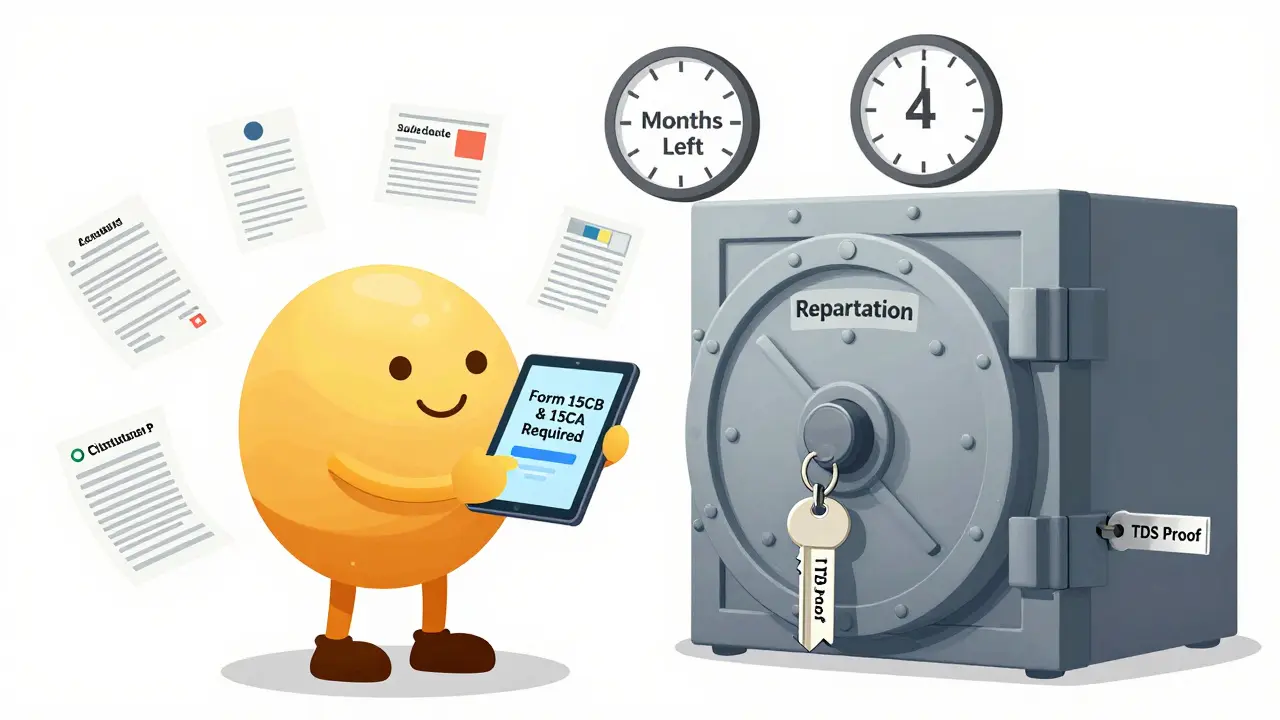
The bank handling your NRE/NRO account will process the transfer only after these documents are submitted. If you skip Form 15CB or 15CA, the bank will freeze the transaction. There’s no workaround. Even if you’re in a hurry, the RBI doesn’t allow exceptions.
For properties bought before 2005, the rules are slightly different. If you bought before April 2005, you can repatriate the full sale proceeds without needing to prove the original investment amount. But if you bought after that date, you must track every rupee you spent.
Tax Implications for NRI Property Owners
Tax on property sales isn’t optional. It’s automatic. When you sell, the buyer is legally required to deduct Tax Deducted at Source (TDS). The rate depends on how long you held the property.
If you sell within two years of buying, it’s a short-term capital gain. You pay tax at your income tax slab rate-up to 30% for high earners. If you hold the property for more than two years, it’s a long-term capital gain. You pay 20% with indexation benefits.
Indexation? That’s your friend. It adjusts your original purchase price for inflation using the Cost Inflation Index (CII) published by the government. For example, if you bought a flat in 2018 for ₹50 lakh and sold it in 2025 for ₹80 lakh, indexation might bump your cost base to ₹68 lakh. That means your taxable gain is ₹12 lakh, not ₹30 lakh. That’s a massive difference.
You can also avoid capital gains tax entirely by reinvesting the sale proceeds into another property in India within two years (or three years if under construction). Or you can invest in specified bonds like NHAI or REC bonds within six months. Both options let you defer or eliminate tax-but only if you follow the deadlines exactly.
Don’t forget: rental income is taxable too. If you rent out your property, the tenant must deduct 30% TDS on rent payments. You can reduce this by applying for a lower TDS certificate from the Income Tax Department. You’ll need to file an annual income tax return in India, even if you live abroad. The IT department tracks this through PAN and property registration records.
Common Mistakes NRIs Make
Most NRIs lose money not because of bad deals, but because of paperwork errors.
- Using a local friend’s account to fund the purchase
- Not registering the property in their name properly
- Ignoring TDS and assuming the buyer handles everything
- Trying to repatriate funds without Form 15CB/15CA
- Buying agricultural land thinking they can convert it later
One client from Sydney bought a villa in Goa using a relative’s savings account. The bank flagged the transaction. The sale deed was canceled. The buyer got their money back-but the seller lost six months and ₹2.5 lakh in legal fees.
Another NRI in London sold a property in Chennai and tried to transfer ₹1.2 crore to his Australian account. He didn’t file Form 15CA. The bank froze the transfer. He spent four months getting the documents right. By then, the exchange rate had dropped 8%. He lost ₹9.6 lakh.
These aren’t rare cases. They happen every week.
What You Need to Do Before Buying
Here’s a simple checklist before you sign anything:
- Confirm the property is not agricultural land or a farmhouse
- Use only your NRE or NRO account for payments
- Get a clear title deed with no pending dues
- Ask for a property tax clearance certificate from the local municipality
- Verify the seller’s ownership via the Sub-Registrar Office
- Work with a chartered accountant familiar with NRI rules
- Keep digital copies of every receipt, bank statement, and deed
Don’t rely on real estate agents to explain FEMA rules. Most don’t know them. Find a legal advisor who specializes in NRI property. The cost is ₹15,000-₹30,000-but it saves you from losing lakhs.

Can You Get a Home Loan as an NRI?
Yes. Indian banks offer home loans to NRIs, but with stricter terms. Interest rates are 0.5%-1% higher than for residents. Loan-to-value ratios are capped at 70-80%. You need to show stable overseas income-usually two years of payslips or tax returns.
Some banks require a co-applicant who is an Indian resident. The property must be in your name, but the co-applicant acts as a guarantor. You can repay the loan from your NRE account. That’s the cleanest way. Repaying from an NRO account is allowed but triggers more scrutiny.
Prepayment is allowed without penalty. Many NRIs use this to pay off loans early when exchange rates are favorable.
Final Thoughts
NRI property investment in India can be smart-if you treat it like a business, not a sentimental purchase. The rules aren’t designed to stop you. They’re designed to protect you-from fraud, from tax evasion, from losing your money.
Stay compliant. Keep records. Use professionals. Don’t assume rules are flexible. The RBI doesn’t bend for emotion. And if you follow the steps, owning property in India can be one of the most stable, long-term investments you’ll ever make.
Can NRIs buy property in India without visiting?
Yes, NRIs can buy property in India without visiting. You can authorize someone via a Power of Attorney (PoA) to handle the purchase on your behalf. The PoA must be notarized in your country of residence and registered in India. Most NRIs use this method for buying apartments or flats. However, the final sale deed must be registered in your name, and funds must come from your NRE or NRO account.
Can I rent out my property in India and send the income abroad?
Yes, you can rent out your property and repatriate rental income. The tenant must deduct 30% TDS on rent payments. You can reduce this by applying for a lower TDS certificate from the Income Tax Department. The net rental income can be transferred to your NRE account and then repatriated without limits. However, you must file an annual tax return in India, even if you live abroad.
What happens if I sell a property and don’t repatriate the money?
If you don’t repatriate the sale proceeds, the money stays in your NRO account in India. You can use it to buy another property, pay taxes, or invest in Indian financial instruments. There’s no penalty for not repatriating. But if you later decide to send it abroad, you’ll still need Form 15CB and 15CA. The money must be transferred through an authorized bank.
Can an NRI inherit property in India?
Yes, NRIs can inherit any type of property in India, including agricultural land. But if you inherit agricultural land, you cannot buy more of it or convert it for non-agricultural use. You can sell it, and repatriate the proceeds under the same rules as purchased property. You must still file Form 15CA and 15CB for repatriation.
Is there a limit on how many properties an NRI can own?
No, there is no legal limit on the number of residential or commercial properties an NRI can own. You can own ten flats, five offices, or a mix. But you can only repatriate sale proceeds from up to two residential properties. For commercial properties, there’s no repatriation limit. Each purchase must be funded through your NRE or NRO account.