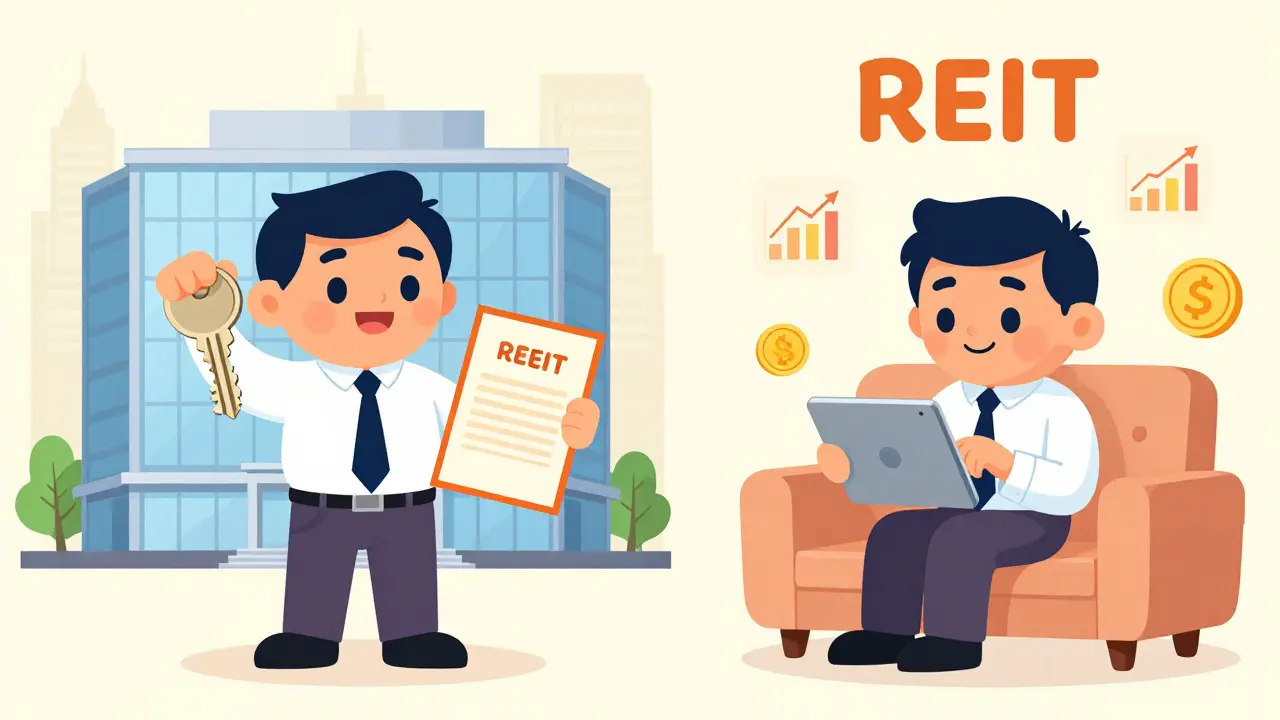
Commercial REITs vs Direct Commercial Property in India: Pros and Cons
You have a lump sum of money-maybe ₹50 lakhs or even ₹2 crores-and you want it to work for you. The Indian real estate market is buzzing, but the old playbook of buying land and waiting isn't the only game in town anymore. You are likely standing at a crossroads: do you buy a physical office space or retail shop directly, or do you invest in Commercial REITs, which are publicly traded funds that own income-generating commercial real estate? This decision changes everything about your liquidity, effort, and returns.
Direct ownership feels tangible. You can walk into your building. But it ties up massive capital and requires constant management. REITs offer stock-market-like liquidity and professional management, but they come with their own set of risks and tax implications. Let’s break down exactly how these two giants of Indian commercial real estate compare, so you can decide where your money fits best.
The Liquidity Trap: Why Direct Property Is Hard to Exit
The biggest advantage of investing in Direct Commercial Property is physical ownership of assets like offices, warehouses, or retail spaces is control. You choose the tenant, you set the rent (within reason), and you oversee maintenance. However, this control comes with a heavy price tag: illiquidity. If you need cash urgently, selling a commercial property is not like selling shares on the NSE or BSE. It can take months, sometimes over a year, to find a buyer, complete due diligence, and register the transfer.
In contrast, REITs are investment vehicles listed on stock exchanges. You can buy units during market hours and sell them instantly if you need liquidity. For an investor who might need access to capital for emergencies or other opportunities, this difference is night and day. Think about it: would you rather wait six months to close a deal on a warehouse in Mumbai, or click a button to liquidate your position in a REIT portfolio?
However, this liquidity introduces volatility. Your direct property value doesn’t fluctuate daily based on global market sentiment. A REIT’s unit price does. If the broader equity market crashes, your REIT investment might dip, even if the underlying buildings are performing well. You have to decide if you can stomach daily price swings in exchange for easy exit options.
Capital Requirements and Entry Barriers
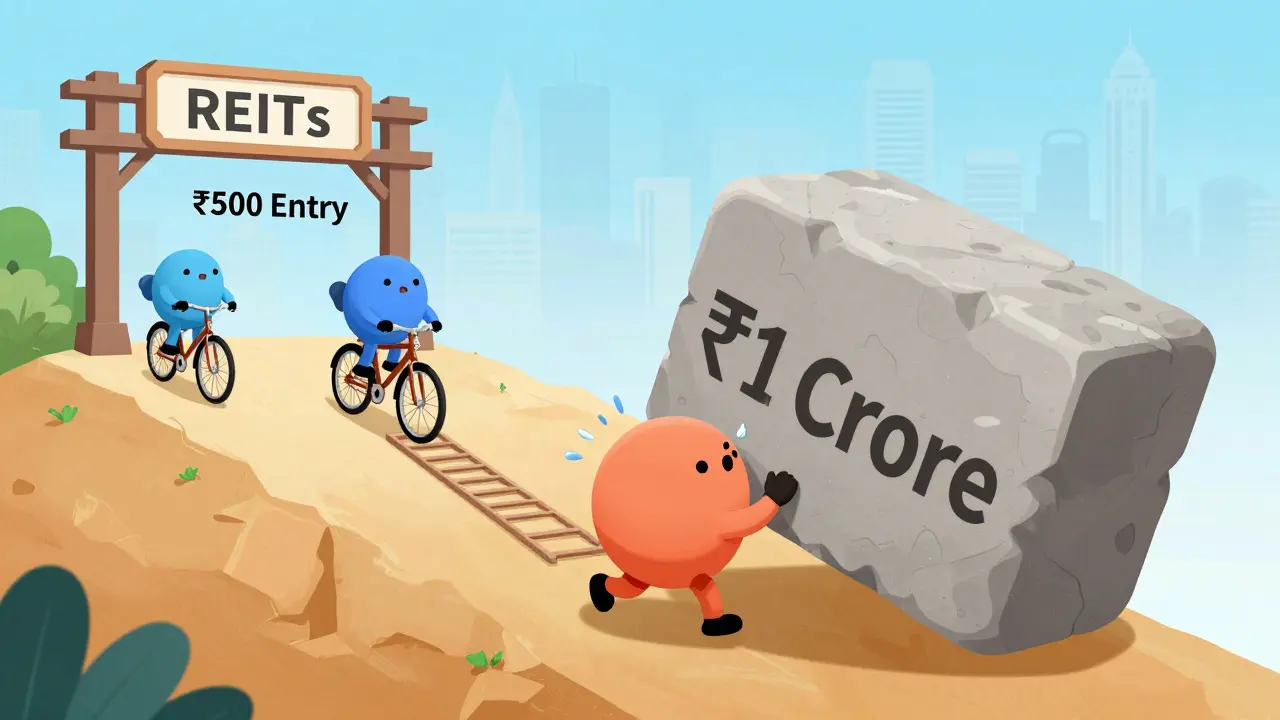
Let’s talk numbers. Buying a prime commercial office space in South Delhi or Bandra Kurla Complex often starts at ₹10-20 lakhs per square foot. A modest 1,000 sq ft office could cost you ₹1.5 crore upfront, plus registration charges, stamp duty, and legal fees. That is a high barrier to entry. Most individual investors cannot afford to diversify; they end up putting all their eggs in one basket because they literally can’t afford a second property.
REITs democratize this access. With as little as ₹500-₹1,000, you can buy units in major Indian REITs like Embassy Office Parks REIT, Mindspace Business Parks REIT, or Brookfield India REIT. This allows you to own a fractional share of multiple Grade-A office buildings across different cities. Diversification is built-in. If one tenant leaves a building in Hyderabad, your overall portfolio impact is minimal because you own stakes in properties across Bangalore, Pune, and Mumbai.
| Factor | Direct Commercial Property | Commercial REITs |
|---|---|---|
| Minimum Investment | ₹1 Crore+ | ₹500+ |
| Diversification | Low (Single Asset) | High (Multiple Assets) |
| Liquidity | Very Low (Months/Years) | High (Intraday) |
| Management Effort | High (Landlord duties) | None (Professional managers) |
Income Streams: Dividends vs Rental Yields
Both avenues generate income, but the structure differs significantly. When you own direct property, you collect rent. In prime Indian commercial hubs, gross rental yields typically range between 4% to 6%. However, this is gross. You must deduct property taxes, maintenance costs, insurance, and vacancy periods. Your net yield might drop to 3-4%. Plus, you bear the risk of non-payment. If a tenant defaults, you have to chase them through legal channels, which is expensive and slow in India.
REITs distribute at least 90% of their taxable income to unitholders as dividends. These distributions are usually quarterly. While the distribution yield also hovers around 4-6%, it is more predictable because REITs have diversified tenant bases. If one company stops paying rent, others continue. Furthermore, REITs benefit from economies of scale in management. They negotiate better service contracts and handle tenant acquisition professionally. You don’t get calls at midnight about a leaking pipe; the fund manager handles it.
There is a nuance here regarding growth. Direct property owners can increase rents aggressively when leases expire, especially in hot markets. REITs also renegotiate leases, but their income is smoothed out. Some investors prefer the potential for sharper rent hikes in direct ownership, while others prefer the stability of REIT distributions.
Tax Implications: The Hidden Cost of Ownership
Taxation plays a huge role in your final returns, and the rules differ sharply between direct property and REITs. As of 2026, the tax landscape for real estate in India has specific quirks you must navigate.
For direct commercial property, rental income is added to your total income and taxed according to your slab rate. If you are in the 30% bracket, you lose nearly a third of your rent immediately. When you sell the property after holding it for more than 24 months, it qualifies as long-term capital gains (LTCG). LTCG on property is taxed at 20% with indexation benefits. Indexation adjusts your purchase price for inflation, which can significantly reduce your tax liability if you held the asset for many years. However, calculating indexation requires meticulous record-keeping of original costs and improvement expenses.
REIT dividends are generally tax-free in the hands of the investor under Section 10(35) of the Income Tax Act, provided certain conditions are met. However, if you sell your REIT units, the capital gains treatment depends on the holding period. Short-term capital gains (held less than 36 months) are taxed as per your income slab. Long-term capital gains (held more than 36 months) are taxed at 20% with indexation. Note that the holding period for LTCG in REITs is longer than for direct property (36 months vs 24 months). This is a critical detail for short-term traders versus long-term holders.

Risk Profile: Vacancy, Interest Rates, and Market Cycles
No investment is without risk. Direct commercial property exposes you to idiosyncratic risk. If your single tenant goes bankrupt or moves out, your income drops to zero until you find a replacement. In a downturn, vacancies can linger for months. You are also exposed to location-specific risks. If a new highway bypasses your industrial park, its value plummets. There is no hedge against bad luck in direct ownership unless you own multiple properties, which requires immense capital.
REITs mitigate idiosyncratic risk through diversification. But they introduce systemic risk. REITs are sensitive to interest rates. When the Reserve Bank of India raises repo rates, borrowing costs for companies go up, potentially slowing business expansion and reducing demand for office space. Additionally, higher interest rates make fixed-income instruments like bonds more attractive, causing investors to flee REITs for safer yields. This can depress REIT unit prices even if occupancy remains high.
Another risk for REITs is management quality. You are trusting the fund manager to make smart acquisitions and lease decisions. If they buy overvalued assets or fail to retain tenants, your investment suffers. In direct ownership, you control every decision. You know exactly what you’re getting into.
Who Should Choose What? A Decision Framework
So, which path is right for you? It depends on your profile, goals, and tolerance for hassle.
Choose Direct Commercial Property if:
- You have significant capital (₹1 Cr+) and want full control over your asset.
- You believe in a specific micro-market’s growth potential (e.g., emerging tech hubs in Tier-2 cities).
- You want to leverage debt extensively using bank loans, which are often easier to secure against physical collateral than against financial assets.
- You are willing to act as a landlord, handling maintenance, tenant relations, and legal disputes.
Choose Commercial REITs if:
- You have limited capital but want exposure to premium commercial real estate.
- You prioritize liquidity and want the ability to exit quickly.
- You seek passive income with minimal effort and no management headaches.
- You want instant diversification across multiple prime locations and blue-chip tenants.
- You are comfortable with stock market volatility and understand interest rate dynamics.
Many sophisticated investors use a hybrid approach. They hold core stable assets directly for long-term appreciation and use REITs for liquidity and diversification. This balances the tangibility of bricks and mortar with the flexibility of financial markets.
Are REIT dividends really tax-free in India?
Yes, dividends received from Indian REITs are generally tax-free in the hands of the investor under Section 10(35) of the Income Tax Act, provided the REIT complies with regulatory requirements. However, capital gains from selling REIT units are taxable. Short-term gains are taxed at your slab rate, while long-term gains (held >36 months) are taxed at 20% with indexation.
Can I get a loan against my REIT investments?
It is difficult to get traditional mortgage-style loans against REIT units like you can with physical property. Some banks may offer margin funding or securities-backed loans, but the loan-to-value ratios are lower, and interest rates are higher compared to home or commercial property loans. Direct property is much easier to leverage.
Which is better for inflation hedging: Direct Property or REITs?
Both can hedge against inflation, but in different ways. Direct property values and rents tend to rise with inflation, offering a natural hedge. REITs also benefit as rents increase, but their stock prices can be volatile. Historically, direct real estate has been seen as a more stable inflation hedge, though REITs offer better liquidity if you need to react quickly to economic shifts.
What happens if a REIT fails or performs poorly?
If a REIT performs poorly, the unit price will drop, and distributions may decrease. Unlike a private partnership, you cannot easily sue the manager for poor performance unless there is fraud. However, REITs are regulated by SEBI, which imposes strict governance standards. Poor performance usually reflects market conditions or strategic missteps, not insolvency, as the underlying assets still have value.
Is it worth buying direct property in Tier-2 cities instead of REITs?
Tier-2 cities like Indore, Jaipur, or Coimbatore are seeing rapid commercial growth. If you have local knowledge and connections, direct investment here can yield higher capital appreciation than REITs, which focus mostly on Tier-1 metros (Mumbai, Delhi-NCR, Bangalore). However, the liquidity risk is higher in Tier-2 markets. REITs currently lack significant exposure to these smaller cities, so direct ownership offers unique upside if you pick the right location.