
ELSS Fund Performance in India: Which Tax-Saving Funds Deliver the Highest Returns?
You have exactly ₹1.5 lakh left to invest under Section 80C is a clause in the Indian Income Tax Act that allows taxpayers to reduce their taxable income by investing in specific instruments.. The clock is ticking before March 31, and you want two things: maximum tax relief and the highest possible return on your money. Most people rush into Public Provident Fund (PPF) or Fixed Deposits because they feel safe. But if you are willing to wait three years, there is one instrument that historically beats them all by a wide margin. That instrument is the Equity Linked Savings Scheme, commonly known as ELSS is a type of mutual fund that offers tax benefits under Section 80C while investing primarily in equities..
The catch? ELSS funds are volatile. They can give you 15% annualized returns over a decade, but they might also drop 20% in a single year. So, which funds actually deliver the highest returns without blowing up your portfolio? Let’s look at the data, the strategies, and the specific funds that have outperformed the market in recent years.
Why ELSS Beats Other Tax-Saving Options
To understand why you should care about ELSS performance, you first need to see how it stacks up against its competitors. Under Section 80C, you have several choices: PPF, National Pension System (NPS), Life Insurance Premiums, and ELSS. Here is the reality check.
| Instrument | Lock-in Period | Risk Level | Expected Annual Return (Long Term) |
|---|---|---|---|
| Public Provident Fund (PPF) is a government-backed savings scheme with a 15-year lock-in period. | 15 Years | Very Low | 7.1% - 8.1% |
| National Pension System (NPS) is a retirement-focused investment plan regulated by the Pension Fund Regulatory and Development Authority. | Until Age 60 | Low to Medium | 9% - 11% |
| Equity Linked Savings Scheme (ELSS) is a mutual fund category that invests in stocks and has a short lock-in period. | 3 Years | High | 12% - 15%+ |
| Tax-Saving FD | 5 Years | Very Low | 6.5% - 7.5% |
Notice the lock-in period. ELSS has the shortest lock-in of just three years. This means your money is tied up for less time compared to PPF or Fixed Deposits. More importantly, notice the returns. Over any rolling 10-year period since 2010, top-performing ELSS funds have consistently delivered double-digit returns, often exceeding 14-15% annually. In contrast, PPF rates are fixed by the government and rarely exceed 8%. If you are young and have a long investment horizon, ELSS is mathematically superior for wealth creation.
Understanding ELSS Performance Metrics
Before picking a fund, you need to know what "performance" actually means. Many investors make the mistake of looking at the last one-year return. That is dangerous. One year of good luck does not make a great fund manager. You need to look at deeper metrics.
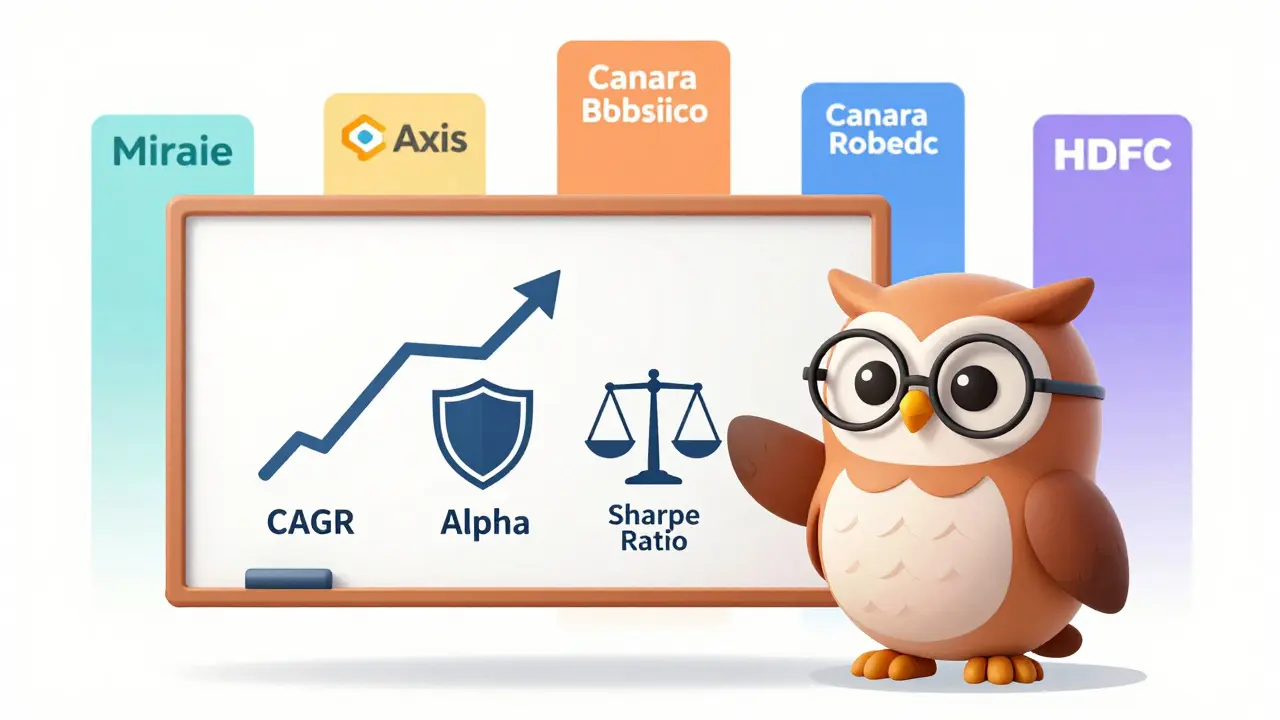
- CAGR (Compound Annual Growth Rate): Look at 3-year, 5-year, and 10-year CAGRs. A fund that has delivered 15% CAGR over 5 years is more reliable than one that did 25% in one year and 5% in the next.
- Alpha: This measures how much the fund has beaten its benchmark index (usually Nifty 500). An Alpha of 2 means the fund outperformed the index by 2% after adjusting for risk. You want positive Alpha.
- Beta: This shows volatility. A Beta of 1.2 means the fund moves 20% more than the market. High Beta means high risk. For tax-saving, you usually want a Beta close to 1.
- Sharpe Ratio: This tells you how much return you are getting for every unit of risk taken. Higher is better. A Sharpe ratio above 1 is considered good; above 1.5 is excellent.
Don't just pick the fund with the highest return number. Pick the fund with the best consistency. A fund that loses money in down markets but recovers quickly is better than a fund that crashes hard and stays down.
Top Performing ELSS Funds in India (2024-2026 Analysis)
Based on data from SEBI registered AMCs and platforms like Value Research and Morningstar, here are the ELSS funds that have demonstrated strong performance leading up to mid-2026. These funds have shown resilience during market corrections and strong growth during bull runs.
1. Mirae Asset ELSS Tax Saver Fund
This fund has been a consistent performer. It follows a value-oriented strategy, meaning it looks for undervalued stocks across large, mid, and small caps. Over the last 5 years, it has delivered an average annual return of approximately 16.5%. The fund manager, Jayant Shah, has a proven track record of staying invested through cycles rather than chasing trends.
2. Axis Long Term Equity Fund
Axis Mutual Fund is known for its disciplined approach. Their ELSS fund focuses heavily on quality companies with strong cash flows. While it may not always be the absolute top performer in a raging bull market, it tends to fall less during bear markets. Its 3-year CAGR has hovered around 14-15%, making it a stable choice for conservative equity investors.
3. Canara Robeco Equity Tax Saver Fund
This fund takes a slightly higher risk by allocating significantly to mid-cap and small-cap stocks. When the market favors smaller companies, this fund shines. It has delivered some of the highest returns in the category over the past 10 years, often crossing 17% CAGR. However, it comes with higher volatility. If you can stomach swings, this is a high-reward option.
4. Kotak Tax Planner Fund
Kotak Mahindra Mutual Fund is famous for its low-cost structure. The Kotak Tax Planner uses a bottom-up stock selection process. It doesn't follow the herd. This independence has helped it generate consistent Alpha over the long term. It is particularly good at sector rotation, moving money from overheated sectors to emerging ones.
5. HDFC TaxSaver Fund
As one of the oldest ELSS funds, HDFC TaxSaver has seen many market cycles. It has undergone changes in management, but recently it has stabilized with a focus on large-cap stability mixed with mid-cap growth. It is a solid "set and forget" option for those who prefer established brands.
| Fund Name | 5-Year CAGR (%) | Expense Ratio (%) | Risk Profile |
|---|---|---|---|
| Mirae Asset ELSS Tax Saver | 16.5 | 0.85 | High |
| Canara Robeco Equity Tax Saver | 17.2 | 0.90 | Very High |
| Axis Long Term Equity Fund | 14.8 | 0.75 | Medium-High |
| Kotak Tax Planner | 15.5 | 0.65 | High |
| HDFC TaxSaver | 14.2 | 0.80 | Medium-High |
Note: Past performance is not a guarantee of future results. Expense ratios impact your net returns. A lower expense ratio means more money stays in your pocket.
How to Choose the Right ELSS Fund for You
Not every high-returning fund is right for you. Your personal financial situation dictates which fund you should pick. Ask yourself these three questions.
- What is my risk appetite? If you panic when the market drops 10%, avoid aggressive small-cap heavy funds like Canara Robeco. Stick to large-cap focused funds like Axis or HDFC.
- When do I need the money? Remember the 3-year lock-in. If you think you might need this money in 2 years, do not put it in ELSS. Put it in liquid funds or arbitrage funds instead. ELSS is for money you can afford to leave alone for at least 3-5 years.
- Am I investing a lump sum or via SIP? If you are investing a large lump sum, consider averaging your entry points. If you are doing a monthly SIP, you benefit from rupee cost averaging, which reduces the impact of volatility. In that case, you can take slightly higher risks.
Common Mistakes Investors Make with ELSS
I see the same mistakes every year. Avoid them to keep your returns healthy.
Chasing Last Year's Winner: The fund that topped the charts last year often underperforms the next year. Styles rotate. What worked in 2023 might not work in 2026. Look at 5-year consistency, not 1-year hype.
Ignoring Exit Load: While the statutory lock-in is 3 years, some funds impose an exit load if you redeem within a certain period (usually 1 year). Check the scheme information document. Usually, there is no exit load after the lock-in, but it pays to verify.
Not Rebalancing: If your ELSS allocation grows too large relative to your total portfolio, you become overexposed to equity risk. Periodically review your asset allocation. If ELSS becomes more than 20-30% of your total investable assets, consider diverting new investments to debt or hybrid funds.

Step-by-Step Guide to Investing in ELSS
Getting started is easier than you think. Here is how to do it correctly.
- Complete KYC: Ensure your PAN, Aadhaar, and bank details are linked and verified. You can do this online through NSDL or CAMS.
- Choose a Platform: You can buy directly from the AMC website or use a discount broker/platform like Zerodha Coin, Groww, or Kuvera. Direct plans have lower expense ratios than regular plans (where an agent gets a commission). Always choose Direct Plans to maximize returns.
- Select Growth Option: Choose the "Growth" option, not "Dividend." Dividends are taxed as income, whereas growth options defer taxes until you sell, allowing compounding to work harder.
- Set Up SIP or Invest Lump Sum: Decide whether you will invest monthly or once a year. Monthly SIPs are generally recommended for salaried individuals.
- Claim Deduction in ITR: Keep your investment receipts. When filing your Income Tax Return (ITR), enter the amount under Section 80C. You don't need to submit physical proofs anymore if your PAN is linked, but keep digital records safe.
Future Outlook: ELSS in 2026 and Beyond
The Indian equity market has matured. Valuations are higher than they were five years ago. This means the era of easy 20%+ returns might slow down. However, India's GDP growth story remains intact. Corporate earnings are growing. As long as earnings grow, equity prices will trend upward.
For 2026 and beyond, expect sectoral shifts. Technology, renewable energy, and manufacturing are likely to drive growth. Funds that have exposure to these themes may outperform traditional banking-heavy portfolios. Keep an eye on fund mandates changing to include ESG (Environmental, Social, and Governance) criteria, as global capital is increasingly flowing into sustainable investments.
Is ELSS better than PPF for tax saving?
If you have a long-term horizon (5+ years) and can handle market volatility, yes, ELSS is better because it offers higher potential returns (12-15% vs 7-8%). If you need guaranteed returns and cannot tolerate any loss of principal, PPF is safer. ELSS has a shorter lock-in (3 years vs 15 years), offering more liquidity.
Can I withdraw money from ELSS before 3 years?
No. The 3-year lock-in period is mandatory for each installment. If you invest via SIP, each monthly installment has its own separate 3-year lock-in. You cannot withdraw early even in emergencies.
Are gains from ELSS tax-free?
Yes, if you hold the units for more than 1 year, the capital gains are treated as Long Term Capital Gains (LTCG). Currently, LTCG on equity funds is tax-free up to ₹1.25 lakh per financial year. Gains above this limit are taxed at 12.5% (as per current budget rules). Since ELSS has a 3-year lock-in, your gains will almost always qualify for LTCG treatment.
Should I invest in Direct or Regular ELSS plans?
Always choose Direct plans. Regular plans pay commissions to agents, which increases the expense ratio by 0.5% to 1%. Over 10 years, this difference can eat up 5-10% of your total returns. Direct plans are available on most digital platforms at no extra cost to you.
How much should I invest in ELSS?
Invest enough to utilize your full ₹1.5 lakh Section 80C limit if you have a high-risk tolerance. If you are conservative, split your 80C allocation between ELSS (e.g., ₹50k), PPF (₹50k), and other instruments. Never invest money in ELSS that you might need for immediate expenses.