How to Choose an NPS Annuity Provider in India: IRDAI-Regulated Options
Choosing the right NPS annuity provider isn’t just about picking the highest payout-it’s about finding a provider that actually delivers when you need it most. With over 50 million subscribers in India’s National Pension System (NPS), the number of people retiring and moving into annuity phase is growing fast. But not all annuity providers are created equal. Some offer better guarantees, clearer terms, or more flexibility. And since IRDAI regulates them, you have real protections-but only if you know what to look for.
What Is an NPS Annuity?
When you retire from NPS, you’re required to use at least 40% of your accumulated corpus to buy an annuity. That’s the part that gives you a regular pension for life. The rest (up to 60%) can be taken as a lump sum. But here’s the catch: the annuity isn’t automatic. You have to choose a provider, pick a plan, and sign the contract. If you don’t, your funds stay locked in a default scheme with lower returns.
An annuity is essentially an insurance product. You hand over your money, and in return, you get monthly payments. The size of those payments depends on three things: how much you invest, your age at purchase, and the type of annuity you select. Not all providers offer the same options. Some only give you basic lifetime payments. Others let you add inflation protection, spouse benefits, or even return of purchase price.
IRDAI’s Role in NPS Annuities
The Insurance Regulatory and Development Authority of India (IRDAI) doesn’t just oversee annuity providers-it sets the rules that keep them honest. Every company offering NPS annuities must be registered with IRDAI and follow strict guidelines on transparency, pricing, and customer service. That means:
- They can’t hide fees or change terms after you sign.
- They must clearly explain all payout options before you commit.
- They’re required to maintain reserves to ensure they can pay you for life.
- Complaints can be escalated to IRDAI’s grievance portal if they break rules.
That’s your safety net. But knowing IRDAI is watching doesn’t mean you can skip due diligence. Some providers still offer worse deals than others-especially if you don’t compare.
Key Annuity Types You Can Choose
Not all annuities are the same. IRDAI-approved providers typically offer five main types. Each affects your monthly income differently:
- Lifetime Annuity - You get paid monthly until you die. No money goes back to your family.
- Lifetime Annuity with Return of Purchase Price - Your heirs get back the full amount you paid if you pass away early.
- Lifetime Annuity with Spouse Benefit - Your spouse keeps receiving payments after your death, usually at 50% or 100% of your original amount.
- Lifetime Annuity with Inflation Protection - Payments increase each year to keep up with rising costs (usually 3%-5% annual hikes).
- Joint Life Annuity with Last Survivor Benefit - Payments continue to your spouse for life, even after you pass.
Here’s the reality: the more benefits you add, the lower your monthly payout. A basic lifetime annuity might give you ₹8,000/month. Add spouse and inflation protection? That drops to ₹6,200. You need to decide what matters most: immediate cash flow, or long-term security for your family.

Top IRDAI-Regulated Annuity Providers for NPS
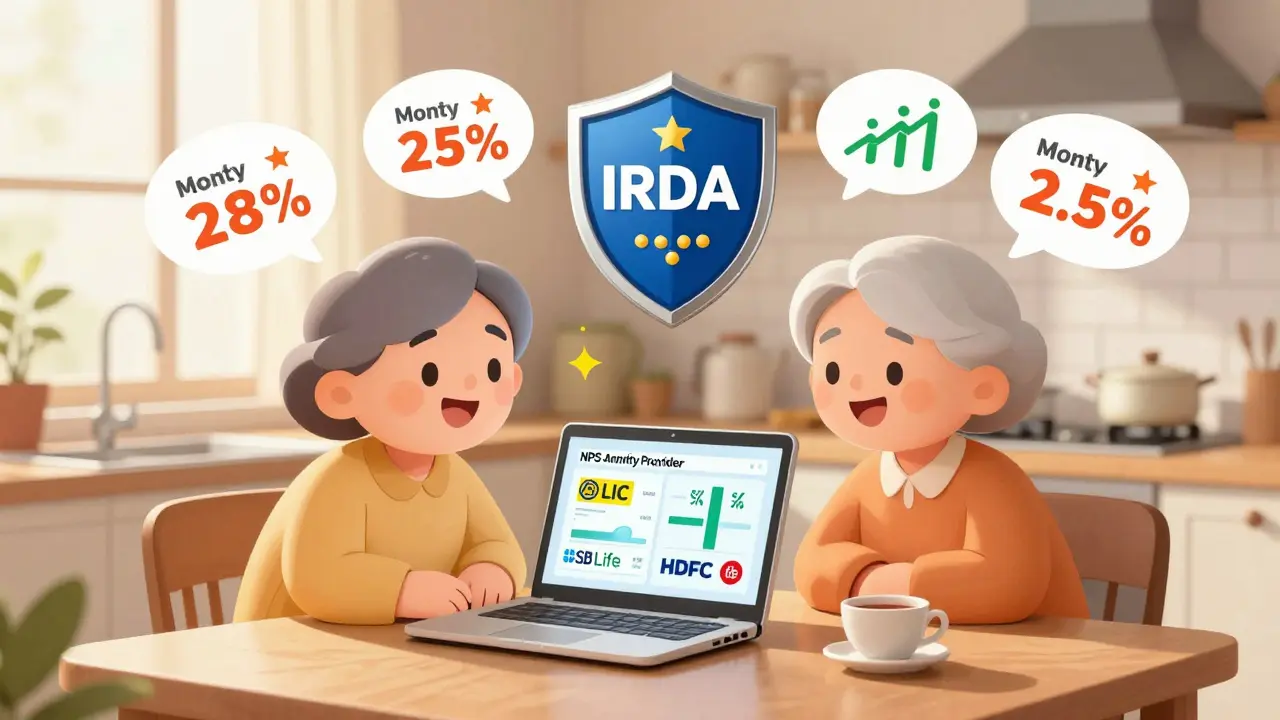
As of 2026, only eight insurers are approved to offer NPS annuities. These include big names and a few specialized players:
| Provider | Best For | Minimum Age | Inflation Option? | Spouse Benefit | Return of Premium? |
|---|---|---|---|---|---|
| Life Insurance Corporation of India (LIC) | Trust and stability | 60 | Yes | Yes (100%) | Yes |
| SBI Life Insurance | High payout rates | 60 | Yes | Yes (50%) | No |
| HDFC Life | Flexible payout options | 60 | Yes | Yes (100%) | Yes |
| ICICI Prudential | Online process | 60 | Yes | Yes (100%) | Yes |
| Max Life Insurance | Low-cost plans | 60 | Yes | Yes (50%) | No |
| Kotak Mahindra Life | Customized plans | 60 | Yes | Yes (100%) | Yes |
| Bajaj Allianz Life | Quick settlement | 60 | No | Yes (100%) | No |
| PNB MetLife | Regional service | 60 | No | Yes (50%) | No |
LIC is the most trusted because it’s government-backed and has been around since 1956. But that doesn’t mean it’s always the best deal. SBI Life often offers the highest monthly payouts. HDFC Life and ICICI Prudential stand out for digital ease-you can complete the whole process online without visiting a branch. If you’re worried about inflation eating away your pension, only four providers offer indexed increases. And if you want your spouse to keep getting payments, check whether they offer 50% or 100% continuation.
What You Should Check Before Signing
Don’t just pick the first provider you see. Here’s what to verify:
- Actual payout estimates - Ask for a written quote based on your corpus and age. Don’t rely on online calculators-they often assume ideal conditions.
- Reputation for timely payments - Call IRDAI’s customer service line (toll-free: 14000) and ask if any complaints have been filed against the provider in the last year.
- Flexibility to switch - Once you buy an annuity, you can’t change it. But some providers allow you to switch providers once within the first 30 days if you change your mind.
- Customer support access - Can you reach them by phone? Is there a local branch? Do they have a dedicated NPS helpline?
- Hidden charges - Some charge for policy issuance, documentation, or even for changing your bank account details later. Get all fees in writing.
Common Mistakes People Make
Most retirees make one of these three mistakes:
- Picking based on brand alone - Just because LIC is well-known doesn’t mean it gives you the best payout. Compare numbers first.
- Ignoring inflation - ₹8,000 today might feel like enough. But in 10 years, with 6% inflation, it’s worth only ₹4,400 in real terms. If you can’t afford inflation protection, consider delaying annuity purchase until you’re older-so your corpus grows more.
- Not involving your spouse - If you die and your spouse isn’t covered, they lose their income. Always ask: “What happens to my partner?”
One real case: A retired teacher in Pune chose LIC because her friend recommended it. She didn’t ask about inflation protection. Five years later, her monthly ₹7,500 barely covered groceries. She had to move in with her daughter. A simple upgrade to an inflation-linked plan could’ve kept her independent.
When to Act
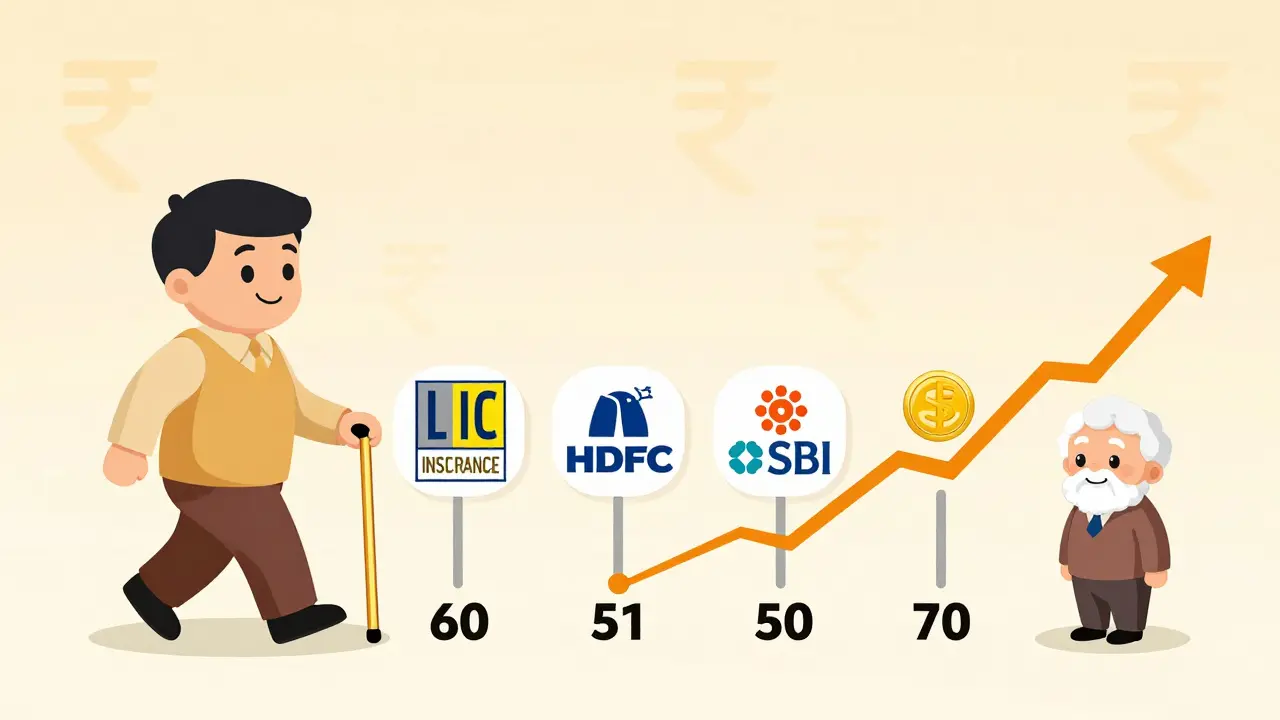
You can start the annuity process as early as age 60. But if you’re still working, consider waiting. Every year you delay means:
- Your corpus grows more (if you keep contributing or earn returns).
- You lock in a higher payout rate (because annuity rates improve with age).
- You have more time to compare providers.
Many people rush into annuity purchases right after retirement-often because they’re told to “secure your income.” But if you’re healthy and financially stable, waiting until 65 or even 70 can boost your monthly income by 15%-25%.
Final Checklist Before You Commit
- ✅ I’ve compared at least three providers using official IRDAI quotes.
- ✅ I’ve asked for a written breakdown of my projected monthly income under each plan.
- ✅ I’ve confirmed whether inflation, spouse, and return of premium options are available.
- ✅ I’ve checked the provider’s IRDAI complaint history on their official portal.
- ✅ I’ve spoken to someone who already bought an annuity from this provider.
- ✅ I’ve read the fine print on cancellation, switching, and fees.
Choosing your NPS annuity provider is one of the most important financial decisions you’ll make after retirement. It’s not about the biggest name. It’s about the best fit-for your life, your family, and your future.
Can I change my annuity provider after I’ve bought the plan?
No, once you purchase an annuity, you cannot switch providers. However, most IRDAI-approved companies allow you to cancel and switch within the first 30 days after purchase, as long as you haven’t received your first payment. After that, the contract is binding. Always double-check before signing.
What happens to my annuity if the provider goes bankrupt?
IRDAI requires all annuity providers to maintain a statutory reserve fund to cover future liabilities. If a company fails, IRDAI steps in to transfer your policy to another insurer. Your payments may pause briefly, but they won’t stop. This has happened only twice in India’s history, and pensioners were fully protected both times.
Is it better to buy an annuity from LIC or a private company?
LIC offers unmatched trust and stability, but private insurers like SBI Life, HDFC Life, and ICICI Prudential often offer higher payouts and better digital services. If you prioritize safety and customer service, LIC is solid. If you want more money each month and a smooth online experience, go with a private provider. Always compare actual quotes-not reputation.
Can I buy more than one annuity from different providers?
Yes. While you must use at least 40% of your NPS corpus to buy one annuity, you can split that amount across multiple providers. For example, you could buy a basic annuity from LIC and a separate inflation-linked one from HDFC Life. This diversifies risk and gives you more control over your income streams.
Do I need to pay taxes on my NPS annuity payments?
Yes. Annuity payments are treated as regular income and taxed according to your income tax slab. Unlike the lump sum portion (which is tax-free up to 60%), monthly annuity income is fully taxable. Plan for this when calculating how much you’ll actually receive each month.