How to Rebalance a Retirement Portfolio in India: Practical Annual Steps
Imagine you set aside money for your golden years five years ago. You bought some stocks because they promised high growth and kept some cash in bonds for safety. Fast forward to today. The stock market has surged, while bond yields have stayed flat. Suddenly, what used to be a balanced mix is now heavily weighted toward risky assets. If the market crashes tomorrow, you’re exposed far more than you planned.
This is why rebalancing matters. It’s not just a finance buzzword; it’s the act of bringing your investments back to their original risk profile. For investors in India, this process involves navigating specific tax laws, unique instruments like the National Pension System (NPS), and a volatile equity market that can swing wildly within months.
Most people think rebalancing happens automatically or only when they retire. That’s a dangerous myth. Without annual checks, your portfolio drifts away from your comfort zone. This guide breaks down exactly how to fix that drift every year, using practical steps tailored to the Indian financial landscape.
Why Your Portfolio Drifts Off Course
Asset allocation is the backbone of any retirement plan. When you start, you might decide on a 60% equity and 40% debt split. This means for every ₹100 you invest, ₹60 goes into stocks or equity mutual funds, and ₹40 goes into safer options like government bonds or fixed deposits.
Over time, different assets grow at different speeds. Let’s say equities return 15% annually while debt returns 7%. After one year, your ₹100 becomes ₹113. But the composition has changed. The equity portion grew by ₹9 (₹60 * 15%), becoming ₹69. The debt portion grew by ₹2.80 (₹40 * 7%), becoming ₹42.80. Your new split is roughly 61% equity and 39% debt. It looks small, but over five or ten years, this "drift" can push your equity exposure to 70% or even 80%.
Here is the trap: higher equity means higher potential returns, but also higher volatility. As you get closer to retirement, your ability to withstand a 20% market drop decreases. If you don’t rebalance, you are inadvertently taking on more risk as you age, which is the opposite of what you should be doing.
The Two Methods of Rebalancing
There are two main ways to bring your portfolio back in line. Knowing which one suits your situation saves you money and hassle.
- Calendar-Based Rebalancing: You pick a specific date-say, January 1st or your birthday-and review your portfolio then. If the allocation is off by more than a certain percentage (like 5%), you adjust it. This method is simple and disciplined. It prevents emotional trading based on daily market news.
- Threshold-Based Rebalancing: You set a limit. If your target is 60/40, you agree to rebalance whenever equity hits 65% or drops to 55%. This method reacts to market changes faster but requires more monitoring.
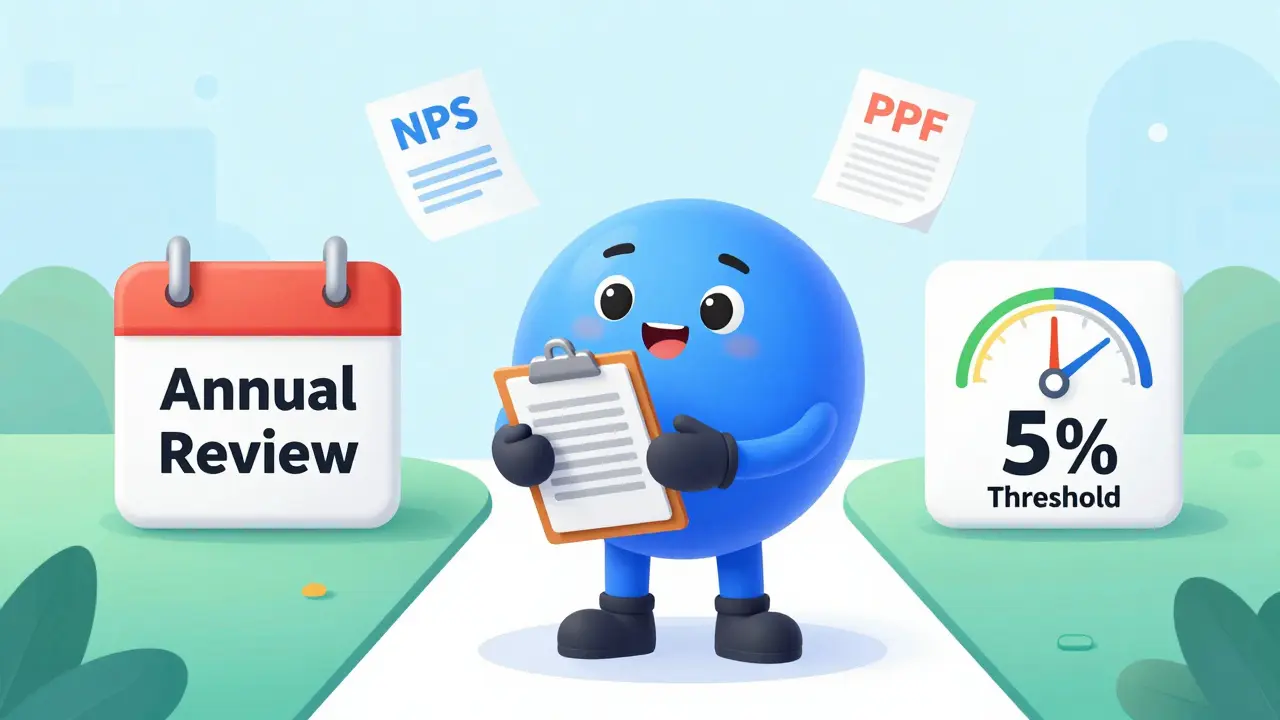
For most Indian retirees or pre-retirees, calendar-based rebalancing is less stressful. It turns a complex task into a simple annual appointment. Combine this with a threshold rule-for example, "I will check every year, but I’ll only trade if the drift is more than 5%"-and you have a robust system.
Step-by-Step Guide to Annual Rebalancing in India
Let’s walk through the actual process. You don’t need a financial advisor to do this, but you do need organization.
Step 1: Gather All Holdings
List every investment account. In India, this often includes:
- Public Provident Fund (PPF)
- National Pension System (NPS) accounts
- Equity Mutual Funds (direct or regular plans)
- Debt Mutual Funds or Liquid Funds
- Fixed Deposits (FDs)
- Individual Stocks
- Gold ETFs or Sovereign Gold Bonds (SGBs)
Calculate the current market value of each. Don’t look at what you paid; look at what it’s worth today.
Step 2: Compare Against Target Allocation
If your target is 60% Equity / 30% Debt / 10% Gold, calculate your current percentages. Use a spreadsheet or a portfolio tracking app. Identify which asset class has grown too much and which has lagged.
Step 3: Execute Trades Tax-Efficiently
This is where many Indians lose money to taxes. Never sell just to rebalance if it triggers a large capital gains tax bill unnecessarily. Instead, use new contributions to rebalance.
If your equity portion is too high, stop buying equity mutual funds for the next few months. Direct all new SIPs (Systematic Investment Plans) or lump sums into debt or gold until the balance corrects itself. Only sell existing holdings if the drift is severe (more than 10%) or if you need cash flow.
Step 4: Review Risk Tolerance
As you age, your "target" should change. A 30-year-old might aim for 80% equity. A 55-year-old should likely shift to 50% equity. A 65-year-old might prefer 30% equity. Adjust your target allocation annually to reflect your remaining working years and health status.
Navigating Indian-Specific Constraints
India’s financial ecosystem has unique features that affect rebalancing. Ignoring them can lead to penalties or missed opportunities.
| Instrument | Liquidity | Tax Benefit | Rebalancing Flexibility |
|---|---|---|---|
| National Pension System (NPS) | Low (locked till 60) | Section 80CCD(1B) extra ₹50k deduction | High (can switch asset classes online instantly) |
| Public Provident Fund (PPF) | Very Low (15-year lock-in) | EEE Status (Exempt-Exempt-Exempt) | None (cannot withdraw early except for house marriage/medical) |
| Equity Linked Savings Scheme (ELSS) | Medium (3-year lock-in) | Section 80C up to ₹1.5L | Medium (can sell units after 3 years) |
| Mutual Funds (Non-Tax Saving) | High | LTCG tax @ 12.5% above ₹1.25L profit (equity) | Very High (buy/sell anytime) |
National Pension System (NPS) is a defined contribution pension scheme regulated by PFRDA. One major advantage of NPS for rebalancing is its flexibility. Unlike PPF, you can change the asset allocation between Equity (E), Corporate Debt (C), and Government Securities (G) at any time via the CRA portal. If your NPS equity allocation has grown too large due to market gains, simply log in and shift future contributions to the 'C' or 'G' tier. Note that if you are above 50 years old, the default auto-choice mode shifts you to a more conservative portfolio unless you opt out. Always check this setting during your annual review.
Public Provident Fund (PPF) is a long-term savings instrument backed by the Government of India offering tax-free interest. Since PPF is illiquid, it acts as the "stable core" of your portfolio. You cannot rebalance PPF directly. Instead, treat it as a fixed block of safe debt. If your overall portfolio needs more debt, increase your PPF contribution up to the ₹1.5 lakh annual limit before looking at other debt instruments.
Tax Implications of Selling Assets
In India, selling assets to rebalance triggers tax events. Understanding these helps you minimize leakage.
Equity Mutual Funds and Stocks: If held for more than one year, profits are subject to Long Term Capital Gains (LTCG) tax of 12.5% on gains exceeding ₹1.25 lakh per financial year. Short term gains (held less than a year) are taxed at 20%. If your rebalancing requires selling equity, try to do it in a financial year where you haven’t exceeded the ₹1.25 lakh exemption limit, or spread sales across two years.
Debt Mutual Funds: Post-April 2023 budget changes, debt fund gains are added to your income and taxed according to your slab rate. There is no indexation benefit for new investments. This makes debt funds less tax-efficient for rebalancing compared to Fixed Deposits or PPF for those in higher tax brackets.
Gold: Physical gold sold after three years attracts LTCG of 20% with indexation benefits. Gold ETFs follow similar rules. Sovereign Gold Bonds (SGBs) are tax-exempt on capital gains if held to maturity (8 years). If you hold SGBs, avoid selling them early just to rebalance; instead, use other liquid assets.

Common Mistakes to Avoid
Even experienced investors make errors during rebalancing. Here are the top three pitfalls in the Indian context:
- Ignoring Inflation: ₹10 lakh today won’t buy what it buys in 20 years. Ensure your rebalancing doesn’t overly favor low-yield debt. Keep enough equity to beat inflation (typically 6-7%).
- Emotional Timing: Don’t sell equities because the market is "too high." Don’t buy because it’s "cheap." Stick to your mathematical targets. Market timing fails more often than it succeeds.
- Overcomplicating with Too Many Funds: Having five different equity mutual funds doesn’t diversify you; it just makes rebalancing harder. Consolidate into broad-market index funds or well-managed active funds to simplify the process.
When to Call a Professional
You can handle basic rebalancing yourself. However, consider hiring a SEBI-registered Investment Advisor if:
- Your portfolio exceeds ₹1 crore.
- You have complex assets like real estate, private business interests, or international holdings.
- You are unsure about your risk tolerance or behavioral biases.
A good advisor charges a flat fee or hourly rate, not a commission on products sold. This aligns their interest with yours.
Final Checklist for Your Annual Review
Before closing your laptop for the year, ask yourself these questions:
- Has my age or health changed significantly?
- Have my income sources changed (e.g., nearing retirement)?
- Is my emergency fund (3-6 months of expenses) intact and separate from investments?
- Did I maximize my tax-saving limits (80C, 80CCD) this year?
- Are my nominees updated on all accounts?
Rebalancing is not a one-time event. It’s a habit. By spending one hour a year adjusting your portfolio, you protect your retirement from unnecessary risk and ensure your money works as hard as you did during your career.
How often should I rebalance my retirement portfolio in India?
Once a year is sufficient for most investors. Set a reminder for your birthday or the start of the financial year (April 1). If your portfolio drifts by more than 5-10% from your target allocation before the annual review, consider an interim adjustment.
Can I rebalance my NPS account freely?
Yes. Unlike PPF, NPS allows you to change the asset allocation between Equity, Corporate Debt, and Government Securities at any time via the Central Recordkeeping Agency (CRA) portal. This is a powerful tool for dynamic rebalancing without triggering tax events.
What is the tax impact of rebalancing equity mutual funds?
If you sell equity mutual funds held for more than one year, gains above ₹1.25 lakh in a financial year are taxed at 12.5%. To minimize tax, use new contributions to buy underweight assets rather than selling overweight assets, unless the drift is significant.
Should I include Gold in my retirement portfolio?
Yes, typically 5-10%. Gold acts as a hedge against inflation and currency depreciation. In India, Sovereign Gold Bonds (SGBs) are preferred over physical gold for retirement portfolios because they offer tax-free capital gains if held to maturity and pay 2.5% annual interest.
How does age affect my asset allocation?
A common rule of thumb is to subtract your age from 100 to determine your equity percentage. For example, a 40-year-old might hold 60% in equity. As you approach retirement (60+), shift towards debt and stable instruments to preserve capital, reducing equity to 20-30%.