Section 80C Documentation Checklist in India: Proofs Required at Filing Time
When you’re filing your income tax return in India, one of the biggest ways to cut your tax bill is through Section 80C. But if you don’t have the right documents ready, you could miss out on thousands of rupees in deductions. It’s not just about claiming the limit - it’s about proving you’re eligible. The Income Tax Department doesn’t ask for these papers upfront, but they will ask for them later if your return gets selected for scrutiny. And when they do, you need to be ready.
What Section 80C Actually Covers
Section 80C lets you reduce your taxable income by up to ₹1.5 lakh per year. That’s not a tax refund - it’s a reduction in the income that gets taxed. So if you earn ₹12 lakh and claim the full ₹1.5 lakh under 80C, you’re only taxed on ₹10.5 lakh. Simple. But not all investments qualify. Only specific ones do, and each one needs its own proof.
The eligible investments include:
- Public Provident Fund (PPF)
- Employee Provident Fund (EPF) - your contribution only
- Life insurance premiums
- Principal repayment on home loans
- Fixed deposits (5-year tenure)
- National Savings Certificates (NSC)
- Equity-Linked Savings Schemes (ELSS)
- Tuition fees for up to two children
- Unit Linked Insurance Plans (ULIPs)
- Senior Citizen Savings Scheme (SCSS)
- Five-year tax-saving fixed deposits
Each of these has different rules. For example, tuition fees only count if paid to Indian schools or universities. And only the principal part of your home loan EMI counts - not the interest. That’s a common mistake.
Documents You Need to Keep Ready
You don’t submit these with your ITR, but you must keep them for at least six years. That’s how long the tax department can come back to you. Here’s what you need for each major investment:
- PPF: Passbook with deposit details and bank statement showing transfers. If you deposited via net banking, keep the transaction receipt.
- EPF: Form 16 from your employer - it shows your contribution. If you’re self-employed and contributed voluntarily, keep bank transfer records.
- Life insurance: Policy number, premium receipt, and policy document. Make sure the policy is in your name, your spouse’s, or your child’s. Parents’ policies don’t count.
- Home loan principal repayment: Bank statement showing EMI payments. The lender usually provides a certificate at year-end. If not, download your loan statement and highlight the principal portion.
- 5-year FDs: FD receipt from the bank. If you opened it online, download the confirmation email and transaction history.
- NSC: Purchase receipt and maturity certificate. These are issued by post offices.
- ELSS: Statement from the mutual fund house showing units purchased and amount invested. Keep the folio number.
- Tuition fees: Official receipts from the school or college. Must include your child’s name, the fee amount, and the institution’s stamp.
- SCSS: Deposit receipt from the bank or post office. Only for individuals aged 60+.
One thing to remember: you can’t claim the same expense twice. If you paid tuition fees for two kids, you can claim both. But if you paid ₹80,000 for one child and ₹70,000 for another, you can only claim ₹1.5 lakh total. The rest is lost.
What Not to Keep
Many people waste time collecting papers that don’t matter. Here’s what you can ignore:
- Interest earned on PPF or NSC - it’s tax-free, so no proof needed.
- Health insurance premiums - those fall under Section 80D, not 80C.
- Donations to charities - those are under Section 80G.
- Gold purchases - even if you buy sovereign gold bonds, they’re under Section 80C only if they’re specifically labeled as tax-saving. Most aren’t.
- Investments in mutual funds that aren’t ELSS - regular diversified funds don’t qualify.
Also, don’t assume your employer’s Form 16 covers everything. It only shows what they deducted from your salary. If you made extra investments - like buying ELSS on your own or paying tuition fees - you need to add those separately. Form 16 is just a starting point.

How to Organize Your Proof
Don’t wait until April to start sorting this out. Start in January. Create a folder - digital or physical - and label it "Section 80C Proofs 2025-26". Here’s a simple system:
- Group documents by investment type.
- Scan every receipt and save as PDF with a clear name: "ELSS_SBI_2025.pdf" or "Tuition_Fee_SchoolX_Jan2025.jpg".
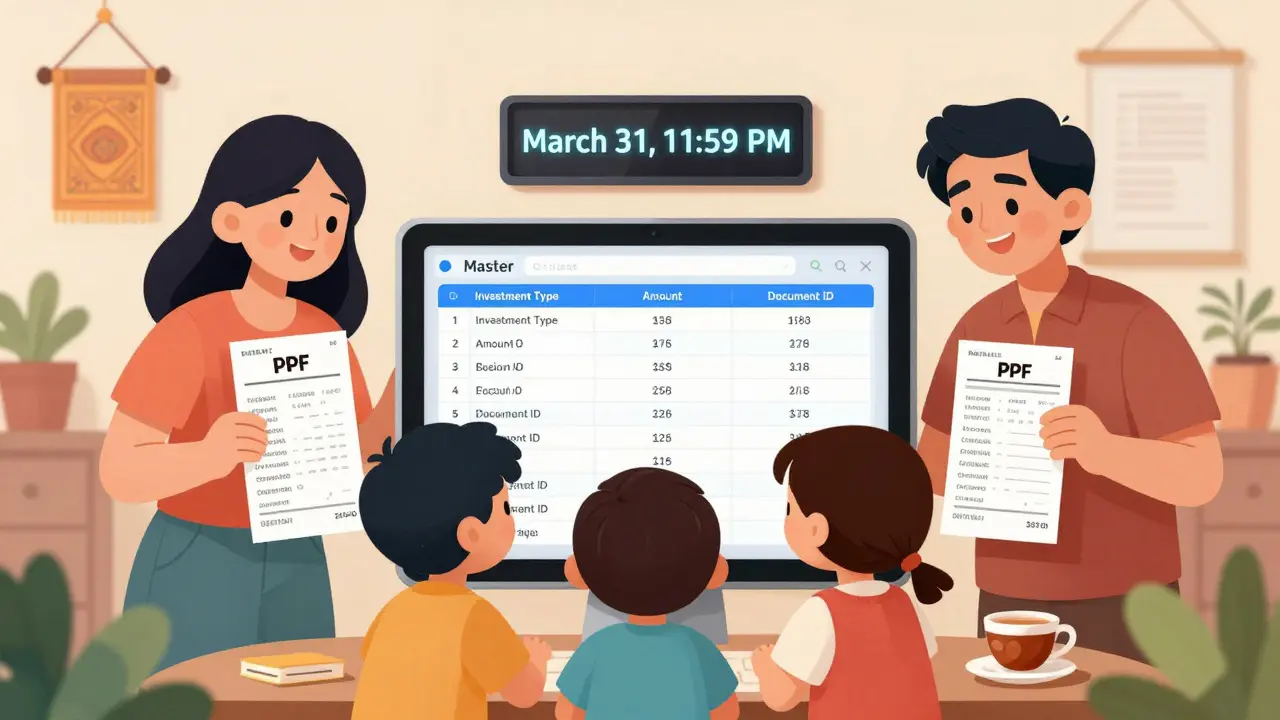
- Keep a master spreadsheet with columns: Investment Type, Amount, Date, Document ID, Bank/Institution.
- Update it every time you make a payment.
Use cloud storage - Google Drive or Dropbox - so you can access it from anywhere. If you’re audited, you’ll need to send these documents quickly. A messy pile of papers will delay everything.
What Happens If You Don’t Have Proof?
If you claimed ₹1.5 lakh under Section 80C but can’t produce proof when asked, the tax department will disallow the entire claim. That means your taxable income jumps back up, and you’ll owe more tax - plus interest. For someone in the 30% tax bracket, losing a ₹1.5 lakh deduction could mean paying an extra ₹45,000 in taxes.
And it’s not just about money. If you’re caught with fake documents - like forged receipts or fake FD certificates - you could face penalties under Section 271(1)(c), which can be up to 200% of the tax evaded. That’s not a risk worth taking.
Pro Tip: Use Your Employer’s Portal
If you’re salaried, your employer’s HR portal often has a "Tax Declaration" section. Submit your investments there before March. They’ll deduct the right amount from your salary all year. That way, your Form 16 already reflects your claims. It reduces the chance of mismatch later.
But even if you do this, you still need to keep your own records. Employers make mistakes. Systems glitch. Don’t rely on them.
Common Mistakes to Avoid
- Claiming life insurance premiums for parents - only your own, spouse’s, or children’s policies count.
- Forgetting to claim tuition fees - many people don’t realize this is under 80C.
- Investing too late - if you buy an ELSS on April 1, it counts for the financial year ending March 31. But if you wait until April 2, you lose it.
- Using the same receipt twice - one investment, one claim. No double-dipping.
- Not keeping digital copies - paper receipts fade, get lost, or get damaged.
Final Checklist
Before you file your ITR, run through this:
- Did I invest in any of the 80C-eligible options?
- Did I get receipts or statements for each?
- Did I scan and label them clearly?
- Did I add them to a master list?
- Did I check that I didn’t exceed ₹1.5 lakh total?
- Did I confirm that all investments are in my name or my dependents’ names?
If you answered yes to all, you’re ready. If not, fix it now. Don’t wait for a notice from the tax department. Proactive is always better than reactive.
Do I need to submit Section 80C proofs while filing my ITR?
No, you don’t submit documents when you file your income tax return. But you must keep them for at least six years. The Income Tax Department may ask for them later if your return is selected for scrutiny. If you can’t produce them, your deduction may be disallowed.
Can I claim tuition fees for more than two children under Section 80C?
No. Section 80C allows deduction for tuition fees paid for a maximum of two children. Even if you have three kids, only the fees for two of them qualify. The limit still applies to the total ₹1.5 lakh under Section 80C.
Is the interest earned on PPF or NSC eligible for deduction under Section 80C?
No. While the amount you invest in PPF or NSC qualifies for deduction under Section 80C, the interest earned on them is tax-free and doesn’t count toward the ₹1.5 lakh limit. You don’t need to claim it - it’s automatically exempt.
Can I claim both EPF and PPF under Section 80C?
Yes. Both your EPF contribution (from salary) and PPF investment (if you opened it yourself) qualify under Section 80C. They are separate instruments, and you can combine them as long as the total doesn’t exceed ₹1.5 lakh in a financial year.
What if I invest ₹2 lakh in ELSS - can I claim more than ₹1.5 lakh?
No. The maximum deduction under Section 80C is capped at ₹1.5 lakh per financial year, regardless of how much you invest. Even if you invest ₹2 lakh in ELSS, only ₹1.5 lakh can be claimed. The extra ₹50,000 won’t reduce your taxable income.