Index Funds vs Active Funds in India: Costs, Tracking Error, and Performance (2026 Guide)
You’ve probably seen the headlines. Year after year, most active funds are mutual funds managed by human portfolio managers who try to beat market benchmarks fail to outperform their benchmark indices over a three- to five-year horizon. In India, this trend is no longer a whisper; it’s a roar. With the rise of low-cost index funds are passive investment vehicles that replicate the performance of a specific market index like Nifty 50 or Sensex, investors are waking up to a simple truth: you might be paying too much for underwhelming results.
But here’s the catch. The Indian market isn’t exactly like the US market. It has higher volatility, different regulatory structures, and a unique mix of retail and institutional players. So, can you just blindly switch everything to index funds? Not necessarily. Understanding the nuances of costs, tracking errors, and actual performance is crucial before you make any moves with your hard-earned money.
The Cost Difference: Where the Money Actually Goes
Let’s talk about the elephant in the room: fees. When you invest in a mutual fund, you pay an expense ratio. This is an annual fee charged by the Asset Management Company (AMC) for managing your money. In the world of passive investing is an investment strategy aiming to match the performance of a market index rather than beat it, these fees are significantly lower because there’s no team of analysts constantly buying and selling stocks to find alpha.
In India, the average expense ratio for an actively managed large-cap fund hovers around 1.5% to 2.0%. Compare that to an index fund tracking the same benchmark, which typically charges between 0.1% and 0.4%. That might sound small, but compound interest works both ways. Over a 15-year period, a 1.5% difference in fees can eat up a massive chunk of your final corpus. If you invest ₹1 lakh per month for 15 years at a 12% return, the extra 1.5% fee in an active fund could cost you lakhs in potential gains.
| Feature | Index Funds (Passive) | Active Funds |
|---|---|---|
| Expense Ratio | 0.1% - 0.4% | 1.5% - 2.5% |
| Turnover Ratio | Low (minimal trading) | High (frequent trading) |
| Tax Efficiency | Higher (lower capital gains events) | Lower (more frequent short-term gains) |
| Management Style | Algorithmic/Replication | Human Discretionary |
Beyond the expense ratio, consider the turnover ratio. Active funds trade frequently. Every time they sell a stock, they trigger a taxable event. In India, equity Long Term Capital Gains (LTCG) are taxed at 10% above ₹1 lakh annually, while Short Term Capital Gains (STCG) are taxed at 20%. High turnover often means more STCG, which hits your post-tax returns harder. Index funds hold stocks until they are removed from the index, resulting in minimal turnover and better tax efficiency.
Understanding Tracking Error: The Silent Risk
If index funds are so cheap and efficient, why don’t everyone use them? The answer lies in a metric called tracking error is a measure of how closely an index fund follows its benchmark index. Tracking error is the standard deviation of the difference between the fund’s returns and the benchmark’s returns. Ideally, you want this to be near zero. However, in practice, it’s never exactly zero.
Why does tracking error occur? There are several reasons. First, the fund needs to keep some cash reserves to handle daily redemptions from investors. Cash doesn’t grow as fast as stocks, so during bull markets, the fund lags behind the index. Second, there are transaction costs-brokerage, stamp duty, and GST on securities transactions. Third, corporate actions like dividends, bonuses, and splits can cause temporary mismatches between the fund’s holdings and the index’s theoretical value.
In India, tracking error is generally manageable for broad-based indices like the Nifty 50 is a benchmark stock market index that represents the weighted average of 50 of the largest Indian companies listed on the National Stock Exchange or the Sensex is the Bombay Stock Exchange's flagship index comprising 30 well-established and financially sound companies. These indices have high liquidity, making it easy for fund managers to buy and sell shares without moving the price. However, for mid-cap or small-cap index funds, tracking error can be higher due to lower liquidity and higher transaction costs. Always check the historical tracking error of an index fund before investing. A consistent positive tracking error (fund outperforming index) is rare and usually unsustainable, while a negative one is common but should be minimal.

Performance: Do Active Managers Add Value?
This is the million-dollar question. Do active fund managers in India actually deliver alpha (excess returns)? The data says it depends on the category. For large-cap funds, the answer is mostly no. Since 2015, less than 20% of large-cap active funds have consistently beaten the Nifty 50 TRI (Total Return Index) over a 5-year period. The market is efficient enough in this segment that it’s hard to find undervalued stocks among the biggest companies.
However, the story changes in mid-cap and small-cap segments. Here, the market is less efficient. Information asymmetry exists, and smaller companies are not covered by as many analysts. Skilled fund managers with deep research capabilities can sometimes identify hidden gems and generate significant alpha. But come with a big caveat: consistency is rare. An active manager who beats the market this year might lag badly next year due to style drift, bad luck, or poor decision-making.
Consider the concept of "style drift." An active fund labeled as "mid-cap" might start investing heavily in large-cap stocks if the manager believes the mid-cap space is overheated. While this might protect the fund during a downturn, it also means you’re not getting the exposure you paid for. Index funds, on the other hand, stick strictly to their mandate. If you buy a Nifty Midcap 150 index fund, you get exactly what’s in the index, nothing more, nothing less. This predictability is a feature, not a bug, for disciplined investors.
When to Choose Which: A Practical Framework
So, how do you decide? It’s not about picking a winner; it’s about building a resilient portfolio. Here’s a practical framework based on your investment goals and risk appetite.
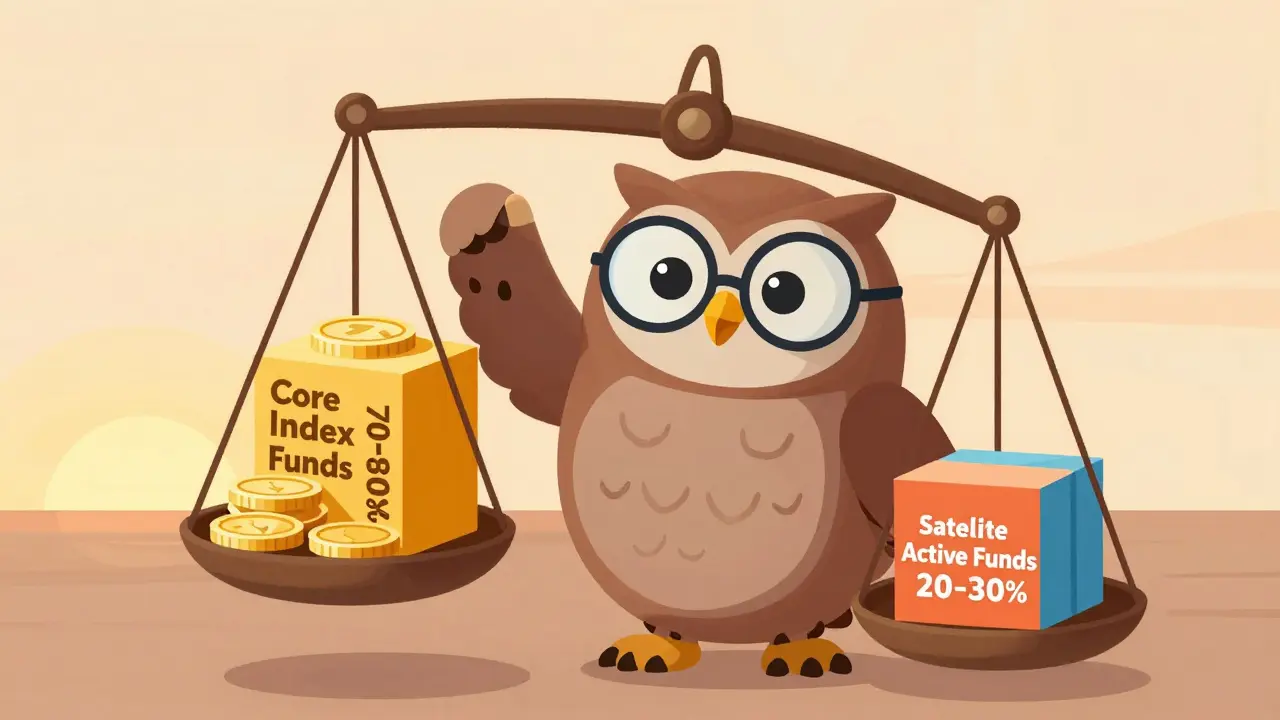
- Core Portfolio Allocation: Use index funds for the core of your portfolio. If you’re investing for retirement or long-term wealth creation, allocate 70-80% to low-cost index funds tracking broad indices like Nifty 50, Nifty Next 50, or Nifty Midcap 150. This ensures you capture market returns at the lowest possible cost.
- Satellite Allocation: Reserve 20-30% for active funds if you believe in the skill of specific fund managers. Focus on categories where active management has historically added value, such as small-cap, contrarian strategies, or sector-specific themes. Only choose active funds that have a proven track record of beating their benchmark over multiple market cycles (bull and bear).
- Market Conditions: In highly volatile or bear markets, active managers can sometimes provide downside protection by shifting to defensive stocks or increasing cash positions. Index funds will fall in line with the market. If you’re worried about a sharp correction, a small allocation to active funds might offer some cushion, though history shows that markets tend to recover eventually.
- Investment Horizon: If your horizon is less than 3-5 years, avoid equity mutual funds altogether, whether active or passive. Stick to debt instruments or liquid funds. For horizons beyond 5 years, the power of compounding favors low-cost index funds.
Don’t forget to look at the fund size. Very small index funds (AUM is Assets Under Management, the total market value of investments managed by a fund less than ₹100 crore) might face liquidity issues or close down. Similarly, very large active funds (>₹10,000 crore) might struggle to deploy capital efficiently in small-cap stocks. Aim for mid-sized funds with stable AUM growth.
Tax Implications and Regulatory Changes in 2026
The tax landscape in India continues to evolve. As of 2026, the new tax regime remains popular due to lower slab rates, but it comes with fewer exemptions. For mutual fund investors, the key takeaway is that LTCG on equities is still taxed at 10% without indexation benefit above ₹1 lakh per year. STCG is taxed at 20%. This makes the tax efficiency of index funds even more attractive. Because they trade less, they generate fewer STCG events, keeping your post-tax returns higher.
Additionally, SEBI (Securities and Exchange Board of India) has been pushing for greater transparency and lower costs. Recent regulations have capped expense ratios for certain categories and mandated clearer disclosure of tracking errors. This regulatory push benefits passive investors, as AMCs are forced to compete on cost and service quality. Keep an eye on any further changes in dividend distribution tax (DDT) or entry load structures, as these can impact net returns.
Common Pitfalls to Avoid
Even with the best information, investors make mistakes. Here are the most common pitfalls when choosing between index and active funds.
- Chasing Past Performance: Just because an active fund topped the charts last year doesn’t mean it will do so again. Rankings change rapidly. Stick to your asset allocation plan.
- Ignoring Expense Ratios: Don’t just look at gross returns. Look at net returns after all fees. A fund with 18% gross return and 2% expense ratio gives you 16%, while an index fund with 17% gross return and 0.2% expense ratio gives you 16.8%. The index fund wins.
- Misunderstanding Tracking Error: A slightly higher tracking error in a mid-cap index fund isn’t always bad if the fund is using sampling techniques to manage liquidity. Read the scheme information document to understand how the fund replicates the index.
- Over-diversification: You don’t need ten different index funds. One Nifty 50 index fund and one Nifty Next 50 index fund might be enough for broad market exposure. Adding more funds increases complexity without adding significant diversification benefits.
Remember, investing is a marathon, not a sprint. The goal isn’t to beat the market every single year. The goal is to build wealth steadily over decades. Low-cost index funds provide a reliable foundation for this journey. Active funds can add spice, but only if used wisely and sparingly.
Are index funds safe?
Index funds are not risk-free. They carry market risk, meaning their value fluctuates with the stock market. However, they are generally safer than individual stocks because they are diversified across many companies. Broad-market index funds like Nifty 50 are considered less risky than sector-specific or small-cap index funds.
What is the minimum investment amount for index funds in India?
Most index funds in India allow you to start with a lump sum of ₹500 or ₹1,000. For Systematic Investment Plans (SIPs), the minimum monthly investment is often as low as ₹500 or even ₹100, depending on the AMC. This makes them accessible to almost all retail investors.
Can active funds ever beat index funds?
Yes, active funds can beat index funds, especially in inefficient markets like small-caps or during periods of high volatility. However, consistent outperformance over 5-10 years is rare. Most active funds underperform their benchmarks after accounting for fees and taxes.
How does tracking error affect my returns?
Tracking error measures the deviation of the fund’s returns from the index. A high tracking error means the fund is not closely following the index, which can lead to unexpected losses or gains. Ideally, you want a low tracking error to ensure you get the market return you expect.
Should I invest in ETFs or Index Funds?
ETFs (Exchange Traded Funds) and index funds are similar, but ETFs trade on stock exchanges like stocks, requiring a demat account. Index funds are bought and sold directly through the AMC at the end-of-day NAV. For most beginners, index funds are easier to use, especially for SIPs, as they can be set up automatically without needing to monitor market prices.