Indian Stock Market Indices Explained: SENSEX, NIFTY 50, NIFTY Bank, and More
If you’ve ever heard someone talk about SENSEX jumping 500 points or NIFTY 50 hitting a new high, you might’ve wondered-what exactly are these numbers? They’re not random guesses. They’re the heartbeat of India’s stock market. These indices tell you how the biggest companies in India are performing, and they’re the first thing investors check every morning. You don’t need to be a finance expert to understand them. In fact, knowing just a few key indices can help you make smarter decisions, whether you’re investing your savings or just trying to follow the news.
What Is a Stock Market Index?
A stock market index is like a report card for a group of stocks. Instead of tracking every single company listed on the exchange-which would be impossible-it picks a small group of the most important ones and uses their performance to represent the whole market. Think of it like measuring the temperature of a room by checking just a few spots. If those spots are warm, the room is probably warm too.
In India, the two main stock exchanges are the Bombay Stock Exchange (BSE) and the National Stock Exchange (NSE). Each has its own flagship index. BSE’s is SENSEX. NSE’s is NIFTY 50. These two are the most watched, but they’re not the only ones. There are indices for banks, IT companies, small businesses, and even specific sectors like pharmaceuticals or energy.
The key thing to remember: an index doesn’t tell you the price of a single stock. It tells you the average movement of a basket of stocks. That’s why you hear phrases like “NIFTY 50 rose 1.2% today”-it means the average value of those 50 big companies went up.
SENSEX: India’s Original Stock Index
SENSEX, short for the S&P BSE SENSEX, is India’s oldest stock index. It started in 1986 and tracks the performance of 30 of the largest and most actively traded companies on the Bombay Stock Exchange. These aren’t random picks. Companies are chosen based on market capitalization, liquidity, and how representative they are of the overall economy.
Some of the names you’ll find in SENSEX: Reliance Industries, HDFC Bank, Infosys, ICICI Bank, and TATA Consultancy Services. These are household names in India. If their stock prices move, SENSEX moves with them.
SENSEX is a price-weighted index, meaning companies with higher stock prices have more influence on the index’s movement. That’s different from NIFTY 50, which uses market capitalization. So if Reliance’s share price jumps from ₹2,800 to ₹3,000, it pulls SENSEX up more than a smaller company’s price change would.
Even though it’s older, SENSEX still matters. It’s the benchmark most Indians think of when they talk about the stock market. When news headlines say “Markets rally,” they’re often referring to SENSEX crossing a new high.
NIFTY 50: The Broader Market Barometer
NIFTY 50, managed by the National Stock Exchange, tracks 50 of the largest companies listed on NSE. It’s broader than SENSEX-not just in number, but in coverage. It includes companies from more sectors, giving a more balanced view of India’s economy.
Like SENSEX, it includes giants like Reliance, HDFC Bank, and Infosys. But it also adds companies like Bajaj Finance, Asian Paints, and Maruti Suzuki, which might not be in SENSEX. This gives NIFTY 50 a more modern, diversified picture of what’s driving growth.
NIFTY 50 is a market-cap weighted index. That means the biggest companies by total value-like Reliance, which is worth over ₹18 trillion-have the most impact. A 5% move in Reliance’s stock can shift the entire index more than a 20% move in a smaller company.
Because it’s larger and more representative, NIFTY 50 is the go-to index for mutual funds, ETFs, and institutional investors. If you’ve ever bought an index fund in India, chances are it tracks NIFTY 50. It’s also used as the basis for futures and options trading-something retail investors can access too.
NIFTY Bank: Tracking the Financial Pulse
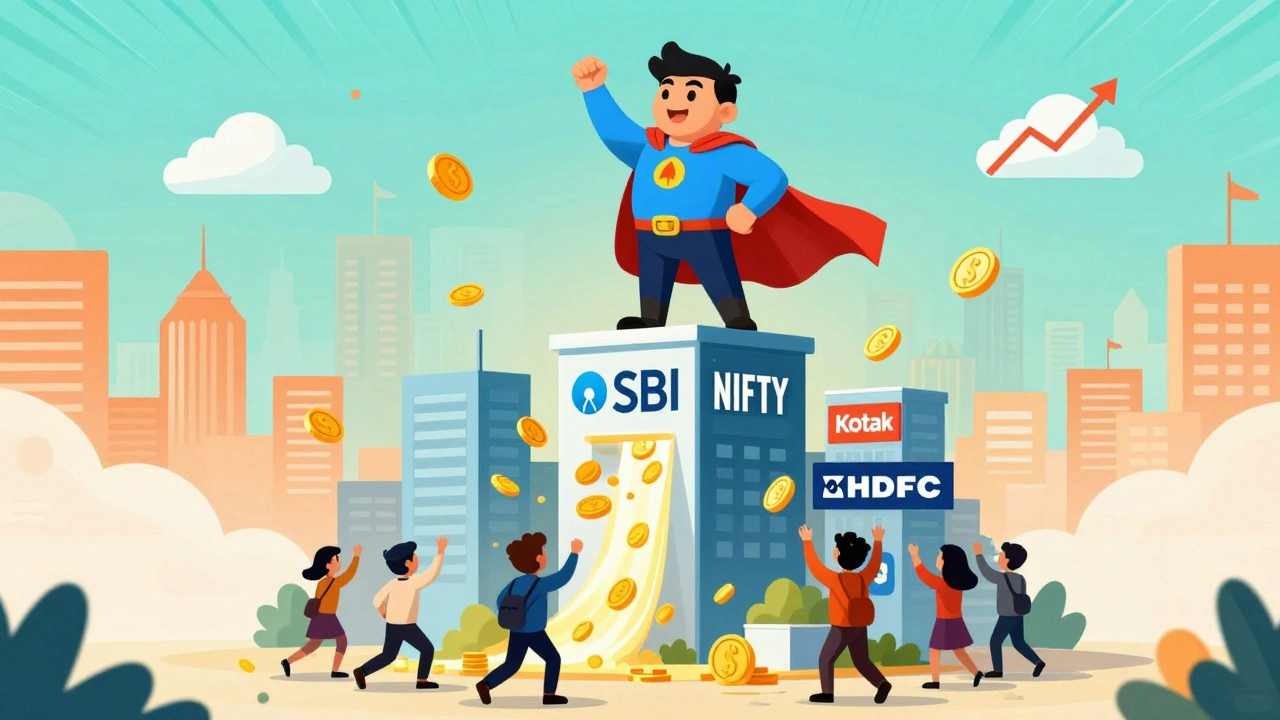
India’s banking sector is massive. Banks control trillions in deposits and loans. So it makes sense that there’s a dedicated index just for them: NIFTY Bank.
This index tracks the 12 largest banking and financial services companies listed on NSE. That includes public sector banks like State Bank of India and private banks like Kotak Mahindra Bank and HDFC Bank. Even non-bank financial companies like Bajaj Finance are included because they operate like banks in many ways.
Why does this matter? Because banks are the engine of the economy. When people take out home loans, businesses get credit, and government spending flows through banks. If NIFTY Bank is rising, it usually means people and businesses are confident enough to borrow and spend. If it’s falling, it could signal tightening credit or rising bad loans.
During economic booms, NIFTY Bank often outperforms NIFTY 50. During downturns, it can fall harder. That’s why traders watch it closely. If you’re investing in financial stocks, NIFTY Bank is your best indicator. And if you’re trying to understand why the market moved today, checking NIFTY Bank can tell you whether banks are leading the charge-or dragging it down.
Other Key Indian Stock Indices You Should Know
SENSEX, NIFTY 50, and NIFTY Bank are the big three, but they’re not the whole story. India has dozens of sector-specific and strategy-based indices. Here are a few others you’ll hear about:
- NIFTY IT: Tracks 10 major IT companies like TCS, Infosys, and Wipro. If tech stocks are booming, this index rises.
- NIFTY Pharma: Includes companies like Sun Pharma, Dr. Reddy’s, and Cipla. It’s a favorite during global health crises or when India’s drug exports surge.
- NIFTY Midcap 150: Shows how mid-sized companies are doing. These are often the next generation of big players.
- NIFTY Smallcap 100: Tracks smaller firms with high growth potential but higher risk.
- NIFTY 100: Combines NIFTY 50 and NIFTY Next 50. It’s a broader snapshot of India’s top 100 companies.
Each of these helps you zoom in. Want to know if Indian tech is strong? Check NIFTY IT. Thinking about investing in small businesses? Look at NIFTY Smallcap. You don’t need to follow them all-but knowing what each one measures helps you make sense of headlines.
Why These Indices Matter to You
Even if you’re not actively trading stocks, these indices affect your life. Mutual funds you invest in? Most are benchmarked to NIFTY 50. Your retirement savings? Likely tied to one of these indices. Even inflation and interest rates are influenced by how these markets perform.
Here’s a simple way to use them:
- If NIFTY 50 is up for three straight days, the economy is likely doing well.
- If NIFTY Bank drops sharply, banks might be worried about loan defaults.
- If SENSEX rises but NIFTY 50 doesn’t, it could mean only a few big stocks are driving the rally.
- If NIFTY IT jumps while the rest are flat, tech earnings might be better than expected.
You don’t need to predict the market. But understanding these indices helps you avoid panic. When markets dip, you can ask: Is this a broad correction, or just one sector struggling? That changes how you react.
How to Track These Indices
You can check all these indices for free. The NSE and BSE websites have live data. Most financial news apps-like Moneycontrol, Economic Times, or Google Finance-show them in real time. Even your bank’s app might have a market summary.
Set up alerts. If you’re watching your investments, get notified when NIFTY 50 moves more than 1% in a day. You don’t need to watch the screen constantly. Just check once in the morning and once after market close.
And remember: daily swings don’t matter as much as long-term trends. A 2% drop today isn’t a crisis. A 20% drop over six months? That’s worth looking into.
Common Mistakes to Avoid
Many new investors make the same mistakes:
- Thinking SENSEX and NIFTY 50 are the same. They’re similar, but not identical. One is BSE, one is NSE. One has 30 stocks, the other 50.
- Believing a rising index means all stocks are going up. Nope. Sometimes just 2 or 3 big stocks are pulling the index up.
- Chasing indices without understanding them. If you buy a fund because NIFTY 50 went up last week, you’re guessing-not investing.
- Ignoring sector indices. If you’re interested in tech, don’t just watch NIFTY 50. Check NIFTY IT too.
The best investors don’t try to time the market. They understand what the numbers mean. They know that NIFTY Bank rising doesn’t mean you should buy every bank stock-it means the financial system is healthy. That’s useful context.
Final Thought: Indices Are Tools, Not Crystal Balls
Stock market indices aren’t magic. They don’t predict the future. They reflect what’s already happened. But that’s powerful enough. They turn chaos into clarity. Instead of wondering whether the market is up or down, you can look at NIFTY 50 and know exactly where things stand.
Start with these three: SENSEX, NIFTY 50, and NIFTY Bank. Learn how they’re built. Watch how they move together-or apart. Over time, you’ll start seeing patterns. And that’s how you stop being confused by the noise-and start making smart choices.
What’s the difference between SENSEX and NIFTY 50?
SENSEX tracks 30 large companies on the Bombay Stock Exchange (BSE), while NIFTY 50 tracks 50 large companies on the National Stock Exchange (NSE). SENSEX is price-weighted, meaning higher-priced stocks have more influence. NIFTY 50 is market-cap weighted, so bigger companies by total value have more impact. NIFTY 50 is broader and more commonly used by mutual funds and ETFs.
Is NIFTY Bank a good indicator of the overall economy?
Yes, because banks are central to lending, spending, and investment. When NIFTY Bank rises, it usually means businesses and consumers are confident enough to borrow money. When it falls, it can signal tighter credit, higher bad loans, or economic uncertainty. It’s not a perfect mirror of the whole economy, but it’s one of the most reliable early warning signals.
Can I invest directly in SENSEX or NIFTY 50?
You can’t buy the index itself, but you can invest in funds that track it. Mutual funds and ETFs (Exchange-Traded Funds) are designed to replicate the performance of SENSEX or NIFTY 50. These are called index funds. They’re low-cost and give you exposure to dozens of top companies at once.
Why does NIFTY 50 sometimes move when SENSEX doesn’t?
Because they include different companies and use different weighting methods. NIFTY 50 includes more mid-cap and newer companies. SENSEX is older and more focused on blue-chip stocks. If a tech stock like Mindtree jumps sharply, it might lift NIFTY 50 but not affect SENSEX much if it’s not in the 30-stock list. Also, trading volumes and liquidity can differ between exchanges.
Which index should I follow if I’m a beginner investor?
Start with NIFTY 50. It’s the most widely used benchmark in India, tracked by most index funds and ETFs. It’s also more diversified than SENSEX, so it gives a clearer picture of the overall market. Once you understand how it moves, you can explore sector indices like NIFTY Bank or NIFTY IT to dig deeper.