Market Capitalization in India: Large-Cap, Mid-Cap, and Small-Cap Stocks Explained
When you hear someone talk about the Indian stock market, they’re usually referring to a handful of giant companies like Reliance Industries or HDFC Bank. But behind those big names are hundreds of other companies-some growing fast, others still finding their footing. The key to understanding how these companies stack up? Market capitalization.
Market cap isn’t just a number on a screen. It tells you how much the market thinks a company is worth right now. And in India, that number separates stocks into three clear groups: large-cap, mid-cap, and small-cap. Each behaves differently, carries different risks, and offers different rewards. If you’re investing in Indian stocks, you need to know the difference.
What Is Market Capitalization?
Market capitalization, or market cap, is simple: it’s the total value of a company’s outstanding shares. You calculate it by multiplying the current stock price by the total number of shares available to the public. For example, if a company’s stock is trading at ₹1,000 and it has 10 million shares, its market cap is ₹10,000 crore (or ₹100 billion).
This number changes every minute the market is open. If the stock price jumps because of strong earnings, the market cap goes up. If investors panic and sell, it drops. That’s why market cap is a real-time snapshot-not a fixed value like a company’s book value or assets.
In India, market cap is used to classify companies into three buckets. These aren’t official government categories, but they’re universally used by brokers, fund managers, and investors to make sense of the market.
Large-Cap Stocks: The Giants
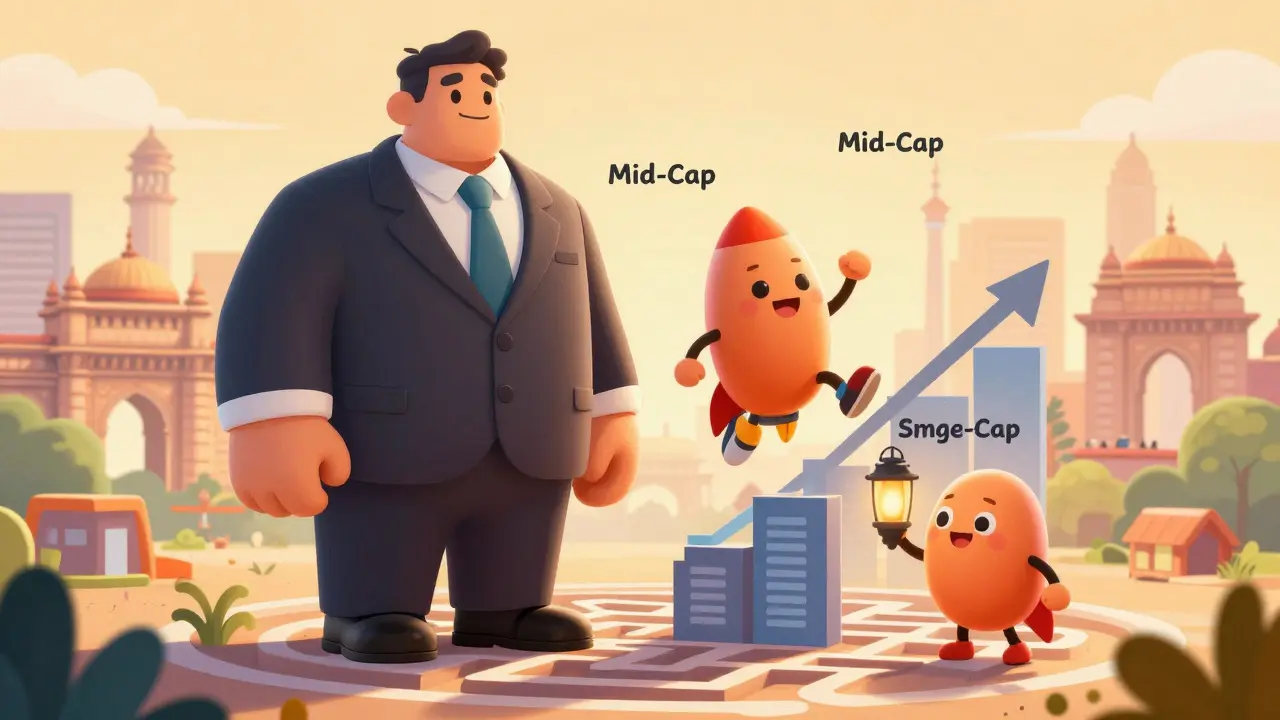
Large-cap stocks are the biggest players in India’s stock market. These are companies with a market cap of ₹20,000 crore or more. Think Reliance Industries, Tata Consultancy Services, HDFC Bank, and Infosys. They’re household names. You see them on TV ads, in news headlines, and in most mutual funds.
Why do people like them? Because they’re stable. Large-cap companies have proven business models, strong cash flows, and often dominate their industries. They’re less likely to collapse during a market crash. During the 2020 pandemic, while many small companies struggled, large-caps like TCS and Infosys kept growing because they served global clients with steady demand.
But there’s a trade-off. Large-caps don’t grow fast. Their best years are behind them. You won’t see a 10x return from a large-cap stock in five years like you might from a small-cap. But if you want steady returns with low drama, this is your zone.
Mid-Cap Stocks: The Growth Engines
Mid-cap companies sit in the middle. Their market cap ranges from ₹5,000 crore to ₹20,000 crore. These are companies that have moved past the startup phase but aren’t giants yet. Examples include Polaris, Trent, and Dixon Technologies.
Mid-caps are where the real action happens. They’re big enough to have solid operations and access to capital, but small enough to grow quickly. A mid-cap company might be expanding into new regions, launching new products, or gaining market share from older players.
In 2023, Dixon Technologies’ market cap jumped from ₹15,000 crore to over ₹1.2 lakh crore in just two years. Why? Because it became India’s top electronics manufacturer for brands like Apple and Samsung. That kind of growth is rare in large-caps but common in mid-caps.
The risk? Mid-caps can be volatile. If they miss a target, their stock can drop 30% in a week. But if they hit it, they can double or triple in value. That’s why many investors use mid-caps as the growth engine in their portfolio-balancing them with stable large-caps.
Small-Cap Stocks: The Wildcards
Small-cap stocks have a market cap below ₹5,000 crore. These are smaller companies, often with fewer than 100 employees, operating in niche markets. You won’t find them on TV. But you might find them in a startup incubator in Bengaluru or a manufacturing unit in Gujarat.
Some small-caps become legends. Think of Titan, which started as a small watchmaker in the 1980s and is now a ₹3 lakh crore company. Or Page Industries, which began as a single-agent distributor of Jockey underwear and grew into a ₹20,000 crore business.
But most small-caps don’t make it. Many go bankrupt. Others get absorbed by bigger players. The problem? They have limited cash, weak balance sheets, and depend on a few customers or suppliers. If interest rates rise or demand falls, they’re the first to suffer.
Still, small-caps offer the highest potential returns. Between 2019 and 2024, the Nifty Smallcap 100 index returned over 200%. That’s more than double the large-cap index. But it came with wild swings-some months up 15%, others down 20%. Only investors with a long horizon and stomach for volatility should touch this space.
How These Categories Work Together
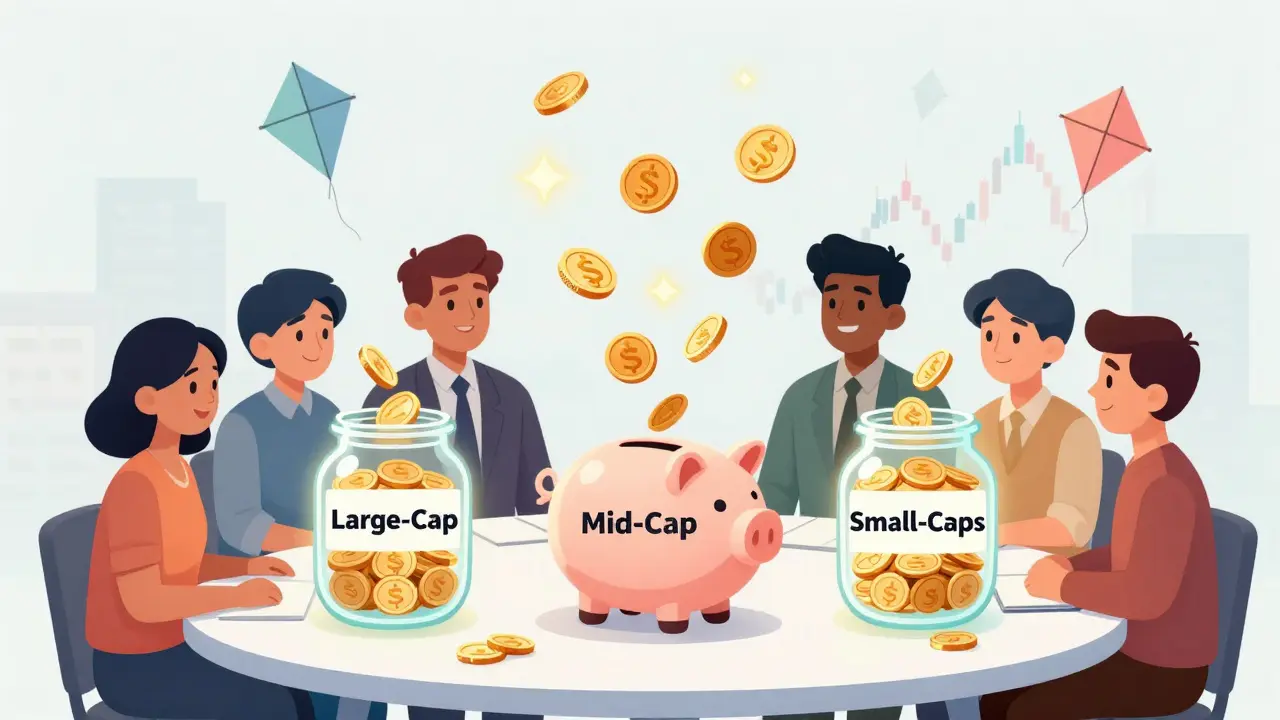
Most smart investors don’t put all their money in one category. They build a portfolio that mixes all three. Here’s a typical breakdown:
- 50% Large-Cap: Your anchor. Provides stability and steady returns.
- 30% Mid-Cap: Your growth engine. Delivers higher returns over 5-7 years.
- 20% Small-Cap: Your lottery ticket. High risk, but can deliver outsized gains.
This mix lets you ride the growth of mid- and small-caps while staying grounded with large-caps. If small-caps crash, your large-caps keep the portfolio from collapsing. If large-caps stall, your mid- and small-caps keep the returns moving.
Rebalancing matters too. Every year, check your portfolio. If small-caps surged and now make up 35% of your holdings, sell a bit to bring it back to 20%. This forces you to sell high and buy low-exactly what investing should do.

How to Find These Stocks
Not every stock is clearly labeled as large, mid, or small-cap. You need to look it up. Here’s how:
- Go to a financial website like Moneycontrol, Screener.in, or BloombergQuint.
- Search for the company name.
- Check its market cap. It’s usually listed right under the stock price.
- Compare it to the standard ranges:
- Large-cap: ₹20,000 crore+
- Mid-cap: ₹5,000-20,000 crore
- Small-cap: Below ₹5,000 crore
Most mutual funds also label themselves. A fund named "Nifty LargeCap 50" holds only large-caps. A fund called "Nifty Midcap 150" holds mid-caps. You can use these as starting points.
Common Mistakes to Avoid
Many investors make the same errors when dealing with market caps:
- Chasing hot small-caps: Just because a small-cap stock jumped 50% last month doesn’t mean it’s a good buy. Many are overhyped.
- Ignoring mid-caps: People think they’re too risky. But mid-caps often offer the best balance of growth and safety.
- Assuming large-caps are safe forever: Even giants can stumble. Yes, Reliance is huge-but it’s also betting billions on new businesses like Jio and retail. That’s risky.
- Buying based on price: A ₹100 stock isn’t "cheap" just because it’s low. A ₹5,000 stock isn’t "expensive" if the company is growing fast. Market cap, not price, tells you the real value.
Why This Matters for Indian Investors
India’s economy is growing fast. More than 60% of the population is under 35. That means demand for phones, cars, homes, and services is rising. The companies that benefit most aren’t always the ones you’ve heard of.
Small-cap companies are building factories in Tier-2 cities. Mid-caps are exporting software and electronics. Large-caps are going global. If you understand market cap, you can see where the real opportunities are-not just where the headlines are.
Market cap isn’t about guessing. It’s about categorizing. It turns a chaotic market into something you can understand. And once you get it, you stop chasing trends. You start building a portfolio that works-no matter what the news says.