PPF vs ELSS in India: Which Is Better for Tax Saving Under Section 80C?
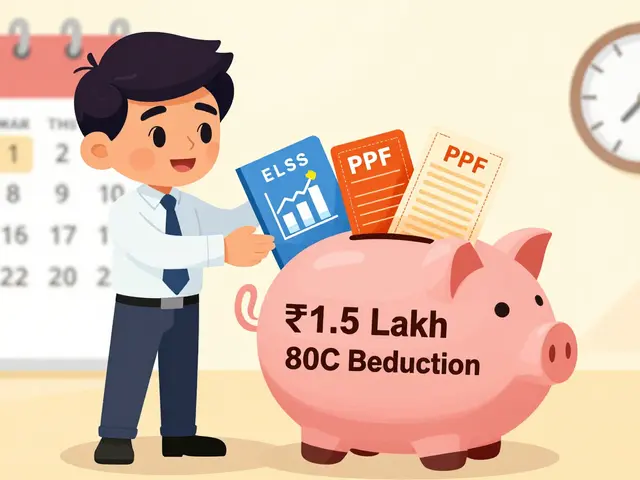
You have exactly ₹1.5 lakh to invest this financial year to maximize your tax deduction under Section 80C. The clock is ticking, and the choice you make today will dictate your liquidity, risk exposure, and returns for the next decade. Do you lock that money away in a government-backed vault with zero volatility, or do you bet on the stock market’s growth potential while accepting a three-year wait before you can touch it? This is the classic battle between Public Provident Fund (PPF) and Equity Linked Savings Scheme (ELSS).
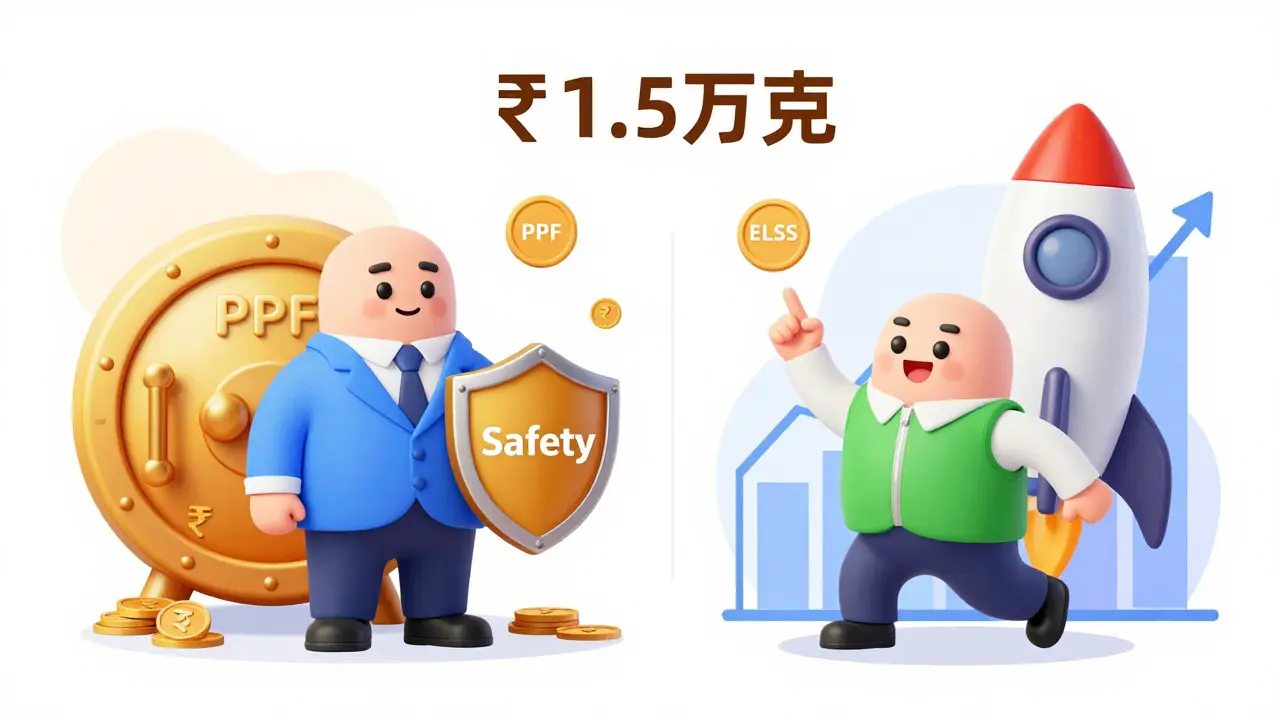
Both instruments serve the same primary purpose: reducing your taxable income. However, they are fundamentally different beasts. One is a debt instrument designed for safety; the other is an equity vehicle built for growth. Choosing the wrong one isn't just about missing out on higher returns-it’s about locking your capital when you might need it most.
The Core Mechanics: How PPF and ELSS Work
To make an informed decision, you first need to understand what you are actually buying. These aren't just investment options; they are distinct financial products with specific rules set by regulators.
Public Provident Fund (PPF) is a long-term savings scheme backed by the Government of India, offering guaranteed interest rates and complete tax exemption on maturity proceeds. It operates under the Ministry of Finance. When you invest in PPF, you are essentially lending money to the government. In return, they promise to pay you a fixed interest rate every year, compounded annually. The current interest rate hovers around 7.1% per annum, though this is reviewed quarterly by the government based on market conditions. The tenure is rigid: 15 years. You can extend it in blocks of five years after maturity, but you cannot withdraw the full amount before the 15-year mark ends. Partial withdrawals are allowed only after the seventh year, and loans against the balance are available between the third and sixth year.
In contrast, Equity Linked Savings Scheme (ELSS) is a type of mutual fund that invests primarily in stocks and shares, offering high growth potential with a mandatory three-year lock-in period. Unlike PPF, ELSS is not backed by the government. It is managed by Asset Management Companies (AMCs) like SBI Mutual Fund, HDFC Mutual Fund, or Axis Mutual Fund. Your money goes into a pool that buys equities (stocks) of companies listed on Indian stock exchanges. Because it is tied to the stock market, the value of your investment fluctuates daily. There is no guaranteed return. However, the lock-in period is significantly shorter: just three years. After 36 months, you can redeem your units instantly, usually within T+2 business days.
Risk Profile: Safety Net vs. Rollercoaster
The biggest differentiator between these two instruments is risk. If you lose sleep when the Sensex drops by 500 points, PPF is likely your sanctuary. If you believe in the long-term upward trajectory of the Indian economy and can stomach short-term volatility, ELSS offers superior upside.
PPF carries virtually zero default risk. Since it is sovereign-backed, the government guarantees both the principal and the interest. Over the last few decades, even during economic downturns, PPF has consistently delivered positive real returns after inflation. It is the definition of "safe." However, "safe" comes at a cost. The returns are capped. You will never see a 20% or 30% jump in a single year. In fact, if inflation spikes to 7%, your real return from a 7.1% PPF interest rate becomes negligible. You are preserving capital, not growing it aggressively.
ELSS, on the other hand, exposes you to market risk. Equity markets are volatile. In 2020, during the pandemic crash, many ELSS funds saw their net asset values (NAV) drop by 30-40%. But here is the catch: those same funds recovered and delivered double-digit annualized returns over the subsequent three years. Historical data shows that equity investments in India have averaged 12-15% CAGR (Compound Annual Growth Rate) over periods exceeding ten years. The key word is "period." If you redeem your ELSS investment during a market dip, you could lose money. But if you hold through the cycles, the compounding effect of equity returns often dwarfs debt instruments like PPF.
| Feature | Public Provident Fund (PPF) | Equity Linked Savings Scheme (ELSS) |
|---|---|---|
| Lock-in Period | 15 Years | 3 Years |
| Risk Level | Very Low (Government Backed) | Moderate to High (Market Dependent) |
| Expected Returns | ~7.1% p.a. (Fixed) | 12-15% p.a. (Historical Average) |
| Tax Benefit Limit | Up to ₹1.5 Lakh | Up to ₹1.5 Lakh |
| Liquidity | Poor (Partial withdrawal after Year 7) | Good (Full redemption after 3 years) |
| Minimum Investment | ₹500 | ₹500 - ₹1,000 (varies by AMC) |
| Tax on Maturity | Tax-Free (EEE Status) | Tax-Free (if held > 1 year) |
Tax Implications: The EEE Advantage
Both PPF and ELSS enjoy the coveted "EEE" status-Exempt-Exempt-Exempt. This means the investment is exempt (you get the deduction), the earnings are exempt (interest/dividends are tax-free), and the maturity proceeds are exempt (withdrawal is tax-free). This is a massive advantage over other investment avenues like Fixed Deposits (FDs), where the interest earned is added to your income and taxed according to your slab.
For PPF, the interest accrued every year is compounded and added to your balance. At the end of 15 years, the entire lump sum-including all accumulated interest-is completely free from income tax. This predictability makes it easy to calculate your final corpus. If you invest ₹1.5 lakh annually at 7.1%, you will accumulate approximately ₹43.5 lakh after 15 years, all tax-free.
For ELSS, the tax benefit works slightly differently due to the nature of equity taxation. Long-Term Capital Gains (LTCG) on equity are tax-free up to ₹1 lakh per financial year. Any gains above ₹1 lakh are taxed at 12.5%. However, since most retail investors do not exceed ₹1 lakh in LTCG from ELSS redemptions in a single year, the effective tax burden is often zero. Furthermore, dividends received from ELSS funds are now taxable in the hands of the investor according to their income slab, but you can opt for the "growth" option instead of "dividend," deferring taxes until redemption. Given the three-year lock-in, you automatically qualify for LTCG treatment upon exit.

Liquidity: When Do You Need the Money?
This is the deciding factor for most investors. Ask yourself: "Will I need this ₹1.5 lakh in the next three years?" If the answer is yes, ELSS is your only viable option among the two. PPF locks your money for 15 years. While you can take partial withdrawals after the seventh year, you must provide a valid reason (like marriage or education), and the process involves paperwork and waiting time. Loans against PPF are limited to 25% of the balance at the end of the fourth year preceding the year of loan application.
ELSS offers much greater flexibility. Once the three-year lock-in expires, you can redeem your units online instantly. The money hits your bank account within two days. This makes ELSS suitable for goals that have a medium-term horizon, such as buying a car in four years or funding a wedding in five years. PPF is strictly for long-term goals like retirement or children's higher education, where the timeline extends beyond a decade.
Who Should Choose What? A Decision Framework
There is no single "better" option. The right choice depends entirely on your age, risk appetite, and financial goals. Here is how to categorize yourself:
- The Conservative Investor / Near Retirement: If you are over 50 or approaching retirement, capital preservation is more important than aggressive growth. Market crashes near retirement can be devastating because you don't have time to recover. For you, PPF is the superior choice. The guaranteed 7.1% return provides stability and predictable cash flow planning.
- The Young Professional / Aggressive Grower: If you are in your 20s or early 30s, you have a long time horizon. You can afford to ride out market volatility. Inflation will erode the purchasing power of PPF returns over 15 years. ELSS allows you to beat inflation and build a larger corpus through compounding equity returns. The three-year lock-in is a minor inconvenience compared to the potential for 12-15% annual growth.
- The Balanced Portfolio Builder: Why choose just one? Most financial advisors recommend splitting the ₹1.5 lakh limit. You could invest ₹50,000 in PPF for safety and ₹1,00,000 in ELSS for growth. This diversifies your tax-saving strategy across asset classes, ensuring you have both a stable foundation and a growth engine.

Common Pitfalls to Avoid
When investing in either instrument, avoid these common mistakes that erode your wealth:
- Ignoring Expense Ratios in ELSS: Not all ELSS funds are equal. Some charge high management fees (expense ratios) which eat into your returns. Look for funds with expense ratios below 1.5%. Direct plans are always cheaper than regular plans because they cut out the distributor commission.
- Missing the Lock-in Window: For ELSS, the lock-in applies to each unit individually. If you invest via SIP (Systematic Investment Plan), each installment has its own three-year countdown. Don't assume your entire portfolio unlocks at once. Track your investment dates carefully.
- Underestimating PPF Contribution Limits: You can contribute a maximum of ₹1.5 lakh per year to PPF. If you try to deposit more, the excess amount will not earn interest and may attract penalties. Ensure your contributions stay within the legal limit.
- Confusing Nomination with Succession: Both PPF and ELSS allow nominations. However, nomination does not override legal heirs' rights in case of death. Update your nominations regularly to ensure smooth transfer of assets to your intended beneficiaries.
Final Verdict: Aligning With Your Goals
If your priority is absolute safety and you want to set money aside for a goal that is 15 years away, PPF is unbeatable. It removes the stress of market timing and guarantees a decent return. It is the bedrock of a conservative portfolio.
If you want to maximize your wealth creation potential and can tolerate short-term fluctuations, ELSS is the clear winner. Historically, equity has outperformed debt over long periods. The three-year lock-in encourages disciplined investing without trapping your capital for half a lifetime.
For most middle-class Indians, the smartest move is not to pick one, but to use both. Use PPF to secure your base and ELSS to grow your top. By diversifying your Section 80C investments, you mitigate risk while capturing growth opportunities. Remember, the best investment is the one that aligns with your personal financial reality, not just the one with the highest historical return.
Can I switch from PPF to ELSS or vice versa?
No, you cannot directly switch or transfer funds between PPF and ELSS. They are entirely separate financial products regulated by different authorities (Ministry of Finance for PPF and SEBI for ELSS). To move money, you would need to withdraw from one (subject to lock-in rules) and reinvest in the other. This may trigger tax implications or penalties depending on the timing and instrument.
Is the interest earned on PPF really tax-free?
Yes, PPF enjoys EEE (Exempt-Exempt-Exempt) status. The interest credited to your account every year is not added to your taxable income. Additionally, the final maturity amount, including all accumulated interest, is completely free from income tax. This makes it highly efficient for taxpayers in higher slabs.
What happens if the stock market crashes after I invest in ELSS?
If the market crashes shortly after your investment, the NAV of your ELSS units will drop. However, due to the three-year lock-in, you are forced to hold the investment. Historically, Indian equity markets have recovered from major corrections within 2-3 years. The lock-in period often acts as a discipline mechanism, preventing panic selling and allowing you to benefit from the eventual market recovery.
Can I invest less than ₹1.5 lakh in Section 80C instruments?
Absolutely. The ₹1.5 lakh is the maximum limit, not a minimum requirement. You can split this amount across multiple eligible instruments like PPF, ELSS, Life Insurance Premiums, Tuition Fees, and NPS. The total deductions claimed from all these sources combined cannot exceed ₹1.5 lakh in a single financial year.
Which is better for a child's education: PPF or ELSS?
It depends on the timeline. If the child is very young (e.g., newborn) and education is 15+ years away, PPF is safer and sufficient. If the child is older (e.g., 10 years old) and college fees are due in 5-8 years, ELSS is better suited because of its shorter lock-in and higher growth potential, assuming you can handle moderate risk.