Retirement Planning for Women in India: Strategies to Bridge the Gap
Women in India live longer than men. That’s a fact backed by census data and health statistics. But here is the catch: they often have less money saved for those extra years. This paradox creates a specific financial vulnerability that standard retirement advice rarely addresses. If you are a woman planning for your future in India, generic tips about saving 20% of your income might not be enough. You need a strategy that accounts for career breaks, lower lifetime earnings, and a longer post-retirement horizon.
The goal isn't just to survive on a pension; it's to maintain dignity, health, and choice when you stop working. This guide cuts through the noise to focus on what actually matters for women building wealth in the Indian context.
Why Women Need a Different Retirement Strategy
Most financial planners use a one-size-fits-all model. They assume a continuous career from age 22 to 60. For many women in India, this assumption fails. The Gender Pension Gap is the disparity between the average pension benefits received by men and women. In India, this gap is wide. According to reports from the National Pension System (NPS) trust, while women constitute nearly half the subscriber base, their account balances are significantly lower than men's. Why? It comes down to three main factors: career interruptions, wage disparities, and higher longevity.
Career breaks are the biggest silent killer of compound interest. A woman might pause her career for five or ten years to care for children or aging parents. During this time, she stops contributing to her savings, but inflation keeps eating away at the value of money. When she returns, she has fewer years to let her investments grow. Then there is the issue of the wage gap. Even in professional sectors, women in India often earn less than their male counterparts for similar roles. Lower income means lower contributions to retirement funds like the Provident Fund (PF).
Finally, consider the timeline. Men in India have an average life expectancy of around 67-68 years, while women live to about 70-71 years. That extra decade requires funding. If you plan your corpus based on living until 80, but you live until 90, you risk outliving your savings. Your strategy must account for this 'longevity risk' explicitly.
The Power of Starting Early with NPS
If you want to beat the clock, the National Pension System (NPS) is a government-backed defined contribution pension scheme in India. offers one of the best tools available. Unlike traditional insurance policies that offer low guaranteed returns, NPS allows your money to be invested in equity and corporate bonds, potentially yielding higher long-term growth. Crucially, the government provides a significant tax break to encourage women to join.
Under Section 80CCD(1B) of the Income Tax Act, individuals can claim an additional deduction of up to ₹1.5 lakh over and above the standard ₹1.5 lakh limit under Section 80C. But here is the kicker for women: they can contribute an extra ₹50,000 specifically to their NPS tier-I account and still get tax benefits. This means a woman can save up to ₹2.05 lakh in taxes annually through NPS alone. For someone in the 30% tax bracket, that is a direct boost to your effective return rate.
Don't just open the account and forget it. Choose an asset allocation that matches your age. If you are under 35, opt for a higher equity exposure (up to 75% if self-selecting). Equity markets are volatile in the short term but historically deliver the best inflation-beating returns over 15+ years. As you approach 50, gradually shift towards debt instruments to preserve capital.
Building a Robust Health Insurance Shield
Medical emergencies are the fastest way to drain a retirement corpus. In India, healthcare costs are rising faster than general inflation. A single hospitalization can wipe out years of savings. This is why health insurance is not optional; it is the foundation of your financial security.
Many women rely on family floater policies where they are added as dependents. This is risky. If you get divorced, widowed, or move out, you lose coverage. You need an individual policy in your name. Look for plans with high sum insured-start with at least ₹10-20 lakhs if you live in a metro city. Consider adding a 'super top-up' plan if premiums for high coverage are too steep. Super top-ups have a deductible, meaning you pay small bills yourself, but the insurer covers massive expenses once the threshold is crossed. This keeps premiums affordable while protecting against catastrophic costs.
Also, check for pre-existing disease waiting periods. If you already have conditions like diabetes or hypertension, disclose them honestly. Hiding medical history leads to claim rejections later, which is a disaster in retirement. Some insurers now offer 'restore benefit' options where the sum insured resets after a claim, provided the total limit hasn't been exhausted. This feature is invaluable for chronic conditions.

Creating Multiple Income Streams
Relying solely on a lump-sum withdrawal or a fixed annuity is dangerous. Annuities provide steady income, but they often fail to keep pace with inflation. After 10 years, your purchasing power could drop by 30% or more if inflation averages 6%. To combat this, you need assets that generate growing income.
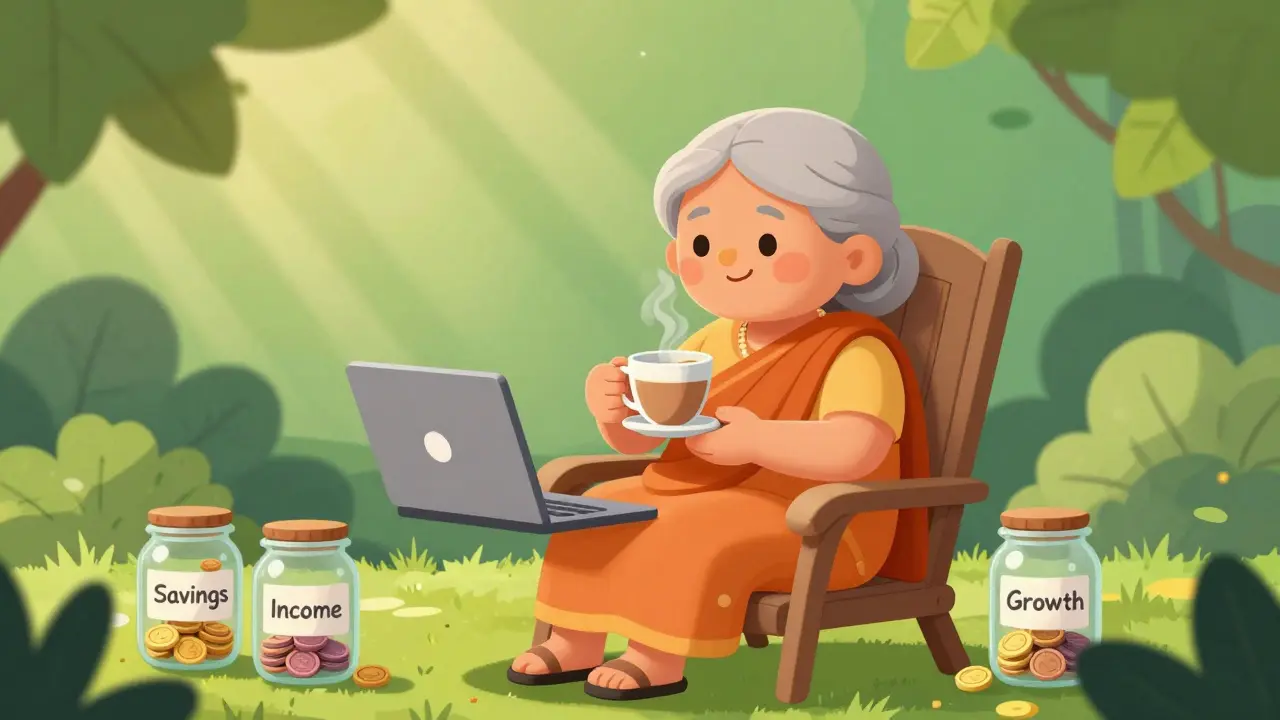
Diversify your retirement portfolio into three buckets:
- Capital Preservation: Liquid funds, fixed deposits, or government securities. This covers 1-2 years of living expenses. It ensures you don't have to sell stocks during a market crash to pay bills.
- Income Generation: Dividend-paying stocks, REITs (Real Estate Investment Trusts), or Infrastructure Funds. These provide regular cash flows that tend to rise over time. REITs allow you to invest in commercial real estate without buying property, offering quarterly dividends and potential capital appreciation.
- Growth Engine: Equity mutual funds or direct stocks. This portion fights inflation. Even in retirement, keeping 20-30% in equities helps your corpus last longer because the growth offsets withdrawals.
Consider starting a side hustle before you fully retire. Many women in India leverage skills like tutoring, consulting, or artisanal crafts. This not only adds income but also provides social engagement, which is crucial for mental health in old age. Platforms like UrbanClap or Etsy make it easier to monetize skills globally or locally.
Legal Protections and Property Rights
In India, cultural norms often sideline women from property ownership. Homes are frequently registered in the husband's or father's name. This leaves women vulnerable if they face separation, widowhood, or family disputes. Securing your legal rights is a critical part of financial planning.
If you own property, ensure it is clearly titled in your name. If you are inheriting property, understand your rights under the Hindu Succession Act (or relevant personal law). Daughters have equal coparcenary rights in ancestral property. Don't sign away these rights due to familial pressure. Consult a lawyer to draft wills or gift deeds if you are transferring assets to protect them.
For married women, consider a prenuptial agreement or post-nuptial settlement if applicable, though these are less common in India. More practically, ensure you have access to all financial documents: bank statements, investment proofs, and property papers. Keep digital copies in a secure cloud storage known only to you. Financial literacy includes knowing where your money is and who controls it.
Managing Family Caregiving Responsibilities
Women in India disproportionately bear the burden of caregiving. Whether it's raising grandchildren or caring for elderly parents, this role often comes without pay and disrupts financial planning. Acknowledge this reality and build buffers.
Create an emergency fund equivalent to 6-12 months of expenses. This fund should be separate from your retirement corpus. Use it for caregiving-related costs so you don't dip into long-term investments. If you hire help, factor those costs into your monthly budget early. Also, explore long-term care insurance, though it is still nascent in India. Some health policies now include room rent limits that cover nursing homes, which can be useful for extended stays.
Communicate with your family about financial expectations. Make it clear that caregiving does not mean financial dependence. Set boundaries regarding how much you will contribute to others' expenses versus your own savings. It is okay to say no to funding relatives' weddings or education if it jeopardizes your retirement security.
| Instrument | Tax Benefit | Liquidity | Return Potential | Best For |
|---|---|---|---|---|
| NPS | High (₹2.05L limit) | Low (Lock-in till 60) | Moderate-High | Core pension corpus |
| PPF | EEE (Tax-free) | Low (15-year lock) | Low-Moderate | Safety & stability |
| Equity Mutual Funds | None (except LTCG) | High | High | Wealth creation |
| Fixed Deposits | TDS applies | High | Low | Emergency fund |
Common Pitfalls to Avoid
One major mistake is prioritizing children's education over retirement. Parents often sacrifice their savings to fund kids' degrees abroad. While noble, this leaves the parents financially dependent on the very children they supported. Remember: you cannot pour from an empty cup. Save for yourself first. Let your children take student loans if necessary. Their independence begins with your financial security.
Another pitfall is falling for high-yield scams. Desperation for quick returns makes seniors targets for Ponzi schemes or unregulated crypto projects. Stick to regulated instruments: SEBI-approved mutual funds, RBI-regulated banks, and stock exchanges. If an investment promises 20% guaranteed returns, it is a scam. Period.
Lastly, ignore inflation. Saving money under a mattress or in zero-interest savings accounts guarantees loss of purchasing power. Your investments must outpace inflation (currently ~6% in India). Aim for real returns of 4-5% after tax and inflation. This requires discipline and a long-term view.
How much should a woman in India save for retirement?
A rough rule of thumb is to aim for a corpus that is 20-25 times your annual pre-retirement expenses. For example, if you need ₹50,000 per month (₹6 lakh/year), target a corpus of ₹1.2 to ₹1.5 crore. Adjust this based on your expected lifespan and inflation assumptions. Start calculating early using online retirement calculators that factor in current age and desired retirement date.
Is NPS better than PPF for women?
It depends on your goals. NPS offers higher tax deductions (up to ₹2.05 lakh) and potentially higher returns due to equity exposure, making it better for wealth creation. PPF offers tax-free returns and safety, ideal for conservative investors. Most women should use both: NPS for the core pension and PPF for safe, liquid savings within the EEE category.
What happens to my NPS money after I die?
If you pass away before retirement age, the entire accumulated amount in your Tier-I NPS account is paid to your nominee or legal heir. This amount is fully tax-exempt. It acts as a death benefit, ensuring your family receives the capital you contributed plus gains.
Can I withdraw from NPS before retirement?
Generally, no. NPS Tier-I is locked in until age 60. However, you can make partial withdrawals for specific reasons like marriage, child education, or medical emergencies after holding the account for 3 years. You can withdraw up to 25% of your own contributions. For home purchase, you can withdraw up to 25% of contributions after 10 years. Always weigh the tax implications before withdrawing.
How do I handle retirement if I have no formal job?
You can still participate in NPS as an 'Other Central Government Employee' or private sector citizen. Open a Tier-I account and contribute regularly. Supplement this with Sukanya Samriddhi Yojana (if you have daughters) or PPF. Focus on building tangible assets like gold or land if possible, but prioritize liquid financial assets for ease of management in old age.