Tax-Saving Investment Plans in India: Strategic Approach to Minimize Liability
You have a salary slip. You see the Tax Deducted at Source (TDS) column. It looks like a chunk of your hard-earned money is gone before it even hits your bank account. Most people look at this number and sigh. They accept it as an unavoidable cost of doing business in India. But here is the truth: that deduction isn't fixed. It’s flexible. The Indian Income Tax Act gives you specific levers to pull to bring that number down significantly.
The biggest lever? Section 80C. This is not just a clause; it is the backbone of tax planning for salaried employees and freelancers alike. If you are filing under the Old Tax Regime-which remains the smarter choice for many investors in 2026 due to available deductions-understanding how to maximize this section is non-negotiable.
Key Takeaways
- The Limit: You can claim up to ₹1.5 lakh per financial year under Section 80C.
- It’s a Bucket, Not a List: All eligible investments share the same ₹1.5 lakh cap. Diversifying within the bucket is key.
- Liquidity Matters: Don’t just park money in long-term locks if you might need cash soon. Mix ELSS with PPF.
- Beyond 80C: Don’t forget Section 80CCD(1B) for an extra ₹50,000 deduction on NPS.
- Deadline Alert: Investments must be made by March 31st to count for that financial year.
Understanding the Section 80C Cap
Let’s clear up a common misconception first. Many beginners think they get ₹1.5 lakh for Public Provident Fund (PPF), another ₹1.5 lakh for Life Insurance, and so on. That is incorrect. Think of Section 80C as a single bucket with a capacity of ₹1.5 lakh. Every eligible investment pours into this same bucket. Once the bucket is full, any additional amount invested in these instruments yields no further tax benefit under this specific section.
So, the goal isn't just to invest; it's to fill that bucket strategically. You want a mix of assets that offers safety, growth, and liquidity. Relying on just one instrument is risky. If you put all ₹1.5 lakh into a 15-year lock-in policy, you lose access to that capital for over a decade. If you put it all into Equity Linked Savings Schemes (ELSS), you face market volatility. The strategy lies in the blend.
The Core Instruments: What Goes Into the Bucket?
To build a robust portfolio, you need to understand the primary vehicles available. Each has different risk profiles, lock-in periods, and returns.
| Instrument | Lock-in Period | Risk Level | Expected Returns | Best For |
|---|---|---|---|---|
| Public Provident Fund (PPF) | 15 years | Low (Government backed) | ~7.1% (Revised annually) | Long-term safety & retirement corpus |
| Equity Linked Savings Scheme (ELSS) | 3 years | High (Market linked) | 12-15% (Historical avg) | Wealth creation & short lock-in |
| National Pension System (NPS) | Until age 60 | Medium-High | 9-12% | Retirement income (Extra ₹50k deduction) |
| Life Insurance Premiums | Policy term (5+ years) | Low | 4-6% (Traditional plans) | Risk cover + tax saving |
| Sukanya Samriddhi Yojana (SSY) | Until daughter turns 21 | Low (Government backed) | ~8.2% (Revised annually) | Parents of girls (<10 years old) |
Strategy 1: The Liquidity Play with ELSS
If you are young, say in your late 20s or early 30s, and you don't have immediate large expenses coming up, Equity Linked Savings Schemes (ELSS) should likely form the core of your 80C allocation. Why? Because three years is the shortest lock-in period among all tax-saving instruments.
Consider this scenario: You invest ₹1.5 lakh in ELSS. After three years, that money is yours. Historically, equities in India have outperformed inflation and fixed-income instruments over multi-year horizons. While there is risk-your principal is not guaranteed-the potential for compounding is higher. For someone who wants to buy a house or fund a wedding in five years, ELSS offers the best balance between tax efficiency and capital accessibility.
However, do not dump the entire amount at once. Use Systematic Investment Plans (SIPs). Investing ₹12,500 monthly smoothens out market volatility. This approach, known as rupee-cost averaging, protects you from buying at a market peak.
Strategy 2: The Safety Net with PPF and SSY
Not every rupee needs to chase high returns. Some money needs to sleep safely. This is where the Public Provident Fund (PPF) shines. Backed by the Government of India, PPF carries zero default risk. The interest rate is revised quarterly by the government. As of 2026, it sits around 7.1%, which is decent but often barely beats inflation.
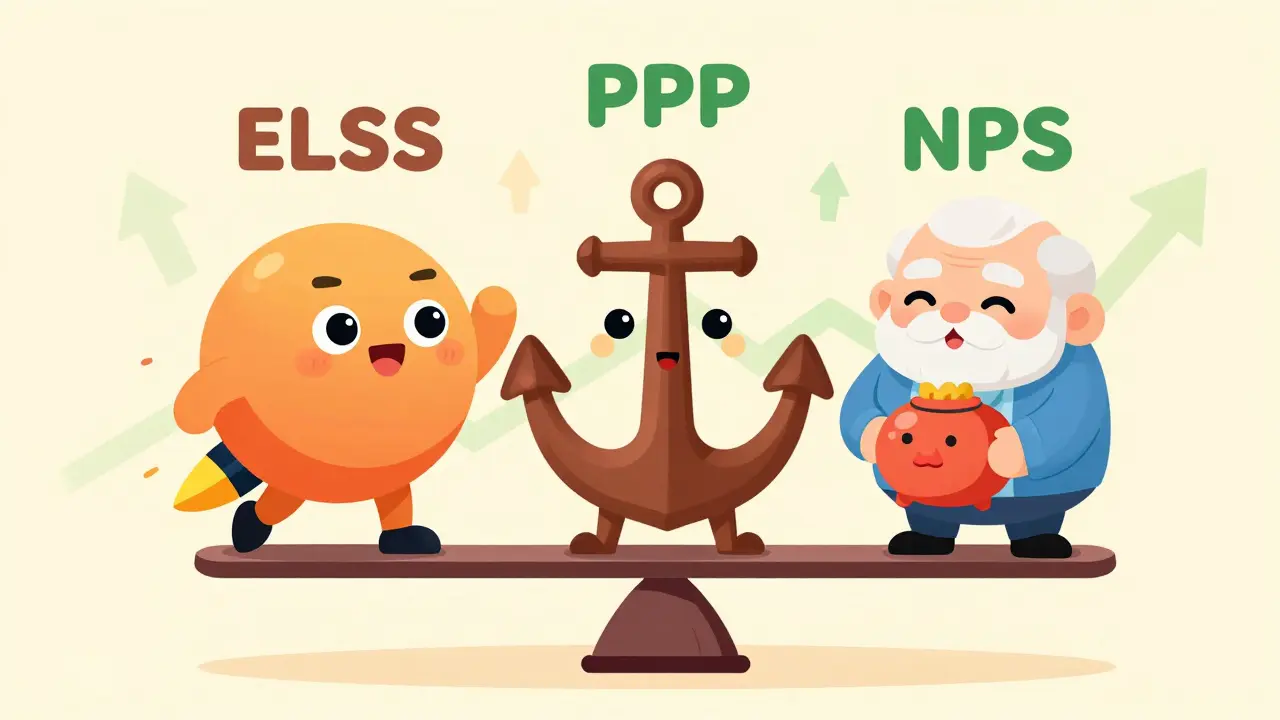
The real power of PPF is the 'EEE' status: Exempt-Earned-Exempt. The investment is tax-free, the interest earned is tax-free, and the maturity amount is tax-free. In contrast, ELSS gains after three years are tax-free, but dividends during the holding period may attract taxes depending on current laws. PPF is the anchor of your portfolio. It ensures that even if markets crash, a portion of your tax-saving corpus remains intact and growing steadily.
If you have a daughter under the age of ten, the Sukanya Samriddhi Yojana (SSY) is arguably better than PPF. It offers slightly higher interest rates and allows partial withdrawals when the girl turns 18 for education purposes. It is a specialized tool for a specific demographic, but incredibly effective if it applies to you.
Strategy 3: The Retirement Boost with NPS
Here is where most people miss out on significant savings. Section 80C covers only part of your pension planning. Enter the National Pension System (NPS).
Contributions to NPS qualify for deduction under Section 80CCD(1B). This is a separate bucket! You can claim an additional ₹50,000 deduction on top of your ₹1.5 lakh 80C limit. This means your total potential tax deduction increases to ₹2 lakh without touching other sections.
NPS is unique because it forces discipline. You cannot withdraw the money until age 60. At maturity, 60% of the corpus can be withdrawn tax-free. The remaining 40% must be used to purchase an annuity, which provides regular pension income. This structure solves the longevity risk-the fear of outliving your savings.
For a professional in the 30% tax bracket, contributing ₹50,000 to NPS saves you ₹15,000 in taxes immediately. Plus, the equity component of NPS (you can choose up to 75% equity if under 35) offers growth potential similar to mutual funds but with lower fees.
Don't Forget the Non-Investment Deductions
Tax saving isn't just about investing new money. It's also about claiming what you already spend. Two major components often get overlooked:
- Housing Loan Principal Repayment: If you have a home loan, the principal amount you repay each year qualifies for Section 80C deduction. Check your bank statement. If you've paid ₹2 lakh towards principal this year, you can only claim ₹1.5 lakh under 80C, assuming you haven't invested elsewhere. This fills your bucket automatically.
- Children's Tuition Fees: Yes, tuition fees for up to two children qualify. However, note that school fee receipts must be specifically for tuition, not transport or extracurricular activities. Many schools issue consolidated receipts, so ask for a breakdown.

The New vs. Old Regime Dilemma in 2026
The government introduced the New Tax Regime with lower slabs but fewer deductions. By 2026, the standard deduction under the new regime has increased, making it more attractive for some. However, if your total eligible deductions under 80C, 80D (health insurance), and 80CCD(1B) exceed the difference in tax liability between the two regimes, the Old Regime still wins.
Run a simple calculation. Calculate your tax under both regimes using a reliable calculator. If your investments in 80C instruments are less than ₹1.5 lakh, the New Regime might save you more money simply due to lower slab rates. But if you are maximizing 80C and adding NPS, the Old Regime usually results in a lower net tax outflow. Always verify this annually as your income and investment patterns change.
Common Pitfalls to Avoid
Even seasoned investors make mistakes. Here are the traps to watch out for:
- Last-Minute Rush: Waiting until March 31st to invest leads to poor decision-making. You might end up buying a product you don't need just to save tax. Plan your investments throughout the year.
- Ignoring Health Insurance: Section 80D allows deductions for health insurance premiums. This is separate from 80C. A family floater policy is essential. Don't skip this for tax reasons; skip it for health reasons.
- Mixing Up Principal and Interest: Only the principal repayment of a housing loan counts for 80C. The interest payment counts under Section 24(b) up to ₹2 lakh. Keep these distinct in your records.
- Overlooking TDS on FDs: Fixed Deposits (FDs) do not offer tax deduction on investment. The interest earned is fully taxable. Many people use FDs to save tax, which is inefficient compared to PPF or ELSS.
Action Plan for the Next Financial Year
Start now. Review your current investments. Are you under-utilizing your 80C limit? If yes, identify the gap. Do you need liquidity? Add ELSS. Do you need safety? Add PPF. Do you want to boost retirement? Add NPS.
Set up auto-debits for SIPs. Automate your PPF contributions. Ensure your employer knows about your NPS contributions if you are enrolled through payroll, or pay directly online. Keep all receipts digital. When filing your ITR, ensure you report these investments correctly to avoid notices from the Income Tax Department.
Tax saving is not a one-time event. It is a continuous process of aligning your financial goals with legal provisions. By treating Section 80C as a strategic portfolio rather than a checklist, you not only minimize your liability but also build wealth for your future self.
Can I claim Section 80C deduction if I am a senior citizen?
Yes, senior citizens can claim Section 80C deductions. However, they also have access to Section 80TTB for exemption on interest income from deposits, which is often more beneficial. They can still invest in PPF, ELSS, and NPS.
Is the interest earned on PPF really tax-free?
Absolutely. PPF enjoys EEE (Exempt-Exempt-Exempt) status. The contribution is deductible, the interest accrued annually is tax-free, and the final maturity amount is also tax-free.
What happens if I withdraw money from ELSS before 3 years?
Does my employer contribute to my NPS under Section 80CCD?
Yes. Your own contribution falls under 80CCD(1) and 80CCD(1B). Your employer's contribution is deductible under Section 80CCD(2) for you (up to 10% of salary) and is also exempt from tax for the employer under certain conditions.
Can I transfer my PPF account if I change jobs?
Yes, PPF accounts are portable. You can transfer your PPF account from one post office or bank branch to another. The continuity of the account is maintained, and the lock-in period continues uninterrupted.