
Taxation of Annuities in India: How Pension Income Is Taxed Post-Retirement
You’ve spent decades saving. You’ve watched your investments grow. Now, you’re ready to retire and live off that hard-earned money. But here’s the catch: the moment you start receiving your pension or annuity payments, the Indian government wants its share. Understanding how annuity tax works in India isn’t just about compliance; it’s about keeping more money in your pocket when you need it most.
Many retirees assume their pension is tax-free because they paid taxes on their salary while working. That’s a dangerous misconception. In India, the taxation of annuities depends heavily on where the money comes from-whether it’s from the Employees’ Provident Fund (EPF), a corporate pension scheme, or a private annuity plan purchased with market-linked funds. The rules are strict, but they also offer specific loopholes if you know where to look.
The Core Rule: Pension as Salary Income
To understand the tax implications, you first need to know how the Income Tax Department classifies your income. Under the Indian Income Tax Act, any regular payment received after retirement is generally treated as 'Income from Salaries' or 'Income from Other Sources,' depending on the source.
If you receive a pension from your former employer or from the Employees’ Provident Fund Organization (EPFO), this amount is added to your total annual income. It doesn’t sit in a separate tax bucket. Instead, it gets merged with any other income you might have, such as interest from fixed deposits, rent from property, or dividends from stocks. This combined total determines your tax bracket.
For example, if you receive ₹30,000 per month as an EPF pension and ₹10,000 per month as interest from savings, your total annual taxable income is ₹4.8 lakh. You will be taxed according to the prevailing income tax slabs for that year. There is no special lower rate for pensioners unless they qualify for specific senior citizen exemptions, which we will cover later.
Is pension income considered salary or other income?
Pension received from an employer or EPF is typically treated as 'Income from Salaries' under the head 'Salary'. However, if you purchase an annuity from a private insurance company using your own accumulated corpus, those payouts are usually taxed under 'Income from Other Sources'.
EPF Withdrawal vs. Annuity Purchase
The biggest decision you face at retirement is what to do with your EPF balance. Do you take it all out? Or do you convert part of it into an annuity? This choice has immediate tax consequences.
Under current rules, if you have completed five years of service, the withdrawal of your EPF corpus is largely tax-exempt. However, you cannot withdraw 100% of it if you want to secure a monthly pension. You must allocate at least 40% of your EPF balance (or ₹50,000, whichever is higher) to purchase an annuity from an insurance company approved by the Insurance Regulatory and Development Authority of India (IRDAI).
This mandatory annuity purchase ensures you have a steady income stream. The remaining 60% can be withdrawn tax-free (provided the 5-year rule is met). Here is the critical part: the monthly pension you receive from this mandatory annuity is fully taxable. Every rupee you get from the insurance company is added to your taxable income for that financial year.
Let’s say your EPF balance is ₹10 lakh. You put ₹4 lakh into an annuity plan. The insurance company pays you ₹2,000 per month. That ₹2,000 is not tax-free. If you earn nothing else, you still pay tax on that ₹24,000 annual income based on your slab rates.
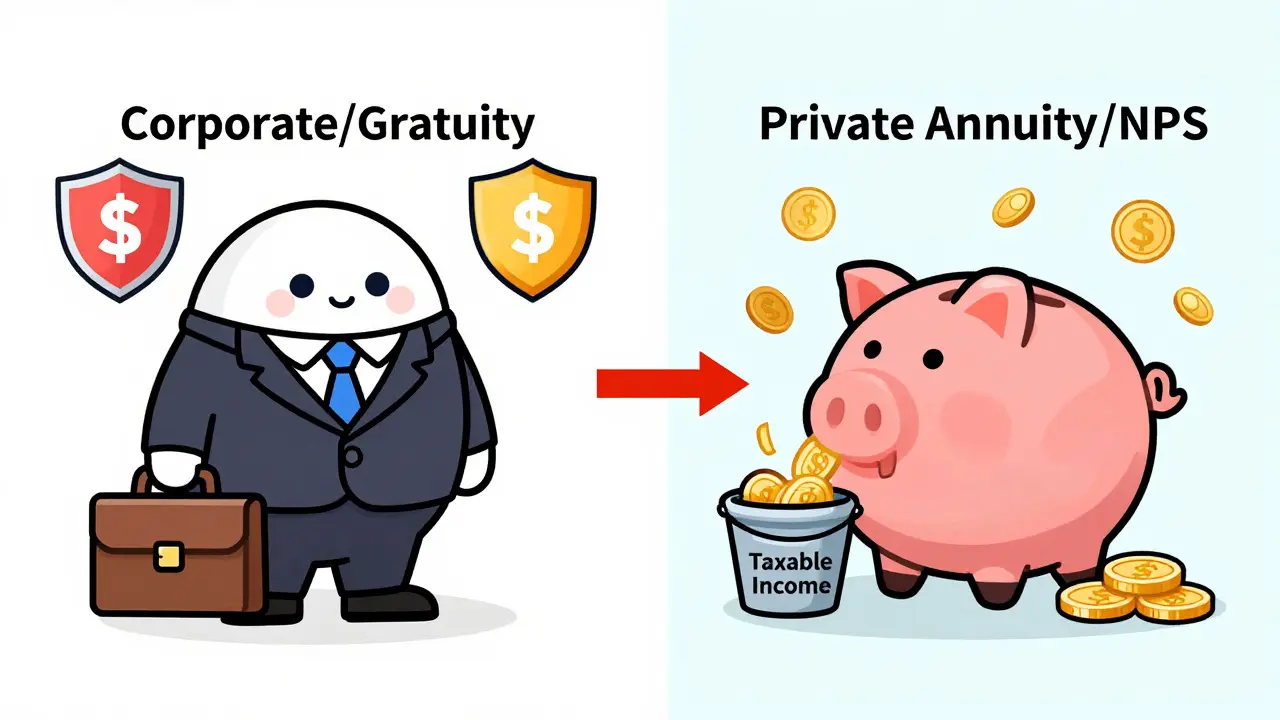
Corporate Pension Schemes and Gratuity
If you worked for a large corporation, you might be part of a Corporate Pension Scheme or receive Gratuity. These have different tax treatments compared to standard EPF.
Gratuity is a lump-sum payment made by employers to employees upon retirement, death, or disablement. For government employees, gratuity is entirely tax-exempt. For private sector employees, there is a limit. The tax-exempt portion is calculated using a formula: (Number of years of service × Last drawn salary × 15) / 26. Any amount exceeding this limit is taxable as salary income.
Similarly, if your company runs a Recognized Provident Fund (RPF) or a Superannuation Fund, the pension derived from these sources is taxable under the head 'Salaries.' Unlike the EPF, where the contribution phase offers tax breaks under Section 80C, the payout phase for corporate pensions does not offer any special deduction. It is simply added to your gross income.
| Source of Income | Tax Treatment | Key Condition |
|---|---|---|
| EPF Corpus Withdrawal | Tax Exempt | Must complete 5 years of service |
| Mandatory EPF Annuity | Fully Taxable | Treated as Salary Income |
| Private Annuity Plan | Fully Taxable | Treated as Income from Other Sources |
| Government Gratuity | Tax Exempt | No limit on exemption |
| Private Gratuity | Partially Exempt | Calculated via statutory formula |
Senior Citizen Benefits and Tax Slabs
While the annuity income itself is taxable, the Indian government provides relief to senior citizens through higher basic exemption limits. As of the 2024-25 financial year (applicable for Assessment Year 2025-26), the new tax regime-which many retirees prefer due to its simplicity and lower rates for middle-income earners-offers significant advantages.
Under the New Tax Regime:
- Individuals below 60 years: Basic exemption up to ₹3 lakh.
- Senior Citizens (60-79 years): Basic exemption up to ₹4 lakh.
- Super Senior Citizens (80+ years): Basic exemption up to ₹5 lakh.
This means if you are 65 years old and receive ₹3.5 lakh annually from your annuity, you pay zero tax under the new regime. This is a crucial strategy. Many retirees opt for the new regime specifically to utilize this higher threshold. However, note that under the new regime, you lose deductions like Section 80C (for investments) and Section 80D (for health insurance premiums). You must calculate whether the higher exemption limit outweighs the loss of these deductions.
If you stick to the Old Tax Regime, you can claim deductions. For instance, if you have medical expenses, you can claim up to ₹50,000 under Section 80D for health insurance premiums for yourself and your spouse. If you are a senior citizen, this limit rises to ₹1 lakh. Additionally, interest income from savings accounts is exempt up to ₹10,000 under Section 80TTA, or ₹50,000 under Section 80TTB for senior citizens. These deductions can significantly reduce your taxable annuity income.
Commutation of Pension: A One-Time Benefit
Some government jobs and select private sector plans allow for 'commutation' of pension. This means you can exchange a portion of your monthly pension for a one-time lump sum payment. This is often used to fund immediate post-retirement needs like home repairs or travel.
Here is the good news: The commuted portion of the pension is tax-exempt. Only the uncommuted monthly pension is taxable. For central government employees, up to 40% of the pension can be commuted tax-free. For other entities, the rules vary, but generally, the lump sum received via commutation is not added to your taxable income. This is a powerful tool for managing cash flow without triggering a tax hike.
However, you cannot commute 100% of your pension. You must retain a minimum monthly payout. The exact percentage allowed for commutation depends on the specific scheme rules. Always check with your HR department or the pension fund administrator before making this election.

Taxing Private Annuity Plans
What if you didn’t join the EPF? What if you invested in a Unit Linked Insurance Plan (ULIP) or a National Pension System (NPS) and bought a private annuity with the proceeds?
For NPS subscribers, the rules are distinct. At retirement, you can withdraw up to 60% of the corpus tax-free. The remaining 40% must be used to buy an annuity. The monthly payments from this NPS annuity are fully taxable. There is no distinction between government and private annuities here; the source of the annuity doesn’t matter, only the fact that it is a recurring payout.
For ULIPs, if the policy was held for more than five years, the maturity proceeds are tax-free under Section 10(10D). However, if you choose to annuitize the value (convert it into a pension), the subsequent monthly payments are taxable as 'Income from Other Sources.' This is a common trap. People think their insurance payout is tax-free forever, but once it becomes a periodic income stream, the tax shield vanishes.
Strategies to Minimize Tax Liability
You can’t avoid tax entirely, but you can optimize it. Here are three practical steps:
- Choose the Right Tax Regime: Compare the old and new regimes every year. If your annuity income is moderate and you don’t have heavy investment deductions, the new regime’s higher exemption limit for seniors is likely better.
- Utilize Section 80TTB: If you keep some retirement funds in bank fixed deposits, ensure you claim the ₹50,000 exemption under Section 80TTB. This directly reduces your taxable income from the annuity.
- Stagger Your Withdrawals: If you have a mix of tax-free corpus (like the 60% EPF withdrawal) and taxable annuity, try to withdraw from the tax-free corpus first during high-income years. Keep your taxable annuity income low to stay within the basic exemption limit.
Common Mistakes to Avoid
One major error is failing to declare annuity income. Some retirees believe that since TDS (Tax Deducted at Source) is not always deducted by insurance companies on small annuity payouts, they don’t need to report it. This is incorrect. All income must be declared in your Income Tax Return (ITR). Failure to do so can lead to penalties and notices from the IT department.
Another mistake is ignoring the impact of inflation. While tax rates are fixed, your annuity payout might be fixed too. If your annuity doesn’t increase with inflation, your real income drops, but your tax liability remains proportional. Consider index-linked annuities if available, even if they offer slightly lower initial payouts, to protect your purchasing power over time.
Is there any tax-free annuity option in India?
Currently, there is no completely tax-free annuity product for general investors. All recurring pension/annuity payments are taxable. However, the tax burden can be minimized by utilizing the higher basic exemption limits for senior citizens under the new tax regime.
Do I need to pay TDS on my pension income?
Yes, if your annual pension income exceeds ₹50,000, the payer (employer or insurance company) is required to deduct TDS at applicable rates. You can submit Form 15G or 15H to avoid TDS if your total income is below the taxable limit.
Can I switch from the old to the new tax regime after filing returns?
No, you must choose your tax regime before filing your return. Once filed, changing the regime requires filing a revised return, which can be complex. It is best to calculate both scenarios before submission.
How is NPS annuity taxed differently from EPF annuity?
Both are fully taxable. The difference lies in the corpus withdrawal. NPS allows 60% tax-free withdrawal, while EPF allows 100% tax-free withdrawal (if >5 years service). The resulting annuity from both is taxed as ordinary income.
What happens if I die before exhausting my annuity?
Most annuity plans have a 'guarantee period' (e.g., 5 or 10 years). If you pass away within this period, the remaining guaranteed payouts go to your nominee. These amounts are taxable in the hands of the nominee as per their income slab.
Retirement is supposed to be a time of relaxation, not tax anxiety. By understanding the nuances of annuity taxation, you can structure your withdrawals to maximize your disposable income. Remember, the goal isn’t just to save money-it’s to ensure that your pension lasts as long as you do. Plan wisely, declare honestly, and enjoy your well-deserved break.