Benami Property Law in India: Compliance Risks for Real Estate Investors
Buying property in India can look like a smart move-low prices, growing cities, high rental demand. But if you’re not careful, that investment could land you in legal trouble under the Benami property law. This isn’t about shady deals in distant villages. It’s about everyday investors who unknowingly break the law while trying to hide ownership or avoid taxes. And the penalties? Fines up to 25% of the property’s value, imprisonment up to seven years, and the government can seize your asset without compensation.
What Exactly Is a Benami Transaction?
A benami transaction happens when property is bought in someone else’s name, but the real buyer pays for it and enjoys the benefits. The person whose name is on the title is called the benamidar. They’re just a front. The real owner-the beneficial owner-stays hidden. This used to be common in India to hide black money, evade taxes, or bypass ownership limits.
For example: You give ₹50 lakh to your cousin, who buys an apartment in his name. You live there, collect rent, and pay all the bills. Your cousin never touched the money. That’s benami. Even if your cousin agrees to it, the law doesn’t care. The transaction is illegal under the Prohibition of Benami Property Transactions Act, 1988, amended in 2016.
The 2016 amendment made the law much stricter. Before, enforcement was weak. Now, there’s a dedicated Income Tax Authority for Benami Transactions (ITABT). They track property transfers, bank flows, and even phone records. If your name shows up as a benamidar for multiple properties, you’re on their radar.
Who Gets Hit the Hardest?
It’s not just wealthy businessmen. Ordinary investors get caught too. Here are the most common traps:
- Buying property in a family member’s name to avoid stamp duty or registration fees
- Using a friend’s name to bypass loan limits or credit checks
- Paying for land in cash and having it registered under a relative’s name to avoid reporting
- Using a company’s name to hide personal ownership, especially if the company has no real business
One investor in Pune bought a commercial plot in his sister’s name because he already owned two properties and thought he couldn’t buy more. He didn’t know the law doesn’t care how many properties you own-it cares who paid. The ITABT traced the money from his account to the seller. His sister lost the property. He got fined ₹1.2 crore and faced a criminal case.
The Real Risk: It’s Not Just About Money
Most people think the worst outcome is losing the property. That’s only half the story. The real danger is the criminal record. If you’re found guilty of a benami transaction, you can be jailed. Even if you didn’t know it was illegal, ignorance isn’t a defense.
The law presumes that any property held in someone else’s name is benami-unless you can prove otherwise. That means you have to show:
- Proof of payment from your bank account to the seller
- A written agreement that clearly states you’re the beneficial owner
- Documents showing you’ve paid property tax, maintenance, or utility bills in your name
If you can’t provide these, the property is seized. No court hearing. No appeal during the initial investigation. The government doesn’t need to prove you meant to hide money. They just need to prove the transaction fits the definition.
How to Stay Legal: 5 Clear Rules
You don’t have to avoid Indian real estate. You just need to play by the rules. Here’s what works:
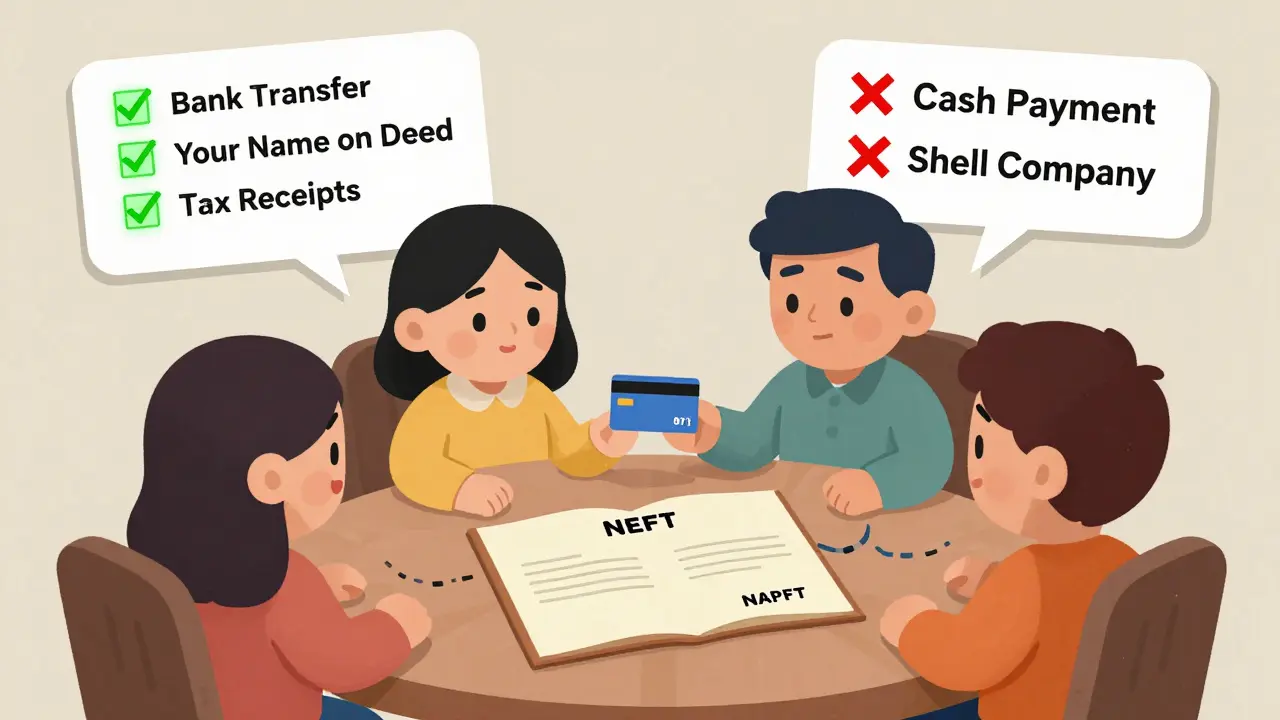
- Buy only in your own name-no exceptions. Even if your spouse is the co-owner, both names must be on the title and both must be on the payment trail.
- Use only bank transfers. Never pay in cash for property. Digital trails are your proof. Even if the seller insists on cash, walk away.
- Keep all documents. Save the sale deed, bank statements, property tax receipts, and any communication with the seller. Store them digitally and physically.
- Don’t use shell companies. If you use a company to buy property, it must be active, have real business, file taxes, and have audited accounts. If it’s just a name on paper, it’s a red flag.
- Check the seller’s history. If the seller is selling multiple properties quickly, or if they’re a close relative of someone you know, dig deeper. They might be part of a benami chain.
One investor in Hyderabad bought a flat using a friend’s company. The company had no employees, no office, no income. The ITABT found the money came from his personal account. The flat was seized. The friend’s company was dissolved. He lost ₹80 lakh and spent six months dealing with lawyers.
What About Joint Ownership?
Joint ownership is legal-if it’s honest. If you and your spouse buy a house together, and both names are on the deed and both contributed to the payment, it’s fine. But if one person paid 100% and the other is just a name on paper, that’s benami.
Same goes for parents and children. If a father pays for a flat in his daughter’s name because she’s a minor, that’s okay. But if she’s an adult and just a front, it’s illegal. The law looks at who funded it, not who’s listed.

How Authorities Catch Benami Deals
The government doesn’t guess. They use data. Here’s how they find you:
- Bank transaction monitoring-large cash deposits or unusual transfers trigger alerts
- Property registration databases-cross-referencing buyer names with income tax returns
- Mobile phone records-tracking who met whom during property deals
- Third-party tips-neighbors, brokers, or even family members report suspicious deals
In 2024, the ITABT seized over ₹12,000 crore worth of property across India. Nearly 60% of those cases involved real estate investors who thought they were being smart. They weren’t.
What If You Already Own a Benami Property?
If you bought property before 2016 and it’s in someone else’s name, you’re still at risk. The law is retrospective. The government can still seize it.
There’s one escape route: the Benami Transactions (Prohibition) Amendment Act, 2016 allows you to declare your property under the Income Declaration Scheme (IDS) if you did so before December 31, 2016. But that window closed. Today, there’s no amnesty. The only option is to transfer the property to your name legally-pay all taxes, penalties, and stamp duty-and hope the authorities don’t act.
But even that’s risky. If you transfer now, you’re admitting guilt. The ITABT can still investigate and charge you. It’s better to avoid the situation entirely.
Real Estate Investing in India: How to Do It Right
India’s real estate market still offers strong returns. Cities like Bengaluru, Pune, and Surat are growing fast. But the rules changed. The era of hidden ownership is over.
Here’s how to invest safely:
- Work with a licensed real estate agent who understands compliance
- Use a property lawyer to review every contract
- Always pay through cheques or NEFT/RTGS
- Register the property under your name only
- Keep records for at least 10 years
Don’t let the fear of benami law stop you. Let it guide you. The best investors in India today aren’t the ones who hide. They’re the ones who document, declare, and stay clean.
Can I buy property in my child’s name in India?
Yes, if your child is a minor. The law allows parents to buy property in a minor’s name as long as the payment comes from the parent’s account and the property is held for the child’s benefit. But if the child is an adult, buying property in their name while you pay for it is considered benami. The key is who funded the purchase, not whose name is on the title.
What happens if I’m just the benamidar and didn’t pay for the property?
Even if you didn’t pay, you can still be penalized. The law treats benamidars as participants in the illegal transaction. You can face fines, property seizure, and even criminal charges. The government doesn’t care if you were pressured or didn’t know the law. Your name on the title makes you legally responsible.
Is it benami if I gift property to a family member?
No, if it’s a genuine gift with proper documentation. If you transfer property to a family member as a gift, with a registered gift deed and payment of gift tax (if applicable), it’s legal. But if you keep control of the property-collect rent, pay bills, make decisions-it’s still benami. The law looks at control, not just the deed.
Can I use a trust to buy property in India without getting flagged?
Only if the trust is properly registered, has real beneficiaries, files tax returns, and isn’t controlled by a single person. Many people set up fake trusts to hide ownership. The ITABT has a list of suspicious trusts. If the trust has no bank account, no activity, and only one person funding it, it’s a red flag. Real trusts are transparent.
How long can the government investigate a benami property?
There’s no time limit. The government can investigate a property transaction from 20 years ago if they find evidence. The law allows them to go back as far as needed. That’s why keeping records for at least 10 years is critical-even if you think the deal is old, it’s never truly safe unless it’s fully documented and legal.