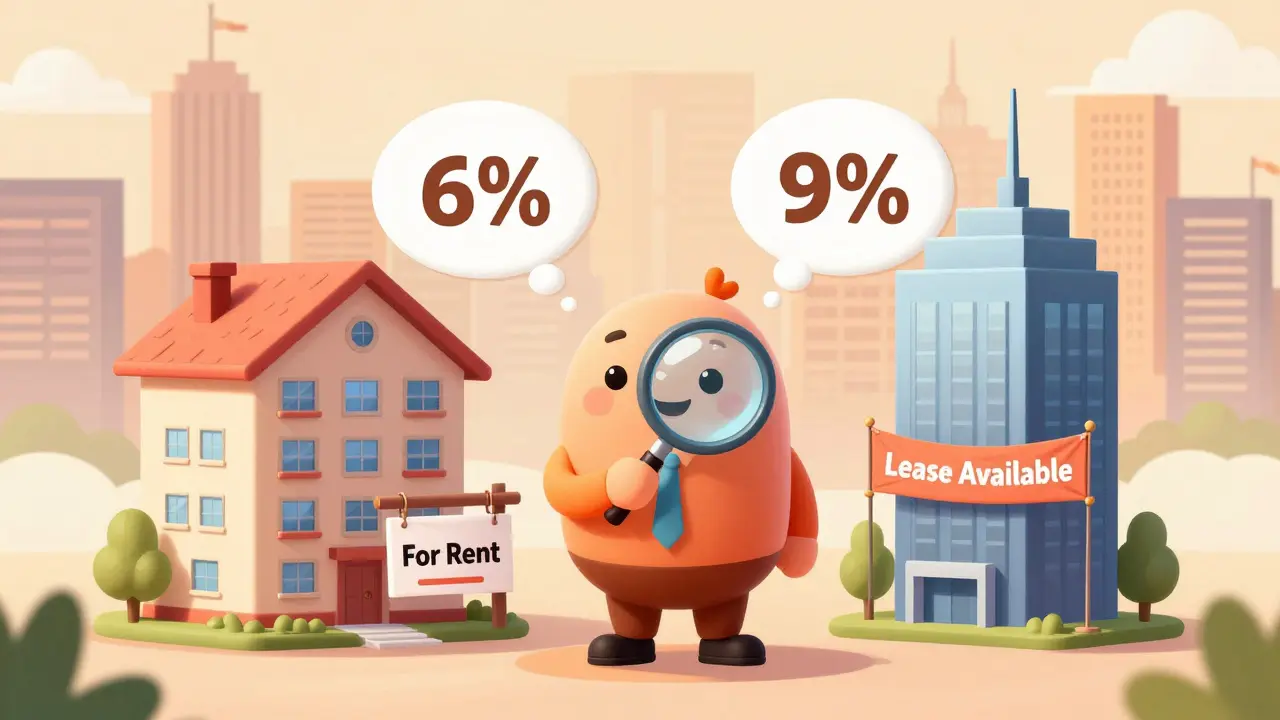
Residential vs Commercial Property Investment in India: Which Is Better?
When you think about investing in real estate in India, two paths keep coming up: residential or commercial. Which one actually gives you more bang for your buck? It’s not about which is "better"-it’s about which fits your goals, your risk tolerance, and how much time you’re willing to put in.
Residential Property: The Familiar Choice
Most first-time investors start here because it feels safe. You buy an apartment in Bangalore, a house in Pune, or a flat in Hyderabad. You rent it out to families, students, or professionals. The demand is steady. People always need a place to live.
In 2025, average rental yields for residential properties in Tier-1 cities like Mumbai, Delhi, and Chennai hovered between 3% and 5%. In Tier-2 cities like Jaipur, Lucknow, or Coimbatore, yields jumped to 6%-8%. That’s because vacancy rates are lower, and landlords don’t need to compete as hard for tenants.
But here’s the catch: residential tenants move. A family might leave after two years. A student graduates and moves out. You’re stuck with maintenance costs-leaky taps, broken ACs, painting, repairs. And if your tenant defaults? You’re out a month’s rent and stuck with legal fees.
Property taxes are higher for residential units in many cities. In Delhi, for example, property tax for a residential unit can be 15-20% higher than for a commercial space of the same size. Plus, capital gains tax kicks in faster if you sell within two years. Long-term holds (over two years) are better, but even then, you’re taxed at 20% with indexation.
Commercial Property: The High-Risk, High-Reward Path
Commercial property means office spaces, retail shops, warehouses, or co-working hubs. These aren’t rented to individuals-they’re leased to businesses. Think a startup leasing 2,000 sq. ft. in Gurgaon, or a pharmacy chain renting a ground-floor space in Ahmedabad.
The big advantage? Longer leases. Commercial tenants sign 3-5 year contracts. Sometimes even 10 years. That means less turnover, fewer vacancies, and more predictable cash flow. In 2025, commercial properties in prime business districts delivered rental yields of 7%-10%. Some industrial warehouses in NCR and Pune hit 11%.
And here’s something most people overlook: commercial tenants often pay for their own maintenance. A typical lease agreement includes a "triple net" clause. That means the tenant covers property taxes, insurance, and upkeep. You just collect rent. No fixing the AC. No dealing with broken lights. You’re the landlord, not the handyman.
But commercial real estate isn’t for everyone. You need more upfront cash. A 1,000 sq. ft. office in Mumbai’s Bandra might cost ₹1.8 crore. A similar residential flat? ₹80 lakh. That’s more than double. And if your tenant leaves? Finding a new business tenant takes time. You might go six months without rent. That’s a big hole if you’re counting on that income.
Market Trends in 2025: What’s Really Moving
India’s commercial real estate market grew 14% in 2024, led by logistics and data centers. Companies like Amazon, Flipkart, and Delhivery are snapping up warehouse space in cities like Bengaluru, Chennai, and Vadodara. Industrial parks near highways are seeing 20%+ annual rent hikes.
Meanwhile, residential demand is shifting. Tier-2 and Tier-3 cities are outpacing metros. Cities like Indore, Bhopal, and Coimbatore saw 18% year-over-year growth in housing sales. Why? Remote work. More people are moving out of Mumbai or Delhi to live cheaper, but still work for metro-based companies.
Government policies are tilting the scales too. The Real Estate (Regulation and Development) Act (RERA) made residential sales more transparent, but commercial projects still face fewer regulations. That means faster approvals for warehouses and offices, but more delays for housing projects.

Which One Gives You More Control?
Residential investing feels hands-on. You pick the location, the builder, the unit size. You can manage it yourself-listing on MagicBricks, screening tenants, collecting rent. It’s doable if you’re local.
Commercial investing? You need professionals. You need a property manager who understands lease agreements, tax filings for businesses, and commercial zoning laws. You can’t just text a tenant to fix a leak. You need lawyers, brokers, and accountants. It’s not DIY.
If you’re the kind of person who likes control, residential gives you that. If you’re okay handing over the day-to-day to experts, commercial opens up bigger returns.
Exit Strategy: Selling Is Different Too
Selling a residential property? You list it. You stage it. You wait for buyers. It can take 3-6 months. In 2025, resale homes in Delhi took an average of 152 days to sell.
Selling commercial? It’s faster-but only if you’ve got the right buyer. Institutional investors, REITs, and private equity firms are actively hunting for commercial assets. A well-located office building in Hyderabad might get multiple offers within 60 days. But you need to have clean titles, clear leases, and audited financials. No messy paperwork.

Who Should Invest in What?
If you’re:
- Starting out with ₹50-80 lakh → Go residential. Lower entry, easier to manage.
- Looking for passive income → Commercial. Longer leases, fewer headaches.
- Wanting to build wealth over 10+ years → Commercial. Higher appreciation potential. Industrial land in Pune has doubled in value since 2020.
- Prefer stability → Residential. Demand doesn’t vanish during economic dips.
- Willing to learn commercial leasing → Commercial. The returns are worth the learning curve.
The Bottom Line: It’s Not Either/Or
The smartest investors in India don’t pick one. They split their portfolio. Put 60% in residential for steady cash flow. Put 40% in commercial for higher returns and long-term value.
For example: a ₹1.2 crore portfolio could mean a ₹72 lakh apartment in Kochi (renting for ₹28,000/month) and a ₹48 lakh retail space in Coimbatore (renting for ₹45,000/month). That’s ₹73,000 in monthly income-with less than 10% vacancy risk.
Residential is the foundation. Commercial is the accelerator. You don’t have to choose. You can have both.
Is residential property in India a good investment in 2026?
Yes, but with conditions. Residential property in Tier-2 and Tier-3 cities like Indore, Jaipur, and Coimbatore is delivering strong rental yields (6-8%) and steady price growth. Demand is driven by remote work, migration from metros, and improved infrastructure. However, in saturated Tier-1 cities like Mumbai and Delhi, prices are flat or declining slightly. Focus on locations with good connectivity, schools, and future development plans.
Can commercial property make you richer than residential?
It can-but it’s riskier. Commercial properties in high-demand areas (like logistics hubs near highways or retail spaces in growing towns) have seen annual returns of 10-14% over the last five years. Residential properties typically return 4-7%. The key difference? Commercial leases are longer and often include tenant-paid maintenance. But if you lose a tenant, you could go six months without income. Residential tenants move more often, but you’ll always have demand.
What’s the minimum budget to invest in commercial property in India?
You need at least ₹40-50 lakh for a small retail or office space in a Tier-2 city. In Tier-1 cities like Bengaluru or Hyderabad, expect ₹1 crore or more for 500-800 sq. ft. of space. Industrial plots in peri-urban areas (like near Pune or Chennai) can start as low as ₹30 lakh for 1,000 sq. ft., but you need to verify zoning and infrastructure access before buying.
Are there tax benefits for commercial property investment?
Yes. Under Section 80IA of the Income Tax Act, income from commercial real estate in certain notified areas (like Special Economic Zones) can be tax-exempt for 10 years. Also, depreciation on commercial buildings is allowed at 5% per year (vs. 2% for residential). You can also claim deductions for property management fees, legal costs, and interest on loans. Residential property doesn’t offer these benefits.
How do I find reliable tenants for commercial space?
Work with a commercial real estate broker who specializes in business leasing. They’ll screen tenants for financial stability, business track record, and credit history. Avoid small startups without revenue proof. Look for established brands, pharmacies, clinics, or franchise outlets-they’re more likely to sign long leases and pay on time. Always require a security deposit equal to 6-12 months’ rent.
Should I invest in both residential and commercial property?
Yes, if you have the capital. Diversifying reduces risk. Residential gives you steady, reliable income. Commercial gives you higher returns and faster appreciation. A common strategy is 60% residential, 40% commercial. This balances stability with growth. For example, a ₹1.5 crore portfolio split this way can generate ₹90,000+ monthly rent with low vacancy risk.
If you’re just starting, begin with residential. Once you’ve got one property under your belt, use the equity and experience to move into commercial. You don’t need to be an expert on day one. You just need to start.