Essential Indian Stock Market Terms: 10 Must-Know Concepts for New Investors
Starting to invest in the Indian stock market can feel like walking into a crowded bazaar where everyone’s speaking a different language. You hear words like equity, IPO, demat account, and NSE, and suddenly you’re lost. But here’s the truth: you don’t need to be a finance expert to begin. You just need to understand the basics. These 10 terms aren’t just jargon-they’re the building blocks of every successful investor’s journey in India.
Equity: Owning a Piece of a Company
When you buy shares of a company like Reliance Industries or Tata Motors, you’re buying equity. That means you own a tiny slice of that business. If the company does well, your shares go up in value. If it struggles, they drop. Equity isn’t a bet-it’s ownership. Unlike a fixed deposit where you earn interest, with equity, your return comes from price growth and dividends. In India, most retail investors start with equity because it’s accessible, liquid, and offers the highest long-term returns compared to gold or real estate.
Stock Exchange: Where Buyers and Sellers Meet
India has two major stock exchanges: the National Stock Exchange (NSE) and the Bombay Stock Exchange (BSE). These aren’t physical buildings anymore-they’re digital platforms where millions of trades happen every day. The NSE is bigger and more modern, handling over 70% of daily trading volume. The BSE is older, founded in 1875, and still counts the Sensex as its flagship index. When someone says, “I bought shares on NSE,” they mean they used that platform to execute their trade. You don’t pick between them directly-your broker does it for you.
Demat Account: Your Digital Share Wallet
You can’t hold physical share certificates anymore in India. Since 1996, all shares must be held electronically in a demat account. Think of it like a digital wallet for your stocks. You open one with a broker like Zerodha, Upstox, or ICICI Direct. Without a demat account, you can’t buy or sell shares. It’s linked to your bank account and PAN card. Every time you buy shares, they appear in your demat account. When you sell, they disappear. It’s fast, secure, and eliminates the risk of lost or forged certificates.
IPO: First Time on the Stock Market
An IPO, or Initial Public Offering, is when a private company sells its shares to the public for the first time. Think of it like a startup opening its doors to investors. Companies like Paytm, Zomato, and Nykaa went public through IPOs. When you apply for an IPO, you’re trying to buy shares before they start trading on the stock exchange. It’s exciting-but risky. Some IPOs jump 50% on day one. Others fall 30%. Don’t assume an IPO is a guaranteed win. Check the company’s financials, business model, and why it’s raising money before you apply.
Brokerage: The Middleman You Can’t Avoid
You can’t buy stocks directly from the stock exchange. You need a broker. Brokers are licensed intermediaries who connect you to the market. They charge a fee called brokerage for every trade. In India, discount brokers like Zerodha charge as little as ₹20 per trade, no matter how many shares you buy. Full-service brokers like Kotak Securities charge more-sometimes 0.5% per trade-but offer research, advice, and portfolio management. For beginners, a discount broker is the smart choice. You get low costs and clean tools to learn on your own.
Mutual Funds: Invest in a Basket, Not Just One Stock
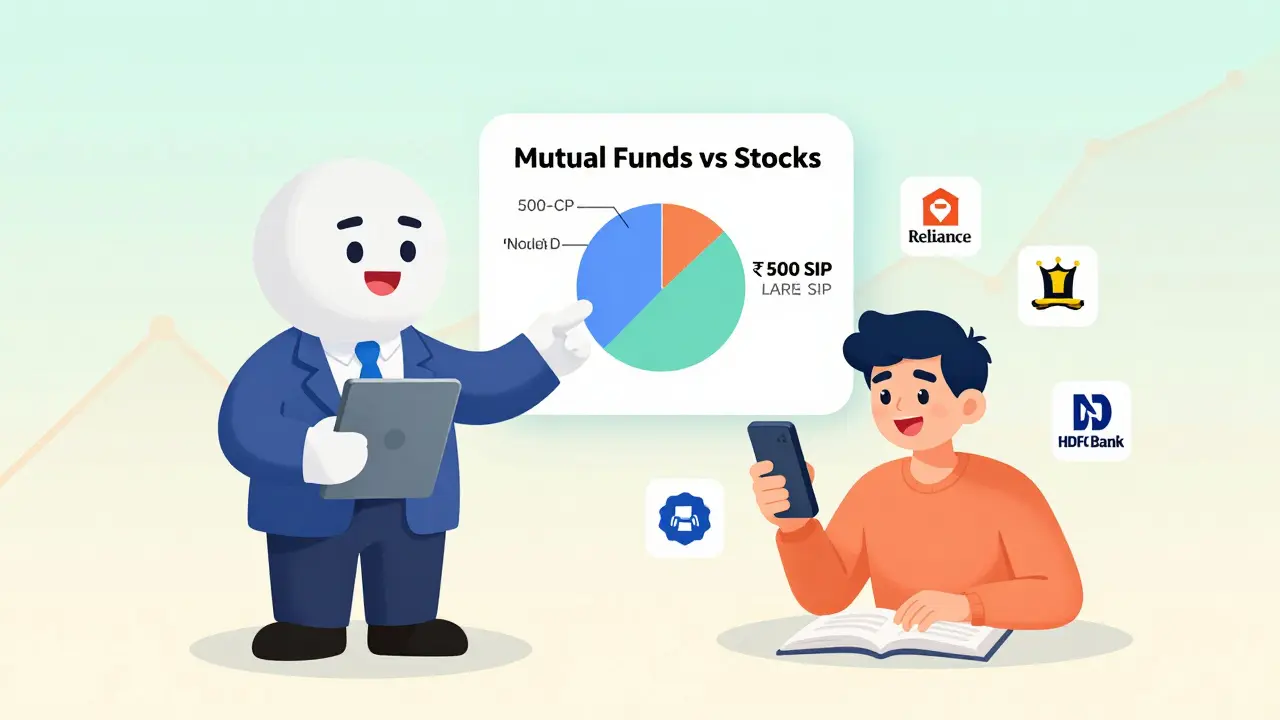
Not everyone wants to pick individual stocks. That’s where mutual funds come in. A mutual fund pools money from hundreds of investors and buys a mix of stocks, bonds, or both. A professional fund manager decides what to buy. In India, you can find mutual funds focused on large-cap stocks, small-cap stocks, technology, or even gold. Systematic Investment Plans (SIPs) let you invest as little as ₹500 a month. Over time, this builds wealth without needing to time the market. Over 70 million Indians now invest in mutual funds-more than those who own shares directly.
Index: The Market’s Pulse
An index tracks the performance of a group of stocks. In India, the two main ones are the Nifty 50 and the Sensex. The Nifty 50 is made up of the 50 largest companies listed on the NSE. The Sensex tracks 30 big companies on the BSE. When people say, “The market is up today,” they mean one of these indexes rose. Index funds and ETFs let you invest in the whole index at once. This is a simple, low-cost way to match the market’s average return. Warren Buffett recommends index funds for most people-and that advice works just as well in India.
Dividend: Cash From Your Ownership
Some companies share their profits with shareholders in the form of dividends. If you own 100 shares of HDFC Bank and it declares a ₹10 dividend per share, you get ₹1,000 in your bank account. Dividends are paid quarterly or annually. Not all companies pay them-especially younger ones that reinvest profits to grow. But if you want steady income from your investments, look for dividend-paying stocks. In India, companies like ITC, Coal India, and Power Grid are known for consistent payouts. Dividends are taxed at your income tax rate, so factor that in.
Market Capitalization: How Big Is the Company?
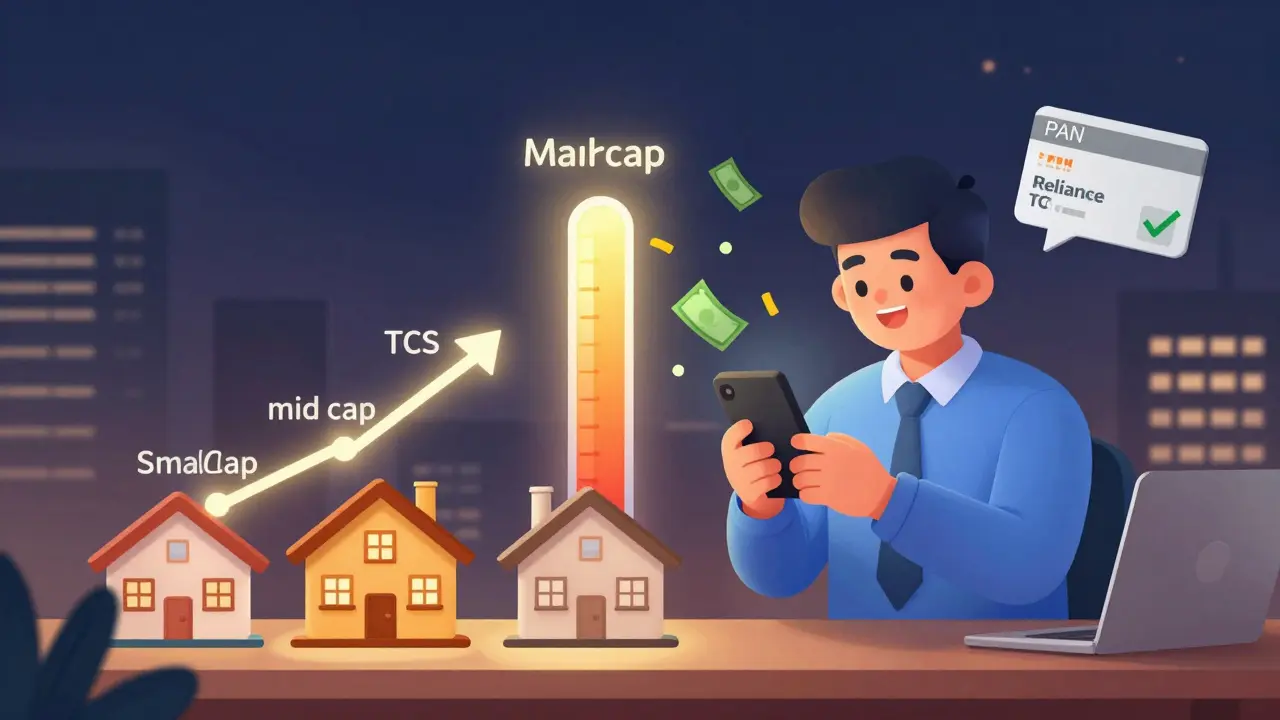
Market cap tells you the total value of a company. It’s calculated by multiplying the share price by the total number of shares. For example, if a company’s share price is ₹1,000 and it has 10 million shares, its market cap is ₹10,000 crore. In India, companies are grouped as large-cap (top 100), mid-cap (next 150), and small-cap (the rest). Large-cap stocks are stable but grow slowly. Small-cap stocks are risky but can grow fast. Most beginners start with large-cap because they’re less volatile. Over time, you can add mid and small-cap for growth.
Volume: How Much Is Being Traded?
Trading volume is the number of shares bought and sold in a day. High volume means lots of people are trading that stock. Low volume means few are interested. High volume often means the stock is liquid-you can buy or sell quickly without changing the price. Low volume can mean you’ll struggle to sell when you want to. In India, stocks like Reliance, TCS, and HDFC Bank trade with high volume daily. Smaller companies might trade just a few thousand shares a day. Stick to high-volume stocks as a beginner. It reduces risk and makes trading easier.
What Comes Next?
Now that you know these 10 terms, you’re ahead of 90% of new investors in India. But knowledge alone won’t make you rich. Start small. Open a demat account with a discount broker. Try a ₹1,000 SIP in a large-cap mutual fund. Read the annual reports of companies you’re curious about. Track the Nifty 50 daily. Don’t chase hot tips. Don’t panic when markets dip. The Indian stock market rewards patience. It doesn’t care how fast you learn-it cares how consistently you show up.
Can I start investing in the Indian stock market with ₹500?
Yes. You can open a demat account with zero minimum balance at brokers like Zerodha or Upstox. You can start a Systematic Investment Plan (SIP) in a mutual fund with as little as ₹500 per month. Even buying one share of a stock under ₹500 is possible. The key is starting early, not how much you start with.
Is the Indian stock market safe for beginners?
The market itself is regulated by SEBI, which protects investors from fraud. But the risk comes from your own choices-like chasing tips, overtrading, or investing money you can’t afford to lose. Beginners should stick to large-cap stocks, mutual funds via SIPs, and avoid leverage or options until they’ve learned more. Safety comes from discipline, not the market.
Do I need a PAN card to invest in stocks?
Yes. A PAN card is mandatory for opening a demat account and trading in the Indian stock market. It’s used for tax tracking and identity verification. If you don’t have one, apply for it through the NSDL or UTIITSL website. It takes about 10-15 days to get.
What’s the difference between a mutual fund and a stock?
A stock represents ownership in a single company. A mutual fund holds a basket of 20-100+ stocks (or bonds) managed by a professional. If one stock in the fund falls, others might rise and balance it out. Stocks are riskier but offer higher potential returns. Mutual funds spread risk and are easier for beginners.
How do I know if a stock is overpriced?
Look at the P/E ratio-Price to Earnings. It’s the stock price divided by the company’s earnings per share. A P/E of 30 means you’re paying ₹30 for every ₹1 of profit. Compare it to the industry average. If a tech stock has a P/E of 80 while peers are at 40, it might be overvalued. But high P/E can also mean strong growth expectations. Don’t rely on one number-look at revenue growth, debt levels, and management quality too.