
Best Indian Cities for Real Estate Investment in 2025: Top Markets to Watch
Buying property in India in 2025 isn’t about chasing hot spots anymore-it’s about finding places where demand, infrastructure, and policy align to create real, lasting value. If you’re looking to invest, you need more than just a rising price tag. You need cities where jobs are growing, public transport is expanding, and young professionals are moving in droves. Here are the top Indian cities for real estate investment this year, backed by current data, construction activity, and buyer behavior.
Hyderabad: The Tech-Driven Growth Engine
Hyderabad isn’t just India’s software capital-it’s becoming its most reliable property market. The city added over 120,000 new tech jobs between 2023 and 2025, with companies like Microsoft, Google, and Amazon expanding their campuses. This isn’t just about IT professionals either. Back-office operations, logistics hubs, and healthcare startups are pouring in too. As a result, residential demand in areas like Gachibowli, HITEC City, and Kondapur has surged. New apartment projects are selling out within weeks, and rental yields average 6.5%-among the highest in the country. The Metro expansion, now covering 72 km with 10 new lines under construction, is making suburban areas like Shamshabad and Serilingampally attractive for mid-income buyers. If you’re looking for steady, long-term appreciation with strong cash flow, Hyderabad is still the safest bet.
Bengaluru: High Risk, Higher Reward
Bengaluru’s real estate market is a rollercoaster, but for investors who can stomach volatility, the returns are hard to ignore. The city added 85,000 new tech jobs in 2024 alone, and startups raised over $5 billion in funding. But here’s the catch: supply hasn’t kept up. Land scarcity in the core areas-Whitefield, Electronic City, and Indiranagar-means prices have jumped 18% since 2023. New launches are mostly premium and ultra-premium, with average prices hitting ₹12,000 per sq.ft. in the best pockets. The silver lining? The Peripheral Ring Road and Namma Metro Phase 2 are finally moving forward. Areas like Devanahalli and Doddaballapur, once considered far-flung, are now seeing 20%+ annual price growth. Investors who bought here in 2022 are seeing 3x returns. But tread carefully. Overbuilding in the outskirts is causing inventory gluts. Stick to projects by builders with a track record-like Prestige, Godrej Properties, or Sobha-and avoid speculative plots in unregulated layouts.
Pune: The Balanced Contender
Pune is the quiet winner of India’s real estate race. It’s not flashy like Bengaluru, but it’s more stable. The city has a mix of IT, manufacturing, and education sectors driving demand. Companies like Tesla, BMW, and Siemens have set up large manufacturing units here, bringing in skilled workers and their families. The Pune Metro’s first phase opened in 2024, and Phase 2 is already under construction, connecting key corridors from Swargate to Chakan. Property prices in Kharadi and Hinjewadi have stabilized after a 2023 spike, now hovering around ₹9,500-11,000 per sq.ft. Rental yields are solid at 5.8%, and occupancy rates for apartments are above 95%. What sets Pune apart is its low risk of oversupply. Unlike other cities, new projects here are mostly by established developers with pre-booked buyers. If you want a market that doesn’t crash when interest rates rise, Pune is your play.
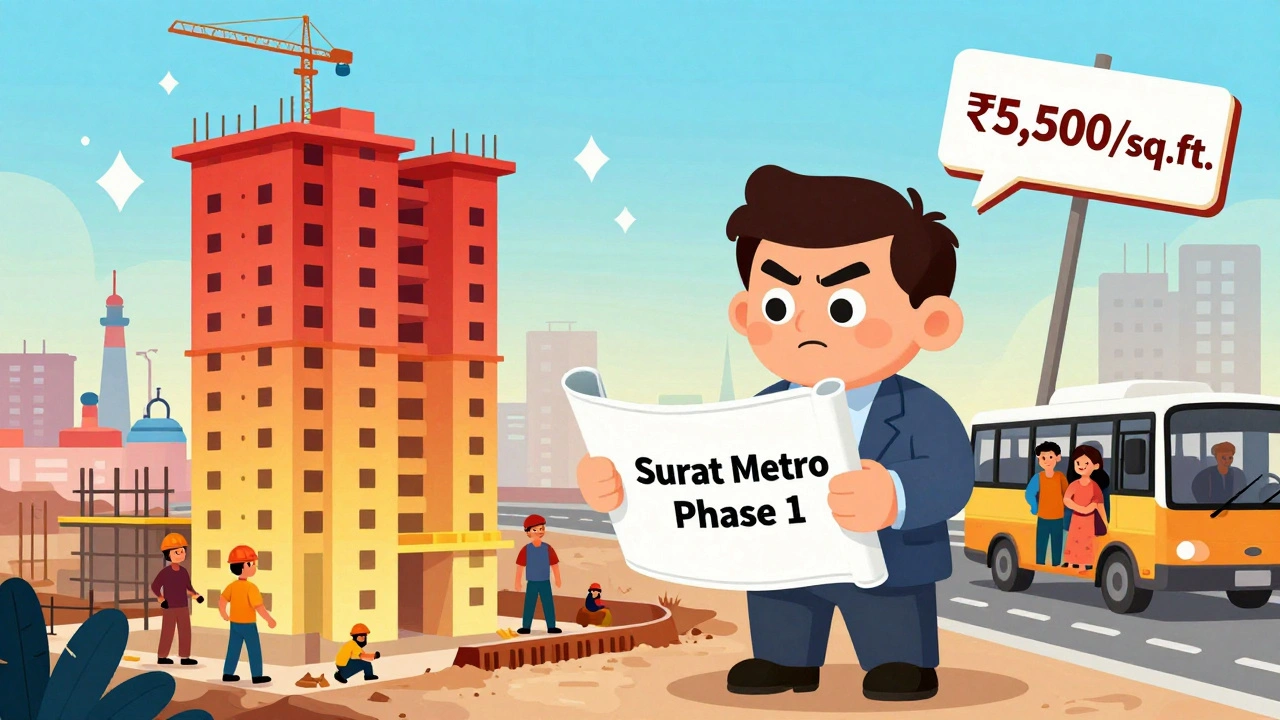
Surat: The Hidden Gem
Surat is the most underrated real estate market in India-and it’s not even close. This diamond and textile hub has seen a 30% population growth since 2020, driven by migration from rural Gujarat and neighboring states. The city’s GDP grew by 12.4% in 2024, far outpacing national averages. Real estate prices here are still low-₹5,000-7,000 per sq.ft. in prime areas like Udhna and Katargam-but demand is exploding. The Surat Metro, approved in 2023 and under construction, will cover 45 km by 2026. New industrial zones in Mangrol and Sachin are attracting thousands of workers every month. The best part? Rental demand is sky-high. A 2BHK apartment in Udhna rents for ₹18,000-22,000 a month, and vacancy rates are below 2%. Investors are buying off-plan and flipping within 18 months. Surat isn’t for the faint-hearted-it’s still developing-but for those who know how to spot early movers, it’s the most promising opportunity in India right now.
Ahmedabad: The Policy-Driven Winner
Ahmedabad’s real estate boom is no accident. It’s the result of smart urban planning. The city’s GIFT City, India’s first international financial services center, is now home to over 150 global firms, including JP Morgan, HSBC, and Deloitte. Thousands of professionals are relocating here, creating massive demand for housing. The Ahmedabad Metro’s Phase 1 is fully operational, and Phase 2-extending to Gandhinagar-is scheduled to open in late 2025. Property prices in Satellite and Prahlad Nagar have climbed 15% since 2023, but they’re still 30% lower than Bengaluru’s. The government’s focus on affordable housing has led to over 45,000 units approved under PMAY since 2022. If you’re looking for a city with strong institutional backing, low corruption, and transparent approvals, Ahmedabad is your pick. It’s not the flashiest, but it’s the most predictable.
Chennai: The Value Play
Chennai is the comeback story of Indian real estate. After years of stagnation, the city is finally waking up. The Chennai Metro’s second phase is expanding into Velachery and Tambaram, two areas that were once considered dead zones. Major automakers like Hyundai and Ford have doubled their production capacity here, bringing in skilled labor from across South India. Property prices in OMR (Old Mahabalipuram Road) are up 12% year-over-year, and new launches are selling fast. The biggest shift? Buyers are moving away from the city center. Areas like Sholinganallur and Siruseri now account for 60% of all new sales. The average price per sq.ft. is ₹7,500-8,500-still affordable compared to other metros. Rental yields hover at 5.5%, and occupancy is high. If you’re looking for a market that’s undervalued but on the rise, Chennai offers the best risk-reward ratio in South India.
What to Avoid in 2025
Not all cities are worth your money. Delhi’s market is still weighed down by oversupply in Noida and Ghaziabad. Many projects there have been sitting empty for over two years. Kolkata’s infrastructure hasn’t improved enough to support new demand. Lucknow and Jaipur are growing, but their markets are too small to absorb large investments. And don’t get lured by ‘new town’ projects in far-flung suburbs-most lack basic utilities, schools, or hospitals. Stick to cities with active metro expansion, real job growth, and clear government plans. If a city doesn’t have at least two of these, skip it.
How to Invest Smart in 2025
- Buy off-plan, not resale: New projects have 20-30% lower entry costs and better appreciation potential.
- Focus on transit corridors: Properties within 2 km of metro stations or upcoming expressways gain 15-25% faster.
- Check builder reputation: Use only RERA-registered developers with completed projects. Avoid unknown names, even if they offer big discounts.
- Look at rental yield, not just price: A ₹80 lakh apartment that rents for ₹40,000/month is better than a ₹60 lakh one that rents for ₹25,000.
- Don’t over-leverage: Interest rates are still above 8.5%. Keep your loan-to-value under 70%.
Final Take
The best real estate markets in India in 2025 aren’t the biggest-they’re the most connected. Hyderabad, Pune, and Ahmedabad offer stability. Bengaluru and Surat offer high growth. Chennai offers value. Each has its own rhythm. The key is matching your investment goals to the city’s trajectory. Don’t chase trends. Follow infrastructure, jobs, and policy. That’s how you build wealth, not just buy property.
Which Indian city has the highest rental yield for real estate in 2025?
Hyderabad currently leads with average rental yields of 6.5%, followed closely by Surat at 6.2%. These cities have high tenant demand due to strong job growth in tech and manufacturing, combined with relatively lower property prices. In contrast, cities like Bengaluru and Delhi have lower yields (4-5%) because property prices are much higher, even though rental rates are also high.
Is it better to buy in a metro or a tier-2 city in 2025?
It depends on your goal. If you want steady, long-term appreciation with low risk, tier-2 cities like Surat, Ahmedabad, and Pune are better. They’re growing fast but still have affordable entry prices. If you’re looking for high liquidity and faster price jumps, metros like Bengaluru and Hyderabad offer that-but with more volatility. Tier-2 cities also have less regulatory risk and fewer oversupply issues.
What’s the minimum investment needed to enter the Indian real estate market in 2025?
You can start with as little as ₹25-30 lakh in cities like Surat or Ahmedabad for a 1BHK apartment. In Pune or Chennai, expect ₹40-50 lakh for a 2BHK. In Bengaluru or Hyderabad, you’ll need ₹60-75 lakh minimum for a decent unit. Off-plan projects often allow lower down payments-sometimes as low as 10-15%-making it easier to enter with limited capital.
Are RERA-registered projects safer to invest in?
Yes. RERA registration ensures the builder has met legal requirements for land ownership, project approvals, and financial disclosures. It also protects buyers by mandating timely delivery and escrow accounts for funds. In 2025, over 95% of new launches in top cities are RERA-compliant. Avoid any project without RERA registration-it’s a red flag for delays, fraud, or legal issues.
How do interest rates affect real estate investment in India right now?
Home loan rates are at 8.5-9.25% as of late 2025, which has cooled speculative buying but strengthened demand from genuine end-users. Investors should avoid stretching their budgets too thin. A higher down payment reduces monthly payments and makes the investment more resilient to rate hikes. Properties with strong rental income can offset higher EMIs, making them more viable than low-yield assets.
For investors looking beyond 2025, keep an eye on emerging corridors like Nagpur’s Smart City zone, Coimbatore’s industrial expansion, and Indore’s new IT park. These are the next tier-2 markets to watch. But for now, stick with the proven winners.