Life Insurance Premiums as Section 80C Deduction in India: Rules and Limits for 2026
When you pay your life insurance premium in India, you’re not just securing your family’s future-you might also be cutting your income tax bill. That’s the power of Section 80C. It’s one of the most used tax-saving tools by millions of Indian taxpayers, and life insurance is at the top of the list. But here’s the catch: not all policies qualify, and the rules changed in recent years. If you’re paying premiums and thinking you’re getting a tax break, you need to know exactly how much you can claim, what counts, and what doesn’t.
What Section 80C Actually Lets You Deduct
Section 80C of the Income Tax Act, 1961, allows individuals and Hindu Undivided Families (HUFs) to reduce their taxable income by up to ₹1.5 lakh per financial year. This isn’t a tax credit-it’s a deduction. That means you subtract this amount from your gross total income before tax is calculated. So if you earn ₹12 lakh a year and invest ₹1.5 lakh under 80C, you’re taxed only on ₹10.5 lakh.Life insurance premiums are one of the most popular ways to use this deduction. But it’s not about how much you pay-it’s about what kind of policy you have and how much of that payment qualifies.
Eligible Life Insurance Policies
Only certain life insurance policies qualify for 80C benefits. The policy must be issued by an insurer recognized by the Insurance Regulatory and Development Authority of India (IRDAI). That includes all major private insurers like LIC, HDFC Life, SBI Life, and ICICI Prudential, as well as public sector insurers.Term plans, endowment plans, money-back plans, and unit-linked insurance plans (ULIPs) all qualify-as long as they meet the premium-to-sum-assured ratio. That’s the key detail most people miss.
The Premium-to-Sum-Assured Rule
Since April 1, 2013, the government imposed a strict condition: the annual premium you pay cannot exceed 10% of the sum assured (the death benefit) for policies issued after that date. For policies taken before April 1, 2012, the limit was 20%. This rule was introduced to stop people from using insurance as a tax shield without real risk coverage.Let’s say you buy a policy with a sum assured of ₹10 lakh. If it was issued in 2025, your annual premium must be ₹1 lakh or less to qualify for full 80C deduction. If you pay ₹1.2 lakh, only ₹1 lakh counts toward your ₹1.5 lakh limit. The extra ₹20,000 doesn’t get any tax benefit.
For older policies (pre-2013), the 20% rule still applies. So if you have a policy from 2010 with a ₹5 lakh sum assured, you could pay up to ₹1 lakh in premiums and still get the full deduction.
Who Can Claim the Deduction?
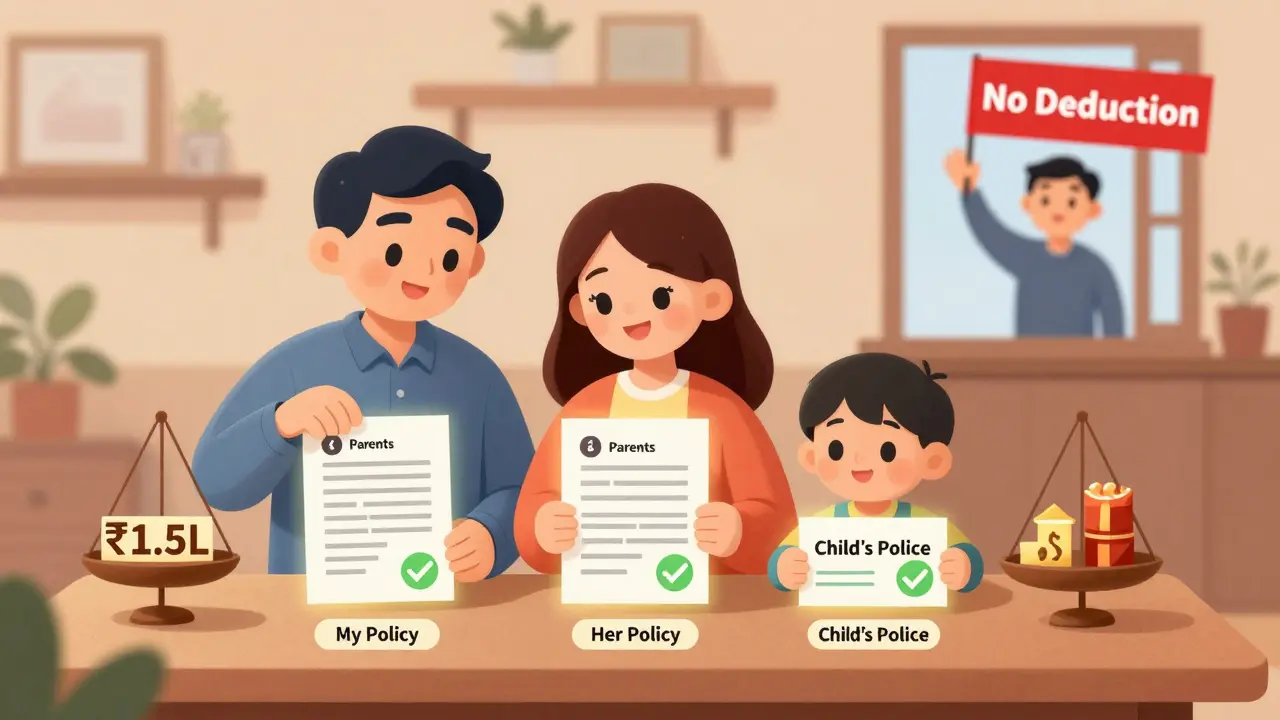
Only the policyholder can claim the deduction. If you pay the premium for your spouse’s policy, you can’t claim it-unless you’re the policyholder. Same goes for children’s policies: you can claim if you’re the one named as the policyholder. But if your parents bought a policy in your name, you can’t claim the premium as a deduction.Also, the premium must be paid out of your own income. If your employer pays your premium as a fringe benefit, you can’t claim it under 80C. It’s already been excluded from your taxable income.
What About Premiums Paid for Parents or In-Laws?
This is a common misunderstanding. You cannot claim tax deduction for premiums paid for your parents, in-laws, or siblings-even if you’re the one paying. The policy must be in your name, your spouse’s name, or your child’s name. That’s it. No exceptions.Some people think they’re helping their parents by paying their insurance, but unless the policy is in their name and they’re the one claiming it, the tax benefit doesn’t transfer to you.

When Premiums Don’t Qualify
Not every payment you make under the name of “life insurance” counts. Here’s what’s excluded:- Premiums paid for foreign insurance policies (even if issued by an Indian company’s overseas branch)
- Additional riders like critical illness or accidental death cover if they’re charged separately and not bundled into the base premium
- Top-up premiums paid after the policy has been active for more than two years
- Premiums paid for policies that have been surrendered or lapsed before the end of the financial year
Also, if you pay a lump sum for multiple years upfront, only the portion applicable to the current financial year counts. For example, if you pay ₹3 lakh for a 3-year premium in March 2025, only ₹1 lakh applies to FY 2025-26. The rest goes to the next two years.
How to Track Your 80C Deductions
You’re not limited to just life insurance. Section 80C includes 14 other options: EPF, PPF, ELSS mutual funds, NSC, tuition fees, home loan principal, and more. The ₹1.5 lakh limit applies to the total of all these.So if you’ve invested ₹50,000 in ELSS mutual funds and ₹30,000 in PPF, you only have ₹70,000 left for life insurance premiums. If you pay ₹1 lakh in premiums, only ₹70,000 of it qualifies. The rest is wasted from a tax perspective.
Keep receipts, bank statements, and policy acknowledgments. Your employer will ask for proof when you submit Form 12BB. The Income Tax Department can also ask for it during an audit.
ULIPs and Tax Treatment
ULIPs are tricky. They combine insurance and investment. The premium you pay qualifies under 80C, but the returns are taxed differently. If you hold the ULIP for at least five years, the maturity amount is tax-free under Section 10(10D). If you exit early, the gains become taxable.Also, if your ULIP premium exceeds 10% of the sum assured, the entire policy loses 80C eligibility-not just the excess. So don’t just look at the premium amount. Check the sum assured first.
What Happens If You Surrender the Policy?
If you cancel your policy within two years of purchase, the tax benefit you claimed in previous years gets reversed. The amount you deducted under 80C in those years gets added back to your income in the year of surrender. You’ll owe tax on that amount, plus interest.That’s why it’s dangerous to buy life insurance just for tax savings and then surrender it after a year. The government catches this. It’s not worth the penalty.
Deadlines and Filing
You must pay the premium before March 31 to claim it for that financial year. Payments made in April 2026 for FY 2025-26 won’t count. But if you pay in March 2026 for a policy due in April 2026, it still counts-because the payment date matters, not the due date.When filing your ITR, you’ll report your 80C deductions under Schedule VI-A. You don’t need to attach documents, but you must keep them for at least six years in case of scrutiny.
Real-Life Example
Raj, 38, earns ₹14 lakh annually. He has:- ₹50,000 in EPF
- ₹40,000 in PPF
- ₹30,000 in ELSS mutual funds
- ₹1.2 lakh in life insurance premiums (sum assured: ₹12 lakh, policy issued in 2024)
His total 80C investment: ₹2.4 lakh. But the limit is ₹1.5 lakh. So he can claim only ₹1.5 lakh. His life insurance premium qualifies fully because ₹1.2 lakh is less than 10% of ₹12 lakh (which is ₹1.2 lakh). But since his other investments already used ₹1.2 lakh, he can claim only ₹30,000 of his insurance premium. The other ₹90,000 doesn’t get any tax benefit.
Had Raj reduced his ELSS investment to ₹10,000, he could have claimed the full ₹1.2 lakh for insurance. That’s the trade-off.
Common Mistakes to Avoid
- Buying a policy with low sum assured to game the 10% rule-this defeats the purpose of insurance
- Assuming all premiums are deductible-many riders and add-ons aren’t
- Forgetting to include all 80C investments when calculating your limit
- Paying premiums in cash without a receipt-digital payments are easier to track
- Waiting until March to decide-better to plan early and spread payments
Is Life Insurance Still Worth It for Tax Saving?
Yes-but only if you need the insurance. Don’t buy a policy just to save tax. If you already have adequate coverage, consider other 80C options like ELSS funds, which offer better returns over the long term. Life insurance is for protection, not wealth creation.But if you’re looking for a safe, guaranteed-return option with protection built in, and you haven’t used your full ₹1.5 lakh limit, then a well-structured term or endowment plan still makes sense.
Final Rule of Thumb
Before paying any life insurance premium, ask yourself:- Do I need this coverage?
- Is the sum assured at least 10 times the annual premium?
- Have I already used up my ₹1.5 lakh 80C limit with other investments?
If the answer to the first question is no, skip it. If the second is no, reconsider the policy. If the third is yes, save your money for next year.
Can I claim life insurance premium under Section 80C for my parents?
No, you cannot claim a tax deduction under Section 80C for life insurance premiums paid for your parents, in-laws, or siblings. The policy must be in your name, your spouse’s name, or your child’s name to qualify for the deduction. Even if you’re the one paying, the policyholder must be eligible under the rules.
What happens if I pay more than ₹1.5 lakh in total under Section 80C?
You can invest more than ₹1.5 lakh in total across all 80C instruments, but only the first ₹1.5 lakh qualifies for tax deduction. Any amount beyond that doesn’t reduce your taxable income. For example, if you invest ₹2 lakh in EPF, PPF, and life insurance combined, you’ll get tax benefit only on ₹1.5 lakh. The extra ₹50,000 is not deductible.
Is the maturity amount from life insurance taxable?
No, the maturity amount from a life insurance policy is generally tax-free under Section 10(10D), as long as the premium paid doesn’t exceed 10% of the sum assured (or 20% for policies issued before April 2012). If the premium exceeds these limits, the maturity proceeds may become taxable. Always check your policy’s terms and the sum assured-to-premium ratio.
Can I claim tax benefit for a term insurance policy under Section 80C?
Yes, term insurance premiums qualify for deduction under Section 80C, provided the annual premium is 10% or less of the sum assured. Term plans are often the most cost-effective way to get high coverage and still claim the deduction. Many people use them specifically for tax planning because they offer pure protection with no investment component.
Do I need to submit proof of premium payment to claim Section 80C?
You don’t need to submit proof while filing your income tax return, but you must keep all payment receipts, bank statements, and policy acknowledgments for at least six years. If the Income Tax Department conducts an audit or scrutiny, they may ask for these documents. Digital payments with clear references are easier to verify than cash payments.
If you’re planning your tax strategy for FY 2026-27, start early. Review your existing policies, calculate your sum assured versus premiums, and decide whether to increase coverage or shift funds to other 80C options. Don’t wait until March. The best tax savings come from planning-not panic.