National Savings Certificate (NSC) in India: Government-Backed 80C Option
When you’re looking for a safe place to park your money and cut your taxes at the same time, the National Savings Certificate (NSC) stands out in India’s financial landscape. It’s not flashy. It doesn’t promise quick returns. But for millions of middle-income families, it’s the quiet, reliable choice that delivers both security and tax savings under Section 80C of the Income Tax Act.
What Exactly Is an NSC?
The National Savings Certificate is a small savings scheme run by the Government of India through India Post. It’s not a stock. It’s not a mutual fund. It’s a government-backed bond you buy with cash, and it earns fixed interest over five years. You can buy NSCs at any post office across the country, and they’re available in two types: NSC VIII Issue and NSC IX Issue. The VIII Issue is the one most people use today-it has a five-year lock-in and is the only one eligible for tax deductions under Section 80C.
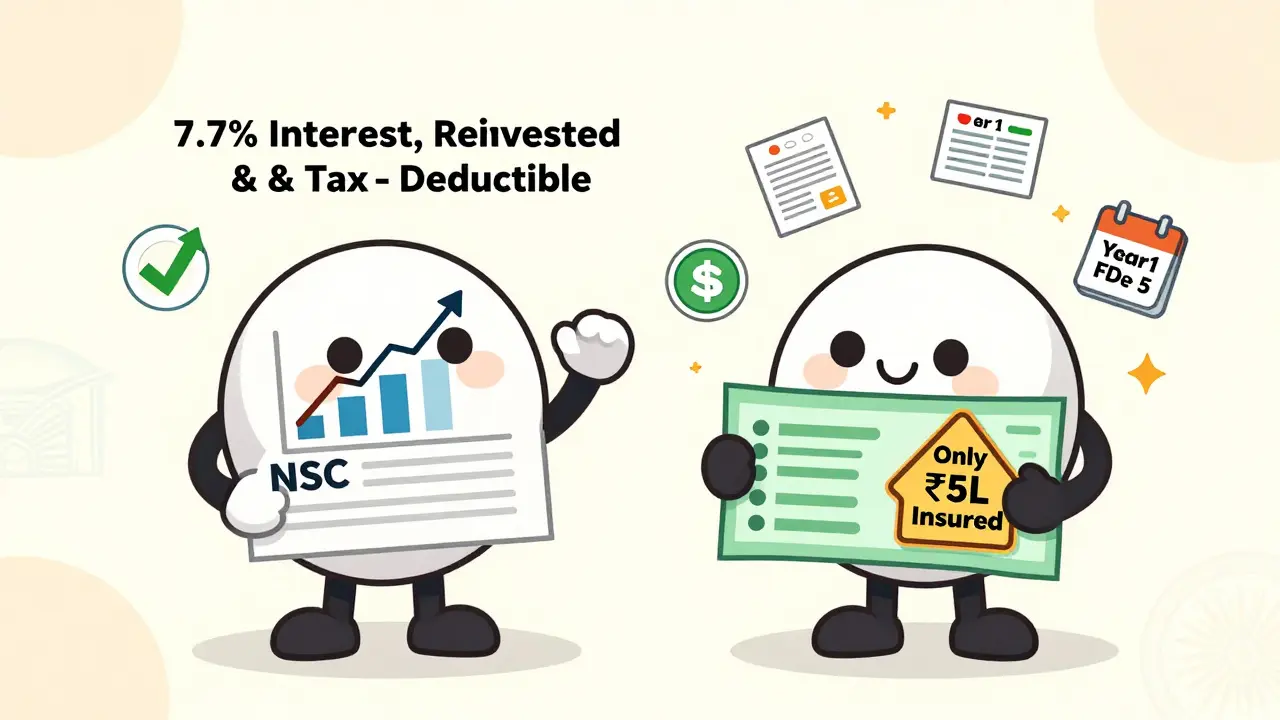
When you invest in NSC, you’re essentially lending money to the government. In return, you get a certificate as proof of investment, and the interest compounds annually. The rate isn’t fixed forever-it changes every quarter based on the government’s G-Sec yields-but it’s always higher than regular savings accounts. As of January 2026, the rate is 7.7% per annum, compounded yearly. That’s more than double what most banks offer on savings accounts.
How NSC Helps You Save Tax Under Section 80C
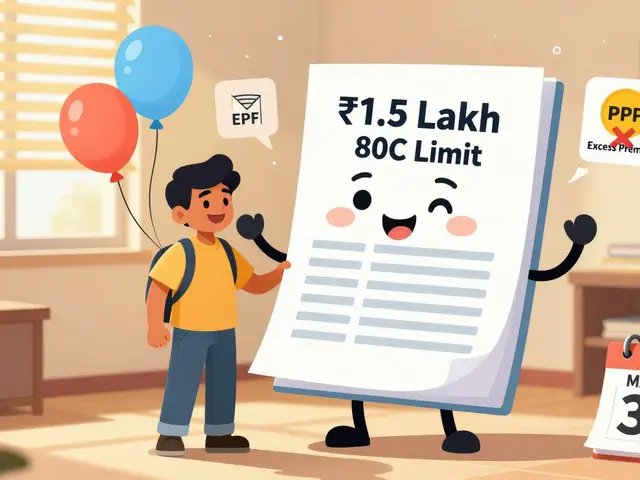
Section 80C lets you reduce your taxable income by up to ₹1.5 lakh per year. You can split this across multiple instruments-PPF, ELSS, life insurance premiums, tuition fees, and yes, NSC. Every rupee you invest in NSC counts toward that ₹1.5 lakh limit.
Here’s the catch: the interest you earn each year is also taxable. But there’s a trick. The interest is reinvested, and since it’s treated as a reinvestment in the next year’s NSC, it qualifies for another 80C deduction. This means you can keep claiming tax benefits on the interest earned during the five-year term, as long as you don’t withdraw it. It’s called the reinvestment benefit, and it’s one of the few places in personal finance where compounding works for your tax savings, not against you.
For example, if you invest ₹1 lakh in NSC in 2025, you get a ₹1 lakh deduction that year. In 2026, the interest earned-₹7,700-is added to your NSC value. When you file taxes in 2026, you can treat that ₹7,700 as a new investment, and deduct it under 80C again. This repeats each year until maturity. By the end of five years, you’ve effectively claimed deductions on more than ₹1.5 lakh, even though your original investment was just ₹1 lakh.
Why NSC Is Safer Than Bank FDs
People often compare NSC with bank fixed deposits. Both offer fixed returns. But here’s the difference: NSC is backed by the Government of India. That means zero default risk. A bank FD? Even if the bank is covered by DICGC insurance, you’re only protected up to ₹5 lakh per person per bank. If you invest ₹10 lakh in an FD, you’re exposed.
NSC has no such cap. You can invest ₹10 lakh, ₹50 lakh, or more-your money is as safe as the Indian government’s balance sheet. And unlike bank FDs, which can be withdrawn early (with penalties), NSC has a strict five-year lock-in. That’s a feature, not a bug. It forces discipline. If you’re the type who keeps dipping into your savings, NSC locks it away until you need it.
How to Buy NSC and What You Need
Buying NSC is simple. Walk into any post office that offers savings schemes. You’ll need:
- Your PAN card
- A valid ID proof (Aadhaar, driver’s license, passport)
- Proof of address (if ID doesn’t show it)
- Cash or a cheque
You can buy NSC in your name, your spouse’s name, or your minor child’s name. If you’re buying for a child, you must be the guardian. Joint ownership is not allowed. The minimum investment is ₹1,000, and you can buy in multiples of ₹100 after that. There’s no upper limit.
Once you pay, you get a physical NSC certificate. It’s not digital yet-though the government is working on it. You’ll need to keep it safe. If you lose it, replacing it is a hassle. Some post offices now offer a receipt cum acknowledgment that you can use temporarily while waiting for the certificate.
What Happens When NSC Matures?
After five years, your NSC matures. The amount you get back is your original investment plus all the compounded interest. For example, if you invested ₹1 lakh at 7.7% per annum, you’ll get back ₹1,46,472 at maturity.
At maturity, you can withdraw the full amount. The interest earned in the final year is taxable as income from other sources. But here’s the thing: since you’ve already claimed deductions on the interest each year, the final tax hit is usually small. Most people don’t pay much extra tax because they’ve already reduced their taxable income over five years.
You can also choose to reinvest the matured amount into a new NSC. That’s common among retirees who want to keep their money safe and continue claiming 80C benefits.
NSC vs PPF: Which Is Better?
Many people ask: Should I pick NSC or PPF? Both are government-backed and offer 80C benefits. But they’re not the same.
| Feature | NSC | PPF |
|---|---|---|
| Lock-in period | 5 years | 15 years |
| Interest rate (Jan 2026) | 7.7% | 7.1% |
| Maximum investment | No limit | ₹1.5 lakh/year |
| Withdrawals | Not allowed before maturity | Partial after 7 years |
| Interest taxation | Taxable annually (but reinvested) | Completely tax-free |
| Eligibility | Individuals, minors (via guardian) | Only Indian residents |
If you want flexibility and tax-free returns, PPF wins. But if you want higher interest, no investment cap, and a shorter lock-in, NSC is better. PPF is for long-term wealth building. NSC is for short-term, tax-efficient savings.

Who Should Invest in NSC?
NSC is perfect for:
- Conservative investors who hate risk
- People who want to maximize their 80C deductions
- Parents saving for their child’s education or marriage
- Retirees looking for steady, safe income
- Anyone who doesn’t trust banks but still wants returns above inflation
It’s not for people who need liquidity. If you might need the money in three years, don’t buy NSC. It’s also not for high-income earners who’ve already hit their ₹1.5 lakh 80C limit. You won’t get any extra benefit.
Common Mistakes to Avoid
Even smart people mess up with NSC. Here’s what to watch out for:
- Buying NSC in your spouse’s name and trying to claim deduction-you can’t. Only the investor gets the deduction.
- Ignoring the interest reinvestment trick. If you don’t reinvest the interest, you lose out on extra tax savings.
- Not keeping the certificate safe. Lose it, and you’ll spend weeks getting a duplicate.
- Thinking NSC is inflation-proof. At 7.7%, it barely beats inflation. It’s about safety, not growth.
Final Thoughts
The National Savings Certificate isn’t glamorous. It doesn’t make headlines. But for the average Indian family, it’s one of the most practical tools they have. It combines safety, simplicity, and tax savings in a way few other instruments do. If you’re not using NSC to reduce your tax burden and build a secure corpus, you’re leaving money on the table.
It’s not a get-rich-quick scheme. It’s a get-steady-rich scheme. And in today’s uncertain economy, that’s worth more than you think.
Can I buy NSC online?
No, you cannot buy NSC online yet. You must visit a post office in person with your documents and payment. The government is working on a digital platform, but as of 2026, physical purchase is still the only option.
Is NSC interest taxable?
Yes, the interest earned each year is taxable. However, since the interest is reinvested into the NSC, it qualifies for another deduction under Section 80C in the next year. This offsets the tax liability and allows you to claim deductions on more than your original investment.
Can I withdraw NSC before 5 years?
No, NSC has a strict five-year lock-in. Early withdrawal is not allowed under any circumstances, not even for emergencies. If you need liquidity, consider other options like bank FDs or debt mutual funds.
Can I invest in NSC for my child?
Yes, you can buy NSC in the name of your minor child. You must be the guardian and sign the application. The investment will count toward your own 80C limit, not the child’s. Once the child turns 18, they can take over the certificate.
What happens if I die before NSC matures?
If the investor dies before maturity, the NSC becomes part of their estate. The nominee or legal heir can claim the maturity amount by submitting the certificate along with a death certificate and proof of inheritance. The interest earned up to the date of death is taxable in the heir’s hands.