Tax Planning Calendar for 80C in India: Monthly Actions to Hit ₹1.5 Lakh Limit
If you’re earning in India and want to cut your tax bill without scrambling in March, you need a simple, month-by-month plan for Section 80C. The ₹1.5 lakh limit isn’t a suggestion-it’s a hard cap. And if you wait until the last week of March to invest, you’re leaving money on the table, paying more tax than needed, and risking missed opportunities. The key isn’t just knowing what qualifies-it’s knowing when to act.
What Section 80C Actually Covers
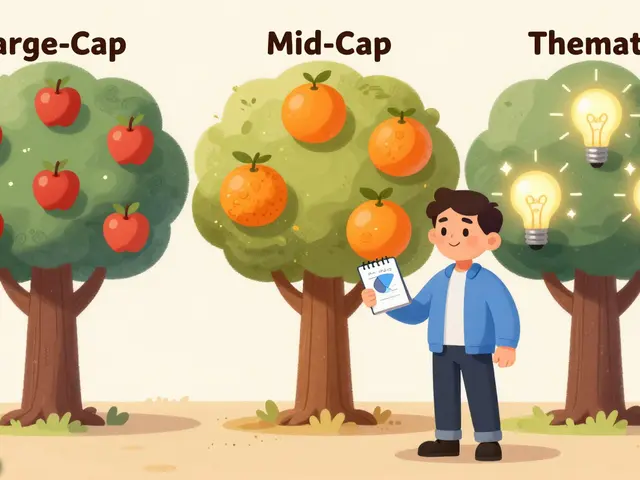
Section 80C isn’t one investment. It’s a list of 15 eligible options that all count toward the same ₹1.5 lakh limit. Some are safe, some are risky, some lock your money for years, and others let you withdraw anytime. You can mix them. You should mix them.
Eligible options include:
- Public Provident Fund (PPF)
- Employee Provident Fund (EPF)
- Life insurance premiums
- Equity Linked Savings Scheme (ELSS)
- Fixed deposits (5-year lock-in)
- National Savings Certificate (NSC)
- Tuition fees for two children
- Principal repayment on home loan
- Sukanya Samriddhi Yojana
- Senior Citizen Savings Scheme
- Unit Linked Insurance Plans (ULIPs)
- Atal Pension Yojana
- Infrastructure Bonds (if issued before 2020)
- Contributions to pension funds under Section 80CCC
- Contributions to NPS (up to ₹50,000 extra under 80CCD(1B))
Don’t confuse 80C with 80CCD(1B). That’s an extra ₹50,000 you can save on top of ₹1.5 lakh if you invest in NPS. But that’s a separate limit. Stick to 80C first.
Why Waiting Until March Is a Mistake
Most people think tax planning is a March ritual. That’s wrong. By March, your salary deductions are already locked in. Your bank FDs are already set. Your ELSS funds are already bought. If you haven’t used your limit by then, you’re stuck paying 30% tax on the last ₹1.5 lakh you earned.
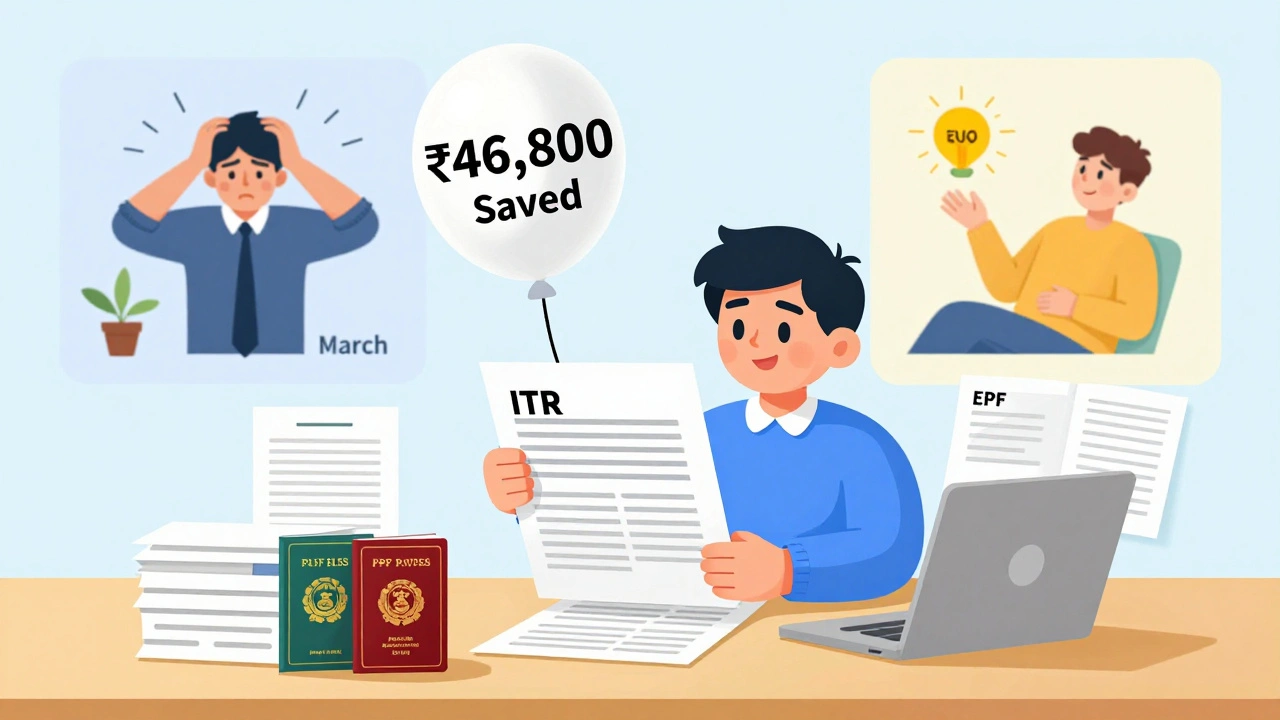
Here’s the real cost: if you’re in the 30% tax bracket and you invest ₹1.5 lakh at the last minute, you save ₹46,800 in tax. But if you invest ₹12,500 every month, you’re not just saving tax-you’re earning returns on that money for 11 months longer.
For example: invest ₹12,500 in ELSS in April. That money grows tax-free for 3 years. If you wait until March, you get zero growth before the lock-in ends. That’s lost compounding. That’s lost wealth.
Monthly Tax Planning Calendar for 80C
Use this as your checklist. Start in April. Stick to it.
- April - Start with ELSS. Pick a top-performing fund (like Parag Parikh Flexi Cap or Axis ELSS). Invest ₹12,500. This gives you 11 months of growth before lock-in ends. ELSS has the shortest lock-in (3 years) and highest return potential.
- May - Top up your EPF if you’re employed. If your employer matches your contribution, you’re getting free money. Even if you’re self-employed, you can open a voluntary EPF account.
- June - Buy NSC or open a 5-year bank FD. NSC gives fixed returns (7.1% as of 2025) and is safe. Bank FDs are even safer but offer lower interest. Both lock your money for 5 years.
- July - Pay tuition fees for your kids. Up to ₹1.5 lakh total for two children. If you paid ₹50,000 in fees this year, claim it now. Keep receipts.
- August - Add to PPF. If you already have a PPF account, deposit ₹12,500. PPF gives 7.1% interest, tax-free growth, and 15-year lock-in. It’s the most stable 80C option.
- September - Review your life insurance. If you bought a policy in January and paid ₹1 lakh premium, you’ve already used most of your limit. If you didn’t, buy a term plan now. Premiums for ₹50 lakh cover cost under ₹5,000/year. That’s ₹4,166/month. Easy to fit in.
- October - Check home loan principal repayment. If you’re repaying a home loan, your monthly EMI includes principal. Track how much you’ve paid so far. If you’ve repaid ₹30,000 in principal, that’s ₹30,000 used. Add it to your total.
- November - If you’re self-employed or in a higher bracket, consider NPS. Even ₹50,000 here doesn’t count toward 80C. It’s extra. But if you’re still under ₹1.5 lakh, use this month to buy more ELSS or top up PPF.
- December - Rebalance. By now, you should be at ₹1 lakh or more. If you’re behind, shift to high-return options. ELSS is still your best bet. Avoid last-minute FDs-interest rates are locked in, and you won’t get the full year’s benefit.
- January - Final push. If you’re at ₹1.2 lakh, invest ₹5,000 in NSC or PPF. Small amounts still count. Don’t leave ₹5,000 on the table.
- February - Confirm all payments. Did your employer deduct your EPF? Did you pay tuition? Did you submit life insurance receipts? Get proof for everything. No receipts = no claim.
- March - File your ITR. Don’t wait. Submit your Form 12BB to your employer by March 10. If you’re self-employed, file your return by July 31. Use the 80C deductions you’ve tracked all year.

What Not to Do
Don’t buy insurance just to save tax. A ₹50,000 ULIP with 40% charges in year one is worse than paying tax. Buy term insurance for protection. Use ELSS for growth.
Don’t invest in tax-saving FDs if you need liquidity. If you’re young and can wait 5 years, fine. If you might need cash in 2 years, skip it.
Don’t ignore your EPF. If you’re employed, your employer contributes 12% of your basic salary. That’s free money. It counts toward 80C. You’re already saving-just don’t forget to claim it.
Don’t assume your employer tracks everything. Many HR teams don’t. You must track your own 80C investments. Use a spreadsheet. Update it monthly.
Pro Tips for Maximum Savings
- Use SIPs for ELSS. Invest ₹12,500 in 12 monthly installments. You’ll average out market volatility and stay disciplined.
- Claim tuition fees for your kids even if they’re in private school. It doesn’t matter if the school is expensive-only the amount paid matters.
- Use your spouse’s 80C limit. If you’re married, both of you get ₹1.5 lakh each. That’s ₹3 lakh in deductions. Split investments between both names.
- Reinvest matured PPF. When your 15-year PPF matures, extend it for another 5 years. You can still withdraw 60% yearly. Keep the rest growing tax-free.
- Track your total every month. Add up EPF, ELSS, NSC, tuition, home loan principal. If you’re at ₹1.3 lakh by February, you know you only need ₹20,000 more.
Common Mistakes and Fixes
Mistake: Investing in tax-saving FDs at the end of March and forgetting to submit proof.
Fix: Submit Form 12BB to your employer by March 10. Keep a scanned copy. If your employer doesn’t adjust your TDS, claim the refund when filing ITR.
Mistake: Buying multiple ULIPs thinking more policies = more tax savings.
Fix: One term plan + ELSS SIP is better than five ULIPs. ULIPs have high fees. They’re not tax-saving tools-they’re insurance traps.
Mistake: Not claiming home loan principal repayment.
Fix: Get your bank’s annual statement showing principal paid. It’s usually listed separately from interest. Claim it under 80C.
What Happens If You Miss the Limit?
If you only invest ₹1 lakh, you pay tax on ₹50,000 extra. At 30%, that’s ₹15,000. That’s a laptop. A flight. A year of Netflix. You’re literally paying for luxury because you didn’t plan.
But if you hit ₹1.5 lakh, you save ₹46,800. That’s the same as getting a 31% raise without working more. That’s the power of 80C.
Next Steps
Open a spreadsheet today. List your current 80C investments. Add up what you’ve spent so far. Then, set monthly targets. Start with April. Don’t wait for January. The earlier you invest, the more you earn. And the less you pay in tax.
Don’t think of this as tax avoidance. Think of it as wealth building. Every rupee you invest under 80C isn’t just a deduction-it’s a seed. Plant it early. Let it grow.
Can I claim tuition fees for more than two children under Section 80C?
No. Section 80C allows tuition fee deductions only for up to two children. Even if you have three kids, you can only claim fees paid for two of them. The limit applies per taxpayer, not per child. If you’re married, both parents can claim fees for their own two children, giving you a combined limit of ₹3 lakh in tuition deductions.
Is PPF better than ELSS for tax saving?
It depends on your goals. PPF offers guaranteed returns (7.1% in 2025), tax-free growth, and 15-year lock-in. It’s safe but slow. ELSS has market risk but historically returns 12-15% over 10 years. ELSS locks in for only 3 years. If you’re young and can handle risk, ELSS grows your money faster. If you’re risk-averse or nearing retirement, PPF is better. Use both for balance.
Can I invest in 80C through my spouse’s name?
Yes. Each individual has their own ₹1.5 lakh limit under Section 80C. If you’re married, you and your spouse can each claim ₹1.5 lakh. You can invest in your spouse’s name-like buying a PPF account in their name or paying their life insurance premium. But you can’t claim deductions for investments made in your own name under your spouse’s limit. Each person’s deductions must be from their own investments.
Do I need to submit proof to the income tax department?
You don’t submit proof directly to the income tax department when filing ITR. But you must keep all documents-receipts, bank statements, policy copies-for at least 6 years. The department can ask for them during an audit or scrutiny. If you can’t produce proof, your deductions will be disallowed. Always keep digital copies.
Can I claim 80C deductions if I’m self-employed?
Yes. Self-employed individuals can claim all 80C deductions. You can invest in PPF, ELSS, NSC, life insurance, and even pay your own EPF contributions. Since you don’t have an employer deducting TDS, you’ll need to pay advance tax and claim deductions when filing your ITR. Track your investments monthly to avoid last-minute stress.
What happens if I invest more than ₹1.5 lakh under 80C?
Only the first ₹1.5 lakh qualifies for deduction. Any amount above that doesn’t reduce your taxable income. For example, if you invest ₹2 lakh in ELSS, only ₹1.5 lakh counts. The extra ₹50,000 is treated like any other investment-gains are taxable. Don’t over-invest hoping for more tax savings. Stick to the limit.
Can I claim 80C deductions for my parents’ insurance premiums?
No. You can only claim life insurance premiums paid for yourself, your spouse, or your children. Premiums paid for your parents, siblings, or in-laws don’t qualify under Section 80C. However, you can claim medical insurance for parents under Section 80D, which has a separate limit of ₹50,000.
Is NPS part of Section 80C?
Partly. Contributions to NPS under Section 80CCD(1) count toward the ₹1.5 lakh limit of 80C. But there’s an additional ₹50,000 deduction available under Section 80CCD(1B), which is extra. So you can invest ₹1.5 lakh under 80C and another ₹50,000 in NPS for a total of ₹2 lakh tax deduction. But only the first ₹1.5 lakh counts toward the 80C cap.