
Tax-Saving ELSS Funds in India: Lock-in, Tax Benefits, and Return Expectations
If you're looking to cut your income tax bill in India while growing your money at the same time, ELSS funds are one of the most straightforward tools available. Unlike fixed deposits or PPF, ELSS mutual funds offer the chance for higher returns-without giving up tax benefits. But they come with a catch: a mandatory three-year lock-in. So, are they worth it? Let’s break down what you really need to know before investing.
What Exactly Is an ELSS Fund?
ELSS stands for Equity Linked Savings Scheme. It’s a type of mutual fund that invests mostly in stocks-typically 80% or more-and qualifies for tax deductions under Section 80C of the Income Tax Act. That means you can claim up to ₹1.5 lakh in deductions each financial year. The rest of the fund’s portfolio may include debt or cash, but the core strategy is equity exposure.
ELSS funds are managed by professional fund houses like Axis Mutual Fund, SBI Mutual Fund, or ICICI Prudential. They’re not insurance products, not fixed-income tools, and not savings accounts. They’re equity funds with a tax perk attached. That’s why their returns are tied to the stock market, and why they can outperform other Section 80C options over time.
The Three-Year Lock-In: What It Really Means
Every rupee you invest in an ELSS fund is locked in for three years. This isn’t optional. You can’t withdraw it early, even in emergencies. But here’s the twist: the lock-in applies per installment, not per lump sum. If you invest ₹50,000 in January 2026 and another ₹50,000 in July 2026, the first ₹50,000 unlocks in January 2029, and the second unlocks in July 2029.
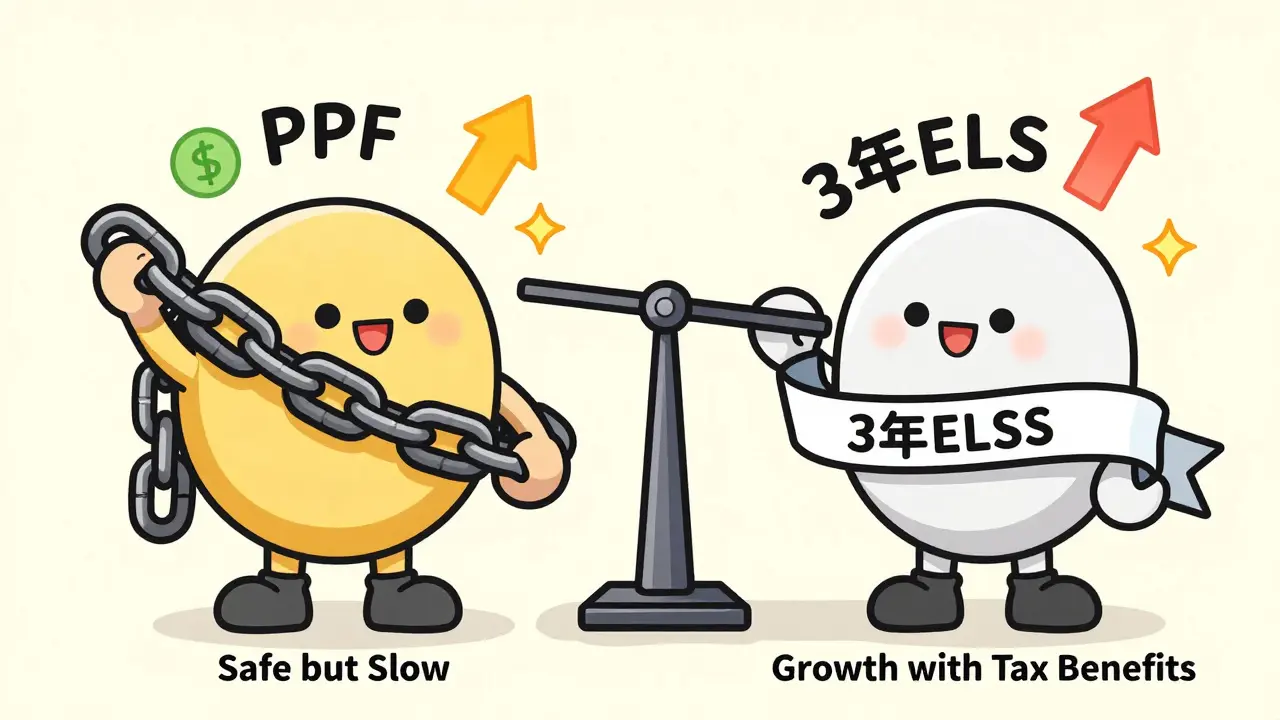
This is different from PPF, where the entire corpus is locked for 15 years. It’s also different from NSC, where you can’t touch the money until maturity. ELSS gives you the shortest lock-in period among all Section 80C instruments. That’s why many investors choose it-they want tax savings without being tied down for decades.
Some platforms let you start SIPs (Systematic Investment Plans) as low as ₹500 a month. Each monthly SIP gets its own three-year clock. So you’re not putting all your money in at once. That reduces risk and helps you average out market highs and lows.
Tax Benefits: How Much Can You Save?
Under Section 80C, you can deduct up to ₹1.5 lakh from your taxable income. That deduction lowers your tax bracket. For someone in the 30% tax slab, that’s a direct tax saving of ₹46,800 per year (including cess). For someone in the 20% slab, it’s ₹31,200. That’s money you keep, not pay to the government.
Here’s the kicker: ELSS funds also offer tax-free growth. Unlike fixed deposits, where interest is taxed every year, ELSS returns are completely tax-free when you redeem after the lock-in. Even dividends are tax-free in your hands. The fund house pays the dividend distribution tax, not you.
Compare that to a fixed deposit. If you earn ₹1.5 lakh in interest from an FD over five years, you’ll pay tax on it every year. With ELSS, you pay zero tax on gains if you hold past three years. That’s compound growth working in your favor.
What Returns Can You Expect?
ELSS funds aren’t guaranteed. They’re equity funds. That means they can go down as well as up. But historically, the best-performing ELSS funds have delivered 12% to 15% annualized returns over 10-year periods. The average across all ELSS funds? Around 11% to 13%.
For example, the Axis Long Term Equity Fund delivered 14.7% CAGR over the last 10 years (as of December 2025). The Parag Parikh Long Term Equity Fund returned 15.2% over the same period. These aren’t outliers-they’re top performers in a category that’s been consistently beating inflation and fixed-income options.
But past performance doesn’t guarantee future results. The market can be volatile. In 2022, many ELSS funds dropped 15-20% due to global rate hikes. But by 2024, most had recovered and gone on to new highs. If you stay invested through cycles, the odds favor you.
Don’t chase the fund with the highest past return. Instead, look at consistency. Check the 5-year and 10-year returns. Look at how the fund handled downturns. A fund that lost less in 2022 and bounced back faster is often better than one that jumped higher in bull markets but crashed harder.
ELSS vs Other Tax-Saving Options
Here’s how ELSS stacks up against other Section 80C tools:
| Option | Lock-in Period | Average Return (10-year) | Tax on Returns | Liquidity |
|---|---|---|---|---|
| ELSS Mutual Fund | 3 years | 11-15% | Tax-free after lock-in | High after lock-in |
| PPF | 15 years | 7-8% | Tax-free | Low |
| FD (Tax-Saving) | 5 years | 6-7% | Taxable annually | Low |
| NSC | 5 years | 7-8% | Taxable annually | Low |
| ULIP | 5 years | 6-9% | Tax-free after lock-in | Very Low |
ELSS wins on returns and lock-in period. PPF and NSC are safer, but you’re earning barely above inflation. FDs are predictable, but you’re paying tax on every rupee of interest. ULIPs combine insurance and investment, but come with high fees that eat into your returns.
If your goal is to grow wealth and reduce taxes, ELSS is the clear winner. If your goal is pure safety with no risk, go with PPF. But if you’re willing to ride out market swings for better long-term gains, ELSS is the smart play.
How to Choose the Right ELSS Fund
There are over 100 ELSS funds in India. You don’t need to pick the best one. You need to pick one that fits your risk profile and investment style.
- Look at the portfolio: Does it hold large-cap stocks (like Reliance, HDFC Bank) or small-caps? Large-cap funds are steadier. Small-cap funds can give higher returns but are more volatile.
- Check the expense ratio: Avoid funds with expense ratios above 2%. Lower fees mean more of your returns stay with you. Most top ELSS funds charge between 1.2% and 1.8%.
- Track record: Look at 5-year and 10-year returns. A fund that consistently beats its benchmark (like Nifty 50 TRI) is a good sign.
- Asset size: Funds with more than ₹5,000 crore in assets tend to be more stable and better managed.
- Dividend vs growth: Always pick the growth option. Dividend payouts are tempting, but they reduce your compounding power.
Don’t try to time the market. Start a SIP. Even ₹2,000 a month adds up to ₹2.4 lakh in five years. With 12% returns, that becomes over ₹3.5 lakh. That’s tax-free wealth.
When Not to Invest in ELSS
ELSS isn’t for everyone. Avoid it if:
- You need access to your money within three years (e.g., planning to buy a car or pay for a wedding).
- You’re risk-averse and can’t handle 15-20% drops in value.
- You’re already maxing out your ₹1.5 lakh Section 80C limit with other instruments like PPF or home loan principal.
- You’re new to investing and don’t understand how mutual funds work.
If you’re unsure, start small. Invest ₹1,000 a month for six months. See how you feel during market dips. If you panic and want to pull out, ELSS might not be right for you yet.
Common Mistakes to Avoid
Many investors make the same errors with ELSS:
- Investing only at year-end: Waiting until March to invest means you miss out on market growth. Spread your investments across the year.
- Chasing performance: A fund that returned 20% last year might be overvalued. Look at consistency, not spikes.
- Ignoring diversification: Don’t put all your ELSS money in one fund. Split between two or three different fund houses to reduce risk.
- Redeeming too early: Selling before three years means you lose the tax benefit. You’ll also pay capital gains tax on any profit.
Keep a calendar reminder for when each SIP installment unlocks. Most fund houses send alerts, but don’t rely on them.
Final Thoughts
ELSS funds are one of the few financial tools in India that let you save tax and build wealth at the same time. They’re not risk-free, but they’re far from reckless. Over the long term, equity markets rise. ELSS funds give you exposure to that growth while giving you a tax break today.
If you’re earning more than ₹7 lakh a year, you’re paying significant taxes. ELSS helps you keep more of it. Start small. Stay consistent. Hold through the ups and downs. In three years, you’ll have more than just a tax deduction-you’ll have real, tax-free wealth.
Is the lock-in period for ELSS funds really three years?
Yes. Every investment in an ELSS fund has a mandatory lock-in period of exactly three years from the date of purchase. This applies to each SIP installment individually. For example, if you invest on January 10, 2026, that amount can only be withdrawn after January 10, 2029. Early withdrawal is not allowed under any circumstances, even in emergencies.
Can I invest more than ₹1.5 lakh in ELSS funds?
Yes, you can invest any amount in ELSS funds. But only the first ₹1.5 lakh per financial year qualifies for tax deduction under Section 80C. Any amount above that doesn’t reduce your taxable income, though it still grows tax-free after the lock-in period. So investing more than ₹1.5 lakh can still make sense if you’re focused on long-term wealth building, not just tax savings.
Are ELSS returns guaranteed?
No, ELSS returns are not guaranteed. Since they invest primarily in equities, their value rises and falls with the stock market. Past performance doesn’t predict future results. While many ELSS funds have delivered 12-15% annual returns over 10 years, there can be years with losses. Investors must be prepared for volatility and hold for the long term to benefit from compounding.
Can I switch from one ELSS fund to another?
You cannot switch or transfer units between ELSS funds during the lock-in period. Once you invest in a fund, you must hold it for three years. After the lock-in ends, you can redeem and reinvest in another fund. But during the lock-in, switching is not allowed-even if you want to move to a better-performing fund.
Do I need to file a separate form to claim ELSS tax benefits?
No, you don’t need a separate form. When you invest in an ELSS fund, the fund house provides a statement showing your investment amount. You just need to include this amount in your tax return under Section 80C, along with other eligible investments like PPF, life insurance premiums, or home loan principal. Your employer may also ask for proof during the year-end tax declaration process.
What happens if I miss my SIP payment in an ELSS fund?
Missing one SIP payment doesn’t affect your existing investments or their lock-in period. Each SIP installment is treated as a separate investment. Only the missed payment won’t be made that month, but your previous installments continue to lock in for three years each. You can restart the SIP anytime without penalty. However, missing payments means you’ll invest less overall, which reduces your long-term returns and tax savings.
Can NRIs invest in ELSS funds?
Yes, Non-Resident Indians (NRIs) can invest in ELSS funds, but only through NRE or NRO bank accounts. The tax benefits under Section 80C are only available to residents of India. NRIs can still invest for growth, but they won’t get the tax deduction. Capital gains are taxed according to NRI tax rules-short-term gains (less than 1 year) are taxed at slab rates, long-term gains (after 1 year) are taxed at 10% above ₹1 lakh.
Next Steps
Start by checking your current tax situation. If you’re not using your full ₹1.5 lakh Section 80C limit, ELSS is the most powerful way to fill the gap. Open a demat or mutual fund account with a platform like Zerodha, Groww, or Paytm Money. Set up a monthly SIP of ₹5,000 to ₹10,000. Pick one or two well-rated funds with a 10-year track record. Then forget about it.
Check your portfolio once a year. Don’t panic during market dips. Don’t chase hot funds. Just keep investing. In three years, you’ll have a tax-free gain. In five, you’ll have more than you started with. In ten, you’ll have real financial freedom.