Trade Settlement in India Explained: How T+1 Settlement Works on NSE and BSE
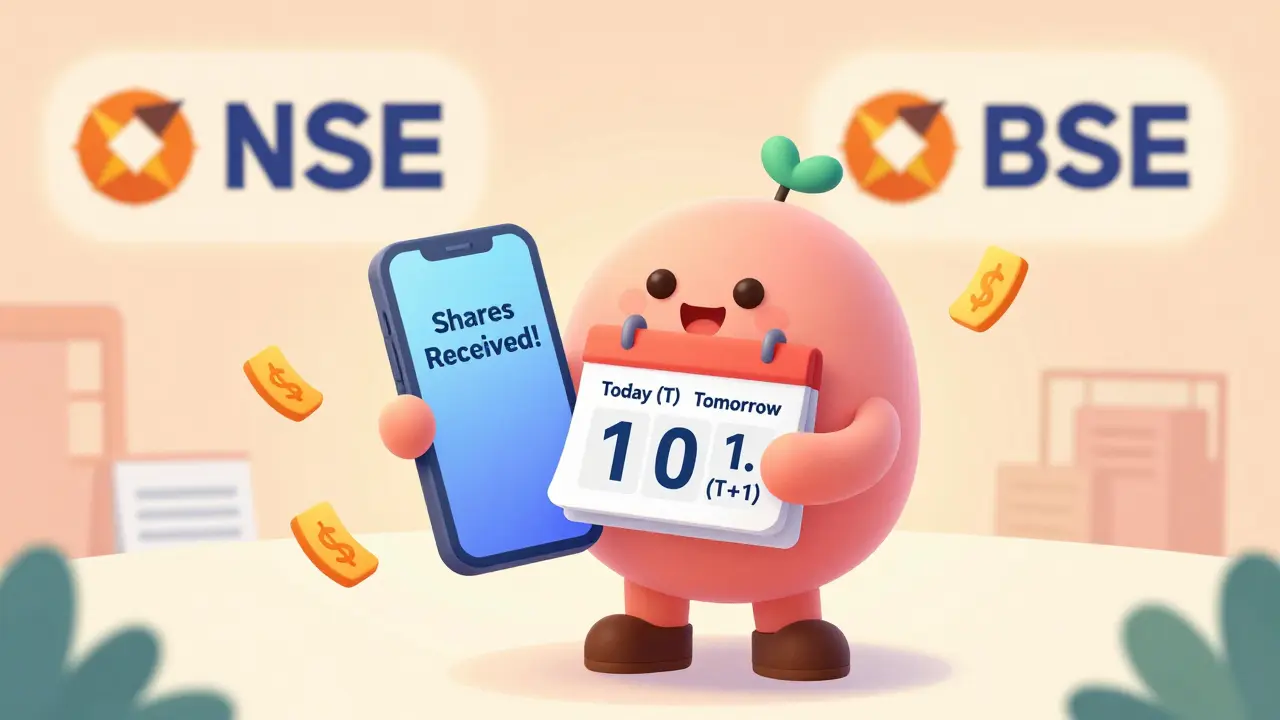
Before 2023, if you bought shares on the National Stock Exchange (NSE) or Bombay Stock Exchange (BSE), you had to wait at least two full business days before those shares showed up in your demat account. That was the T+2 system - trade date plus two days. But today, everything changed. T+1 settlement is now the standard across India’s major stock exchanges. It means if you buy shares today, they’re in your account tomorrow. Sell? The money hits your bank account tomorrow. No more waiting. No more uncertainty. Just faster, cleaner trades.
What Exactly Is T+1 Settlement?
T+1 stands for "trade date plus one day." It’s the time it takes for a stock trade to fully settle - meaning the buyer gets the shares, and the seller gets the cash. Before T+1, India used T+2. That meant trades took two days to clear. The shift to T+1 wasn’t just a technical tweak. It was a major overhaul aimed at reducing risk, increasing efficiency, and making markets more attractive to foreign investors.
Here’s how it works in practice:
- You buy 10 shares of Reliance Industries on Monday at 10:30 AM.
- By Tuesday, those shares appear in your demat account.
- You sell those 10 shares on Tuesday afternoon.
- By Wednesday, the money from that sale lands in your bank account.
That’s it. No delays. No back-and-forth. The entire process - from order to ownership to cash - is compressed into one business day.
Why Did India Switch to T+1?
India didn’t make this change on a whim. The Securities and Exchange Board of India (SEBI) pushed for T+1 after studying global markets and analyzing domestic risks. The biggest reason? Counterparty risk.
Under T+2, if one party - say, a broker or a trader - went bankrupt between trade day and settlement day, the whole chain could collapse. Think of it like a game of dominoes. One fall, and everything behind it tumbles. With T+1, that window shrinks by half. Less time = less chance for something to go wrong.
Another big driver was efficiency. Banks, brokers, and clearinghouses were spending hours each day reconciling trades. With T+1, they process fewer trades per settlement cycle, reducing manual errors and system overload. A 2023 internal report from NSDL (National Securities Depository Limited) showed a 40% drop in settlement fails after the switch.
And then there’s the global angle. Countries like the U.S., Canada, and the U.K. already use T+1. India’s move made its markets more aligned with international standards, encouraging more foreign portfolio investment. In 2024, foreign institutional investors (FIIs) increased their stake in Indian equities by 12% year-over-year - a trend SEBI linked directly to faster settlement cycles.
How T+1 Works on NSE and BSE
Both NSE and BSE follow the exact same T+1 rules. There’s no difference in timing between the two. The process is unified across India’s two largest exchanges.
Here’s the step-by-step breakdown:
- Trade Day (T): You place an order to buy or sell shares. The trade executes during market hours (9:15 AM to 3:30 PM). The system records the trade details - quantity, price, buyer ID, seller ID.
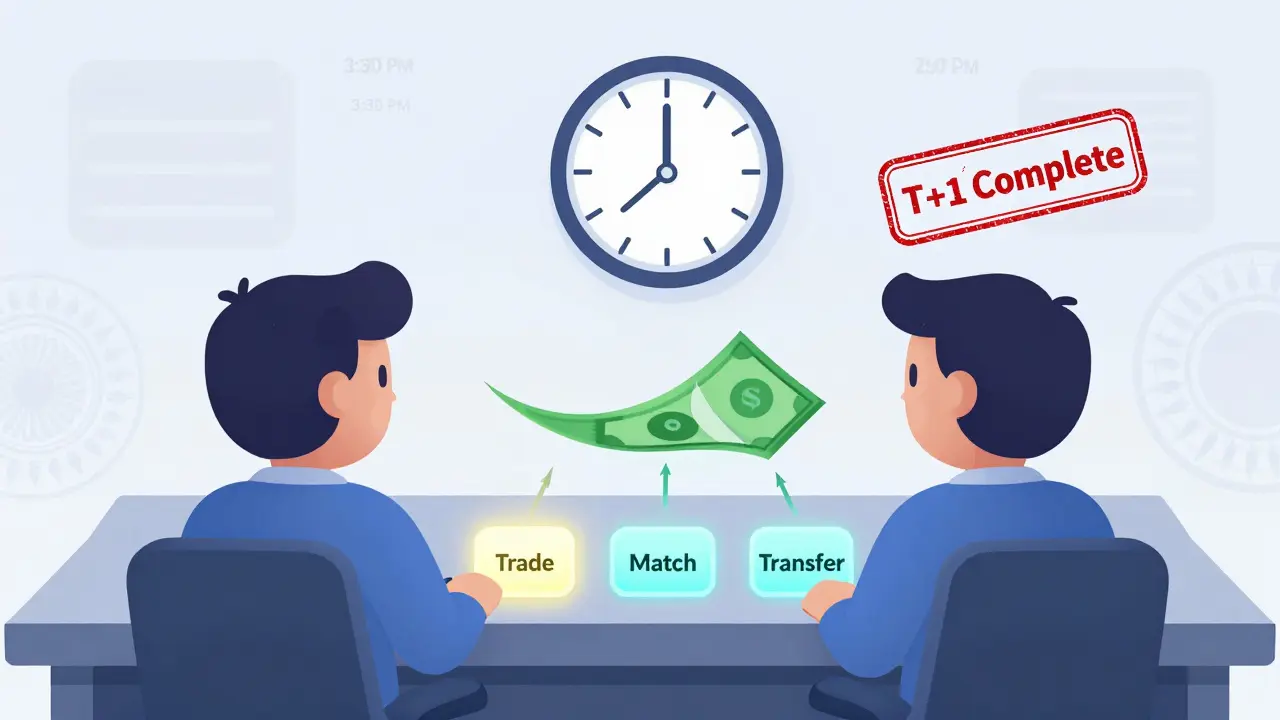
- Next Business Day (T+1): By 2:00 PM, NSCCL (NSE’s clearing corporation) and BSE’s clearinghouse finalize all trades. They match buyers with sellers. Then, they instruct depositories (NSDL and CDSL) to transfer shares from seller to buyer. Simultaneously, banks move money from buyer to seller.
- By End of Day: Shares appear in your demat account. Cash appears in your bank account. Done.
There’s no manual intervention. No paperwork. No waiting for confirmations. The entire system runs on automated algorithms and real-time data feeds between exchanges, depositories, banks, and brokers.
What You Need to Know as a Retail Investor
As a regular investor, you don’t need to do anything differently. But there are a few things you should understand to avoid mistakes.
- You can’t sell shares the same day you buy them. Even though shares appear in your account the next day, the settlement isn’t complete until T+1. If you try to sell before then, your broker will block the trade. This is called "short selling without delivery" - and it’s not allowed under T+1.
- Don’t rely on funds from a sale to make another purchase on the same day. The money from a sale shows up in your bank account on T+1. If you’re trading frequently, you might need to keep extra cash on hand.
- Weekends and holidays matter. If you buy shares on Friday, settlement happens on Monday (assuming Monday isn’t a holiday). If you buy on a holiday, the clock starts the next business day.
Some investors used to try "BTST" - Buy Today, Sell Tomorrow. That’s still possible, but now it’s literally one day. You can’t sell before settlement. That’s a big change from T+2, where some traders exploited the two-day gap.
Who Benefits from T+1?
Everyone wins - but some benefit more than others.
Small investors gain the most. Faster access to cash means you can reinvest quickly. No more waiting two days to buy another stock after selling one. It gives retail traders more control and flexibility.
Brokers save money. Fewer failed settlements mean fewer penalties. Less manual work means lower operational costs. Many brokers have passed these savings on to customers in the form of lower brokerage fees.
Foreign investors now see India as a more predictable market. With T+1, they can move money in and out faster, reducing currency risk and improving cash flow planning.
The system itself is more stable. Fewer settlement failures mean fewer disruptions. In 2024, the overall settlement failure rate dropped from 0.38% under T+2 to just 0.14% under T+1.
What Happens If a Trade Fails?
Even with T+1, things can go wrong. A seller might not have enough shares. A buyer might not have enough cash. When that happens, the exchange steps in.
Here’s how:
- If a seller can’t deliver shares, they’re charged a penalty - usually 0.05% of the trade value per hour until delivery is made.
- If a buyer can’t pay, their broker must cover the shortfall. If they can’t, the exchange auctions off the shares and charges the buyer for any loss.
- Repeated failures lead to restrictions. Brokers who have too many settlement failures get flagged. Some have had their trading privileges suspended.
These penalties aren’t just punishment - they’re incentives. They push brokers and investors to ensure they have the right shares and cash ready before trading.

How T+1 Compares to Other Settlement Cycles
Let’s put T+1 in context.
| Market | Settlement Cycle | Adopted Since | Key Advantage |
|---|---|---|---|
| India (NSE, BSE) | T+1 | 2023 | Reduced counterparty risk, aligned with global standards |
| United States | T+1 | 2024 | Lower systemic risk, faster liquidity |
| United Kingdom | T+1 | 2022 | Improved investor confidence |
| China | T+1 (equities) | 1990s | High turnover, retail-driven market |
| Japan | T+2 | 2017 | Still transitioning |
| Germany | T+2 | 2014 | Banking system inertia |
India is now among the most advanced markets in the world. Only a handful of countries - the U.S., Canada, the U.K., and Singapore - have moved to T+1. India did it faster than most, and without major disruptions.
What’s Next for India’s Markets?
T+1 is just the beginning. SEBI is already testing T+0 for certain categories - like exchange-traded funds (ETFs) and derivatives. In pilot programs, some ETF trades now settle on the same day. This could expand to more products in 2026.
Also, the integration of blockchain for trade settlement is being explored. A 2025 pilot by NSDL and RBI tested a blockchain-based settlement system for government bonds. If it scales, it could make T+1 look slow.
For now, T+1 is the gold standard. It’s simple. It’s fast. It’s secure. And for millions of Indian investors, it’s made stock trading feel less like a waiting game - and more like a real-time opportunity.
Can I sell shares the same day I buy them under T+1?
No. Even though shares appear in your demat account the next day, the settlement isn’t complete until T+1. Selling before settlement is considered a violation and will be blocked by your broker. You must wait until the trade settles before selling.
Does T+1 apply to all types of trades in India?
Yes, T+1 applies to all equity trades on NSE and BSE - including delivery trades, intraday trades (though intraday doesn’t settle), and F&O contracts. However, derivative trades (futures and options) still settle on T+1 for cash, but the underlying equity position follows its own cycle. Mutual fund purchases also follow T+1 for equity funds.
What happens if I don’t have enough cash to buy shares on T+1?
Your broker will not allow the trade to execute unless funds are available. If you try to buy on margin without sufficient collateral, the trade gets rejected. If a trade goes through and you later fail to pay, your broker will cover the amount and charge you penalties, interest, and possibly restrict your trading privileges.
Does T+1 affect IPO applications or IPO allotments?
No. IPO allotments and payments follow a separate timeline. The T+1 rule applies only to secondary market trades - meaning trades that happen after a company is already listed. IPO applications, bidding, and allotment still take 5-7 business days.
How does T+1 impact taxation on stock sales?
Tax rules haven’t changed. Capital gains are still calculated based on the actual trade date, not the settlement date. If you bought on Monday and sold on Tuesday, it’s still considered a short-term gain (held for less than a year). T+1 doesn’t alter tax treatment - only the timing of when shares and cash move.
Final Thoughts
T+1 settlement isn’t just a technical upgrade. It’s a cultural shift in how India thinks about investing. It’s faster, safer, and more transparent. It’s not perfect - there are still glitches, especially around holidays and bank holidays - but the system is working better than ever. For anyone buying or selling stocks in India today, this change means one thing: your money and your shares move when they should. No more waiting. No more guessing. Just trade, settle, and move on.