
Real Estate vs Equity in India: How to Allocate Your Portfolio for Long-Term Wealth
When you’re building wealth in India over decades, two assets keep coming up: real estate and equities. One feels solid-bricks, mortar, a house you can show your kids. The other feels volatile-stock charts, market crashes, headlines about IPOs and crashes. But which one actually builds more wealth over 20 or 30 years? And how much of your money should go into each? This isn’t about gut feeling. It’s about numbers, trends, and what actually works for ordinary people in India today.
Real Estate in India: The Classic Choice
For generations, buying property has been the default move. A flat in Bangalore, a plot in Pune, a house in Lucknow-it’s seen as safe, tangible, and something you can pass down. In 2024, the median price of a 2BHK apartment in Tier-1 cities like Mumbai and Delhi hovered around ₹85 lakh. In Tier-2 cities like Indore or Jaipur, it was closer to ₹45 lakh. That’s a lot of money, but people still pay it. Why? Because they believe land never loses value.
But here’s what most people don’t talk about: rental yields in India are low. In Mumbai, you’re lucky to get 2.5% annual return from rent. In Hyderabad, it’s 3.2%. Compare that to the average dividend yield of Nifty 50 stocks, which has been around 1.4% to 1.8% over the last five years. At first glance, real estate looks better. But you’re forgetting costs.
Property taxes, maintenance, repairs, stamp duty, registration fees, legal checks-these eat into your returns. A ₹50 lakh property might cost you ₹3 lakh in upfront fees alone. Then there’s the time. Finding tenants, dealing with repairs, handling legal disputes-it’s not passive income. It’s a part-time job. And liquidity? If you need cash in a hurry, selling a property can take 6 to 12 months. In a market downturn, you might have to slash your price by 15% just to get a buyer.
Equity in India: The Silent Wealth Builder
Equities don’t come with a key. You can’t touch them. But over the long term, they’ve outperformed almost everything else in India. The Nifty 50 returned an average of 14.3% annually between 2000 and 2025. That’s not a guess-it’s the actual compounded return. Even after the 2008 crash, the 2020 pandemic dip, and the 2022 global slowdown, the index kept climbing.
Here’s what that means in real terms. If you invested ₹10 lakh in a Nifty 50 index fund in 2005, by 2025 you’d have roughly ₹2.9 crore. Same amount in a property bought in 2005 in Bangalore? You’d have maybe ₹1.8 crore, assuming 10% annual appreciation (which is optimistic). And that’s before you factor in inflation, maintenance, and opportunity cost.
Equity investing in India is easier than ever. You don’t need to pick stocks anymore. Index funds like UTI Nifty 50 Index Fund or ICICI Prudential Nifty 50 Index Fund let you own all 50 top companies with one click. SIPs (Systematic Investment Plans) let you invest ₹5,000 a month without thinking about timing the market. You buy more when prices drop, less when they rise. Over time, that smooths out volatility.
And liquidity? You can sell your mutual fund units in under 48 hours. No buyers needed. No paperwork. No negotiation. Just a few taps on your phone.
Why People Still Prefer Real Estate
It’s not irrational. Real estate feels safer because you can see it. You can walk into your apartment. You can show your child where you live. Equities? They’re numbers on a screen. That makes them feel abstract. Plus, there’s cultural pressure. In many families, owning property is a sign of success. Not owning one? That’s a red flag.
There’s also the tax angle. In India, long-term capital gains on property (after 2 years) are taxed at 20% with indexation. On equity mutual funds, long-term gains (after 1 year) are taxed at 10% above ₹1 lakh. So equity wins on tax efficiency too.
But the biggest reason people stick with real estate is fear. They’ve seen friends lose money in stocks. They remember 2008. They heard about someone who bought a flat in 2017 and sold it in 2022 for less. But those stories are outliers. The real story? The average investor who stayed in equities through ups and downs ended up richer than the one who tied up cash in property.

How to Allocate: The Realistic 60-40 Rule
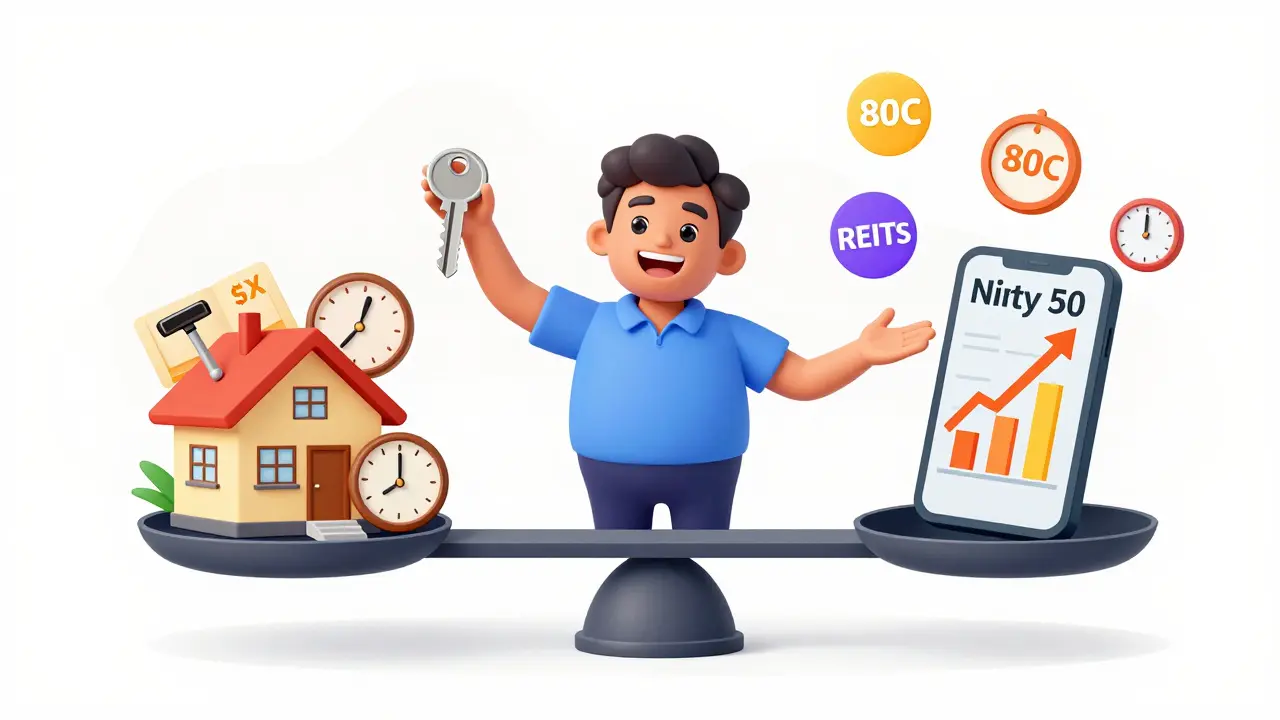
There’s no one-size-fits-all answer. But based on historical data, risk profiles, and liquidity needs, a 60-40 split works for most Indian investors:
- 60% in equities-through index funds via SIPs. Start with ₹5,000 a month. Increase by 10% every year as your income grows.
- 40% in real estate-but only if you’re buying for personal use or to rent long-term. Don’t buy property just to “invest.” If you’re not going to live in it or manage it, skip it.
This mix gives you growth from equities and stability from real estate. It also keeps you from going all-in on either. If the stock market crashes, your property still holds value. If property prices stagnate, your SIPs keep compounding.
Let’s say you’re 30, earning ₹15 lakh a year. You save ₹6 lakh a year. Put ₹3.6 lakh into SIPs. Put ₹2.4 lakh into a down payment for a house you’ll live in. That’s it. No extra plots. No speculative flips. No chasing “hot” localities.
What to Avoid
Don’t buy land in remote areas just because someone told you it’ll “double in 5 years.” That’s gambling, not investing. In 2023, over 68% of land deals in Tier-3 towns failed to appreciate even 3% annually after inflation.
Don’t use your emergency fund to buy a flat. That’s a recipe for disaster. If you lose your job, you can’t sell your house fast enough to cover bills.
Don’t think you need to own a home by 30. The average Indian homeowner is now 38. Delaying ownership to invest more in equities early can make you wealthier in the long run.
Don’t ignore taxes. Use Section 80C to invest in ELSS funds. Use Section 24 for home loan interest deductions. Every rupee saved in tax is a rupee earned.
The Real Winner: Discipline Over Asset Class
It’s not whether you pick real estate or equity. It’s whether you stick with your plan. People who invest ₹10,000 a month in SIPs for 25 years end up with ₹1.5 crore, even if the market drops 30% twice. People who buy one property and sit on it for 25 years? They might have ₹2 crore-but only if they didn’t take a loan, didn’t pay maintenance, and didn’t need to sell during a downturn.
Equities give you growth. Real estate gives you shelter. Together, they give you balance. But only if you treat them like tools-not status symbols.
The future belongs to those who invest early, consistently, and without emotion. Not to those who wait for the perfect time to buy a flat.
Is real estate still a good investment in India in 2026?
Yes, but only if you’re buying to live in or rent out long-term. For pure investment, equities offer better returns with less hassle. Real estate works best as part of a diversified portfolio, not as the main one.
Should I sell my property to invest in stocks?
Only if you don’t need the property for personal use and can reinvest the full proceeds into low-cost index funds. Selling property to chase short-term stock gains is risky. But if you’re moving to a city with no housing needs, and you’ve held the property for over 2 years, selling and investing in equities could boost your long-term wealth.
Can I rely only on equities for long-term wealth?
Yes, many investors in India have built crorepati status using only SIPs in index funds. You don’t need property to be wealthy. But if you want a home, buying one with cash or a small loan is still a smart move-it’s not just an investment, it’s a basic need.
How much should I invest monthly in equities?
Start with 20-30% of your monthly income. If you earn ₹50,000, aim for ₹10,000-₹15,000 in SIPs. Increase this by 10% every year. Over 20 years, even ₹10,000/month can grow to over ₹1.2 crore at 12% annual returns.
Are REITs a good alternative to physical real estate?
Yes. Real Estate Investment Trusts (REITs) like Embassy REIT or Mindspace REIT let you invest in commercial properties without owning them. They pay 6-8% dividends annually and trade like stocks. They’re liquid, regulated, and tax-efficient. For pure real estate exposure without the headaches, REITs are a better choice than buying a flat in a Tier-3 city.
Next Steps
If you’re just starting: Open a demat account. Set up a ₹5,000/month SIP in a Nifty 50 index fund. Don’t wait for the “right time.” Start now.
If you own property: Calculate your net rental yield after all costs. If it’s below 2.5%, consider renting it out longer or selling and reinvesting in equities.
If you’re unsure: Talk to a fee-only financial planner-not a broker selling mutual funds or property deals. Get a one-time review of your portfolio. Then stick to your plan.
Wealth isn’t built by picking the best asset. It’s built by staying in the game, consistently, for decades.